Art! Art! Art! › Works
Pont de Maincy
 Paul Cézanne, 1879
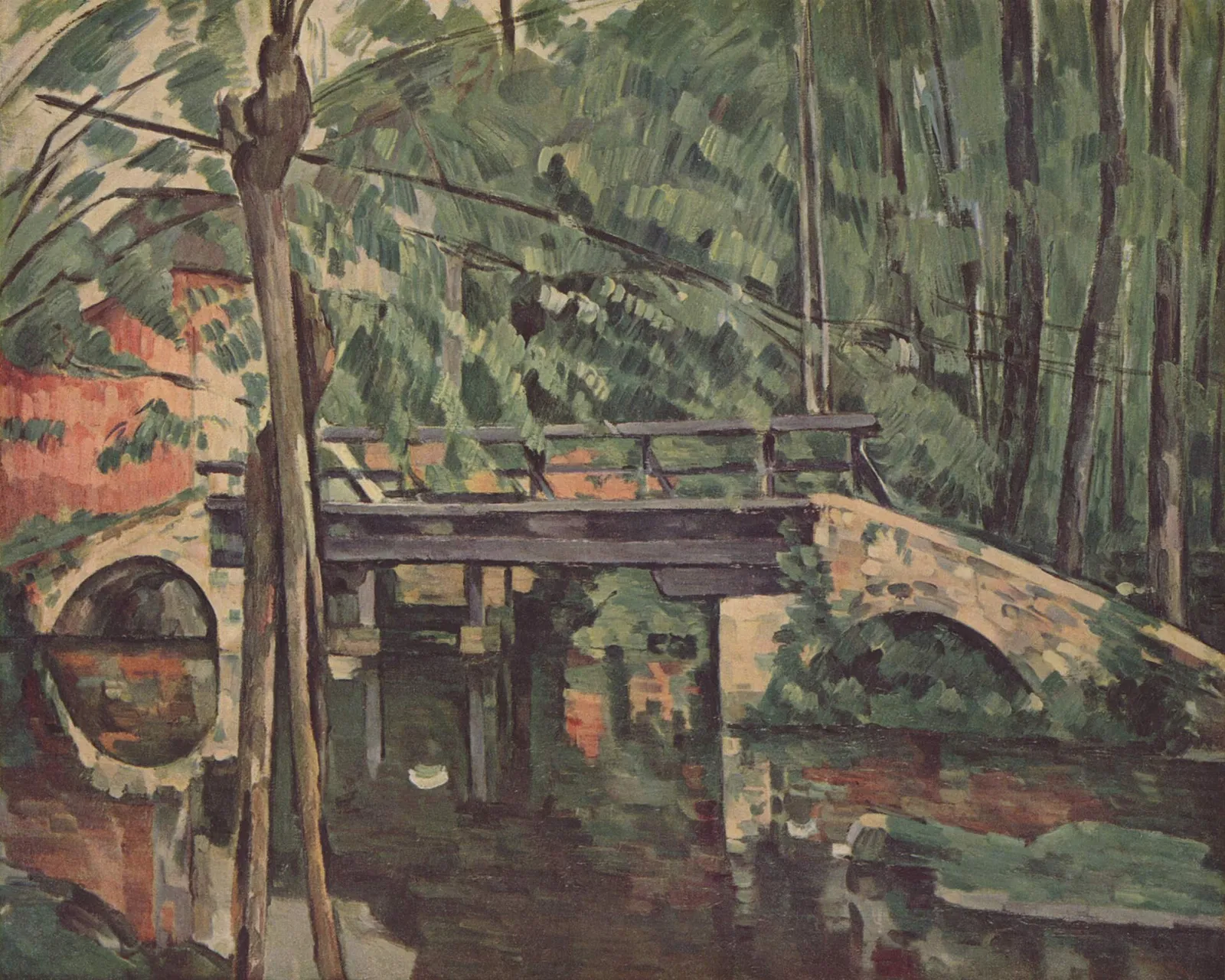
Paul Cézanne's Pont de Maincy, dated 1879, is a quiet landscape of a small bridge crossing still water, framed by dense trees. It belongs to the collection of the Musée d'Orsay, where visitors can study up close how Cézanne built a scene out of deliberate, patterned brushstrokes.
Where to see it
Pont de Maincy is held by the Musée d'Orsay, which is listed as both its collection and its location. Display arrangements can change because of rehangs, conservation work or loans, so check the Musée d'Orsay's official website for current display status, opening hours and ticketing before you visit. The canvas measures 59 x 72 cm, a modest size that rewards standing close enough to see individual strokes, then stepping back to see how they come together.
What to look for in person
Brushstrokes laid like tiles
Look first at the foliage in the upper part of the canvas. Instead of blending colours smoothly, Cézanne applied short, roughly parallel strokes, often slanting in the same direction and grouped into small patches. Up close, these read almost like woven or tiled surfaces. From a few steps back, they turn into the mass of leaves and branches. This method of building form through ordered strokes is closely associated with Cézanne's work around this period, and this painting is a clear place to watch it operate across a whole landscape.
The bridge as a structural anchor
The bridge runs across the composition as a firm horizontal, set against the verticals of tree trunks and the diagonals of branches. Notice how these lines lock the picture together, giving a sense of stability rather than a passing glimpse. Below, the water repeats the shapes of the bridge and trees in reflection, so the upper and lower halves of the painting echo each other. Follow the line of the bridge from one bank to the other, and see how your eye is held inside the frame.
A restrained palette of greens and blues
The painting is dominated by greens and blue-greens, with warmer earthy tones in the bridge and banks. Pay attention to how many different greens Cézanne uses and how he places cooler and warmer patches side by side to suggest depth instead of relying on strong shadows. The light feels even and steady rather than flickering. Compare the colour of the water with that of the trees: the reflections are not simple copies, but reworked in their own strokes and tones.
About the painting
Pont de Maincy dates from 1879, a period when Paul Cézanne was moving away from the looser handling of his Impressionist years toward a more ordered, constructed way of painting. During the 1870s he had worked alongside the Impressionists and painted outdoors, directly in front of his motifs. By the end of the decade, while still painting from nature, he was increasingly concerned with the underlying structure of what he saw: how forms sit in space, and how a picture can hold together as a stable arrangement of shapes and colours.
This landscape shows that shift clearly. The subject is simple, a bridge, water and trees, with no figures or narrative. What gives the painting its character is the way it is made. Cézanne organises the scene through repeated, directional brushstrokes and a careful balance of horizontals and verticals, so that the natural setting takes on a measured, almost architectural order.
At 59 x 72 cm, the canvas is of a moderate size typical for an easel landscape. That scale makes it easy to move between two ways of looking: close up, where the surface becomes a field of distinct strokes, and at a distance, where those strokes resolve into foliage, stone and reflection.
Cézanne's approach to structure and colour is widely seen as an important influence on later painters in the early twentieth century. Seeing Pont de Maincy in the Musée d'Orsay gives visitors a chance to observe, within a single landscape, the methods that made his work so significant for those who followed.
Key facts
| Artist | Paul Cézanne |
|---|---|
| Date | 1879 |
| Size | 59 × 72 cm |
| Medium | oil paint, canvas |
| Collection | Musée d'Orsay |
How to visit: Musée d'Orsay
Paris, France · Museum guide
| Opening hours | Tue–Wed, Fri–Sun 09:30–18:00 (galleries close at 17:30) Thu 09:30–21:45 (late opening; galleries close at 21:15) |
|---|---|
| Closed | Every Monday, 1 May and 25 December. |
| Last entry | 17:00 (exhibitions 17:15); Thursdays 21:00 |
| Admission | Full rate, online EUR 16 Full rate, at the museum EUR 14 Reduced rate (on site only) EUR 11 Enfant & Cie, online EUR 13 Enfant & Cie, at the museum EUR 11 Night rate (Thursday), online EUR 12 Night rate (Thursday), at the museum EUR 10 Under 18s; EEA residents under 26 free |
| Free entry | Free for under 18s and residents of the European Economic Area under 26. Free on the first Sunday of the month, with booking required. |
| Booking | Booking is strongly recommended. Entry is by timed slot. |
The museum stays open and all collections and exhibitions remain accessible, but entrances have changed: timed-ticket holders use Entrance 1 (Quay); priority visitors, reseller voucher holders, visitors without tickets and groups use Entrance 2 (Forecourt). Arrive at least 15 minutes before your time slot.
Official ticket page
Official website
View on map
Hours and prices can change. Please check the official website before you go. (Checked on: 2026-11-11)

