Art! Art! Art! › Works
Saint Matthew and the Angel
 Guido Reni, 1620s
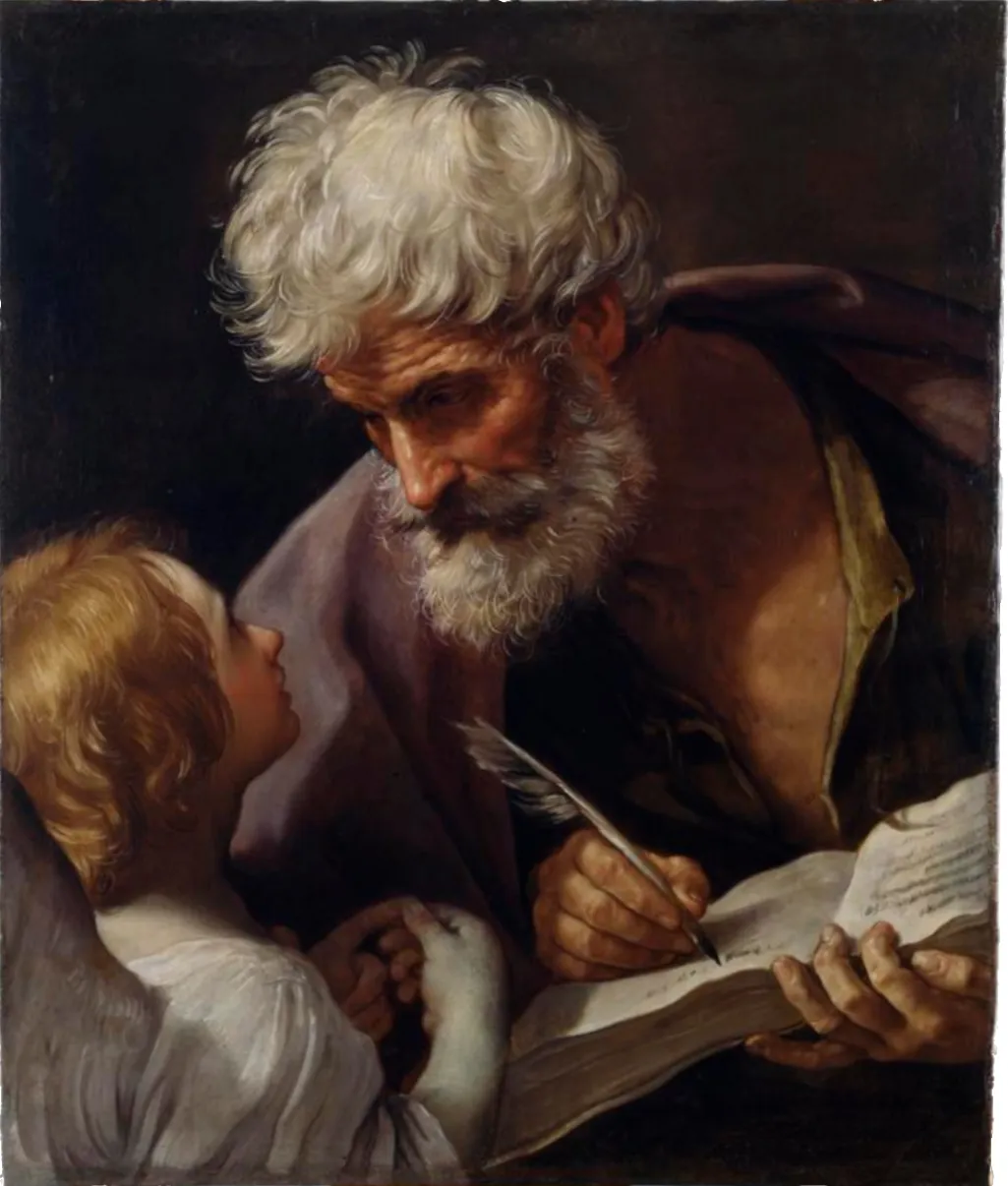
Guido Reni's Saint Matthew and the Angel is in the Pinacoteca Vaticana, the picture gallery of the Vatican Museums. Dated to the 1620s and measuring 79 x 66 cm, it is a compact devotional painting that pairs the evangelist with the angel traditionally linked to him.
Where to see it
The painting belongs to the Pinacoteca Vaticana, the picture gallery within the Vatican Museums in Vatican City. The collection is part of the general Vatican Museums visit, so a standard museum ticket is normally the way in. Displays in large museums change because of conservation, rehanging and loans, so check the Vatican Museums' official website for the painting's current display status, opening hours and ticketing before you plan your trip.
What to look for in person
A painting meant for close viewing
At 79 x 66 cm, this is not a vast altarpiece but a canvas you can take in from a few steps away. Its moderate size suits private devotion and invites you to stand close. Rather than scanning a crowded scene, let your eye settle on the two figures and the space between them. Notice how little is needed to tell the story: the subject depends on the relationship between the saint and the angel, and the size of the picture keeps that encounter direct and personal.
The evangelist and his symbol
In Christian art, each of the four evangelists has a symbol, and Matthew's is a winged man or angel. Painters often turned that symbol into an active presence, showing the angel guiding or inspiring the saint as he writes his Gospel. In front of the painting, look for how Reni handles this exchange: the contrast between the aged, bearded evangelist and the youthful angel, and the way gestures and glances connect them. That contact is the heart of the image's meaning: divine inspiration passing into human work.
Reni's refined manner
Guido Reni is admired for graceful, idealized figures, controlled drawing and carefully balanced color, an approach rooted in the Bolognese tradition of the Carracci and in the example of Raphael. Look at the surfaces: the treatment of skin, the contrast between weathered age and smooth youth, and the way light models faces and hands. Reni tends to favor calm and harmony over dramatic violence, so pay attention to how the mood stays measured while still conveying a moment of spiritual intensity.
About the painting
Guido Reni (1575–1642) was one of the leading painters of seventeenth-century Italy. Trained in Bologna and active for important periods in Rome, he became known for a classical style that balanced naturalism with idealized beauty. His religious works were widely admired and copied, and his treatment of saints, with upturned or intent expressions and clear, graceful forms, shaped how many later viewers pictured sacred figures. Saint Matthew and the Angel, dated to the 1620s, belongs to his mature career. The subject draws on a long tradition: Matthew, a tax collector called by Christ to become an apostle, is credited by Christian tradition with writing the first Gospel. The angel beside him is both his evangelist symbol and a sign that his writing was divinely inspired. Artists across Europe painted this pairing, and it offered a chance to contrast age with youth, earthly labor with heavenly guidance, and weight with lightness. For visitors, the work is a useful entry point into Reni's art. It is modest in size, 79 by 66 centimeters, so it rewards slow looking rather than a quick glance in passing. Consider how the composition directs your attention from one figure to the other, and how Reni uses light and color to set the figures apart from their surroundings. Seeing it in the Pinacoteca Vaticana also places it within a gallery that traces the development of painting from the medieval period onward, so it can be helpful to compare Reni's calm classicism with the more dramatic approaches of other Baroque painters in the collection. Before you go, confirm on the official Vatican Museums website whether the painting is currently on view.
Key facts
| Artist | Guido Reni |
|---|---|
| Date | 1620s |
| Size | 79 × 66 cm |
| Medium | oil paint, canvas |
| Collection | Pinacoteca Vaticana |
How to visit: Vatican Museums
Vatican City, Vatican City · Museum guide
| Opening hours | Mon–Sat 08:00–20:00 (exit from the galleries starts 30 minutes before closing) Last Sunday of the month (free entry) 09:00–14:00 (not when it falls on Easter Sunday, 29 June, 25, 26 or 31 December) 24 and 31 December 08:00–15:00 |
|---|---|
| Closed | Sundays (except the last Sunday of the month). Fixed closures: 1 and 6 January, 11 February, 19 March, Easter Monday, 1 May, 29 June, 14 and 15 August, 1 November, 8, 25 and 26 December. Official calendar: remaining 2026 closures 8, 25 and 26 December; 2027 closures 1 and 6 January, 11 February, 19 March, 29 March (Easter Monday), 1 May, 29 June, 14 and 16 August, 1 November, 8 and 25 December (plus Sundays). |
| Last entry | 18:00 Mon–Sat; 12:30 on free last Sundays; 13:00 on 24 and 31 December. |
| Admission | Adult EUR 20 (ticket office) Adult, booked online (Skip the Line) EUR 25 (EUR 20 + EUR 5 booking fee) Reduced (students, pilgrimages, university institutes, etc.) EUR 10 (EUR 10 + EUR 5 online) Reduced, schools, seminaries and religious colleges EUR 5 (EUR 5 + EUR 2 online) Children under 7 free Audio guide (rental) EUR 8 (on site at the Courtyard of the Cuirasses or with online booking) |
| Free entry | Free on the last Sunday of the month 09:00–14:00 (last entry 12:30), subject to the museum calendar; also for children under 7, disabled visitors (invalidity of 67% or more) plus a companion if not self-sufficient (issued on site, not bookable online), ICOM/ICOMOS card holders, directors of museum or heritage institutions, and certain university teachers with Directorate permission. |
| Booking | Booking is not required. Online Skip the Line tickets are available on the official site for a booking fee. |
Partial temporary closures: 17 Nov, Chiaramonti Museum 16:30–20:00 (last entrance 16:00); 4 and 18 Dec, Sistine Chapel 18:00–20:00 (last entrance 17:30); 7 Dec, Castel Gandolfo complex 14:30–17:30 (last entrance 13:00). Dress code: no sleeveless or low-cut garments, shorts above the knee, miniskirts or hats.
Official ticket page
Official website
View on map
Hours and prices can change. Please check the official website before you go. (Checked on: 2026-11-11)