Art! Art! Art! › Works
Rokeby Venus
 Diego Velazquez, 1644
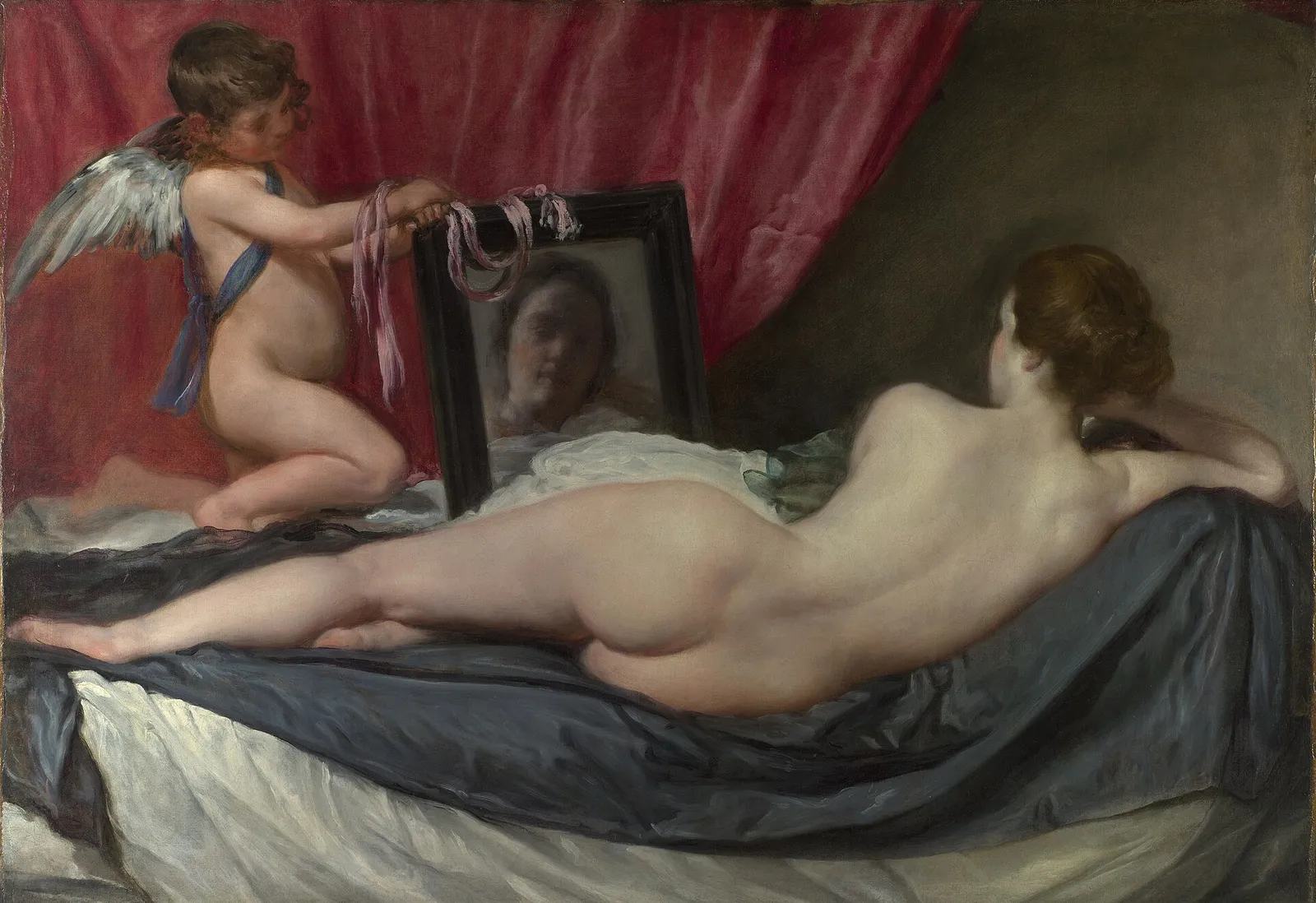
Diego Velazquez's Rokeby Venus shows the goddess of love reclining with her back to us while Cupid holds up a mirror to her face. The painting belongs to the National Gallery, where it can be seen in person. It is dated to 1644 in our records and measures 122.5 by 175 cm.
Where to see it
The Rokeby Venus is in the collection of the National Gallery. Displays change, and works are sometimes moved, rehung, or taken off view for conservation, so check the National Gallery's official website for the painting's current display status before you visit. At 122.5 cm high and 175 cm wide, it is a large canvas; give yourself time to view it both from across the room and from a closer distance.
What to look for in person
The mirror and the blurred face
Start with the mirror held by the kneeling Cupid. Venus's face appears in it, but only softly and indistinctly, so her features are never fully shown. Notice the angle too: viewers have long remarked that the reflection does not follow strict optics, since we see her face in the glass from our position rather than what she herself would see. Velazquez seems more interested in the idea of looking, and being looked at, than in a precise reflection. Spend a moment moving between the clear body and the hazy face.
A nude seen from behind
Velazquez turns the usual reclining nude around, showing Venus from the back. Follow the long, unbroken line from her shoulder down through the waist and up over the hip; it is the main structure of the whole composition. Her pale skin sits against a dark, cool-toned sheet, which makes the flesh tones glow without any strong colour contrast. Above, a heavy red curtain closes off the scene. The palette is restrained, so small shifts of tone across her back carry much of the painting's effect.
Brushwork, near and far
Step closer and look at how the details are made. The pink ribbon draped over the mirror frame, Cupid's wings and the folds of the drapery are painted with loose, rapid strokes that only resolve into form when you step back again. This contrast between close-up freedom and distant clarity is typical of Velazquez's mature manner. The canvas was slashed in 1914 and later repaired; the restoration is careful, and most visitors will not notice it unless they look specifically for the old damage across her back.
About the painting
The Rokeby Venus is one of very few female nudes in seventeenth-century Spanish painting, and it is Velazquez's only surviving painting of the subject. Nudes were rare in Spain at the time, where religious and social conventions discouraged them, so the work stands out within both the artist's output and Spanish art more broadly. The subject is mythological: Venus, goddess of love, lies on a draped couch while her son Cupid, identified by his wings, steadies a mirror for her. Unlike many earlier Venuses, she is not shown frontally. The painting relies on the elegance of her pose and the indirect glimpse of her face to hold the viewer's attention, and it invites reflection on vanity, beauty and the act of looking itself. The painting takes its popular name from Rokeby Park in Yorkshire, England, where it hung in a private collection during the nineteenth century. It later entered the National Gallery's collection, where it has become one of the best-known works by Velazquez outside Spain. In 1914 the canvas was attacked with a blade by the suffragette Mary Richardson as a political protest; the damage was subsequently repaired. For visitors, the work rewards slow viewing. Look first at the overall shape of the figure against the dark sheet, then at the mirror, then at the loose handling of ribbon, curtain and wings. The scale, 122.5 by 175 cm, means the figure is close to life-size, which adds to the sense of quiet intimacy the painting creates.
Key facts
| Artist | Diego Velazquez |
|---|---|
| Date | 1644 |
| Size | 122.5 × 175 cm |
| Medium | oil paint, canvas |
| Collection | National Gallery |
How to visit: National Gallery
London, United Kingdom · Museum guide
| Opening hours | Mon–Thu, Sat, Sun 10:00–18:00 Fri 10:00–21:00 (Friday late) |
|---|---|
| Closed | 24–26 December and 1 January. |
| Admission | General admission (collection) free; donations invited Some exhibitions are charged (e.g. Renoir and Love, until 31 Jan 2027) |
| Free entry | General admission is always free. |
| Booking | No reservation or timed entry is required. Free timed booking gives fast-track entry. |
Building work and improvements are under way: some rooms are closed and some paintings have moved, so check the floorplans or collection search before visiting. A new Research Centre is due to open in 2028. On 17 November only, some east wing rooms and the Espresso Bar close from 16:00.
Official ticket page
Official website
View on map
Hours and prices can change. Please check the official website before you go. (Checked on: 2026-11-11)
