Art! Art! Art! › Works
Portrait of Innocent X
 Diego Velazquez, 17th century
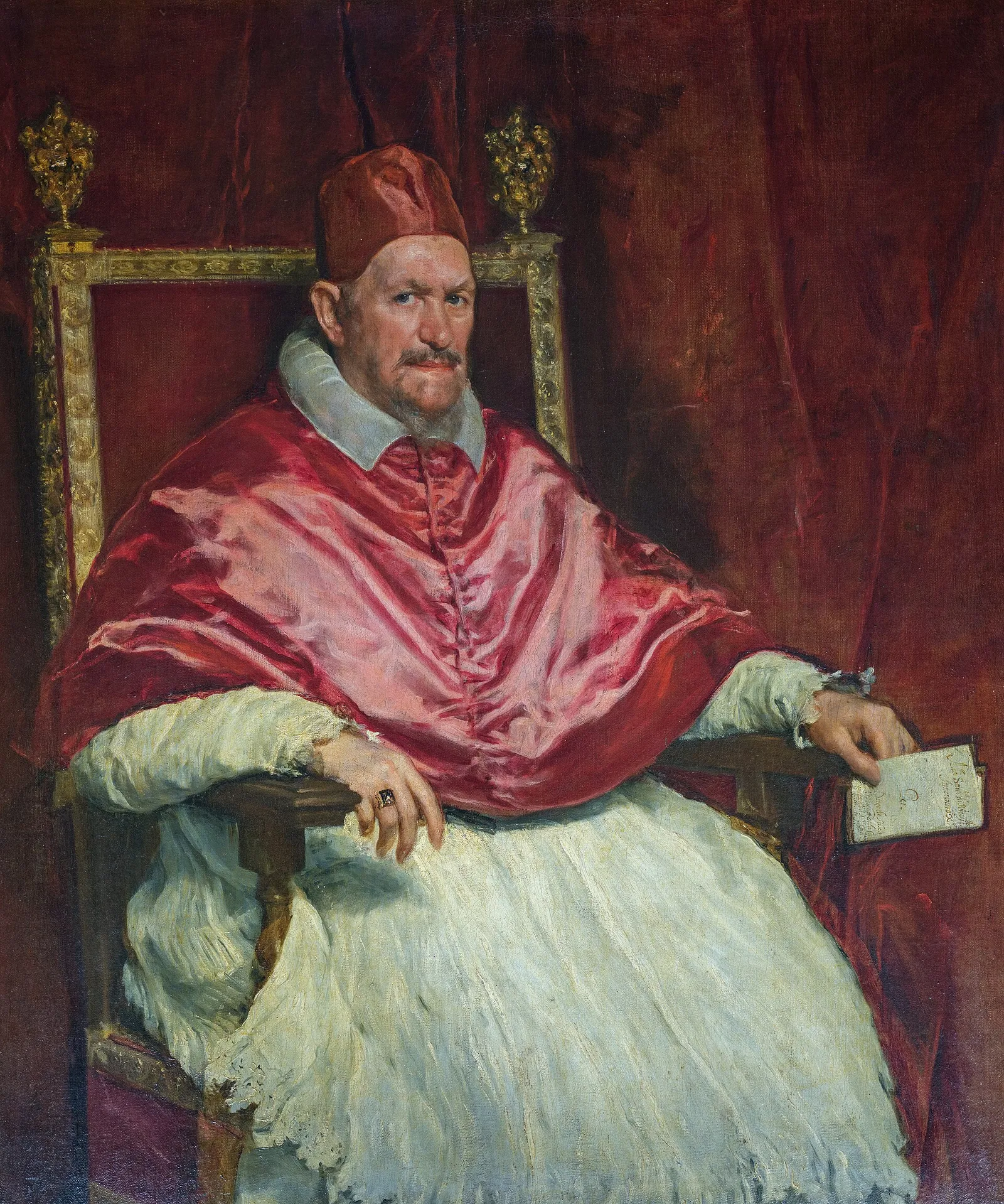
Diego Velázquez's Portrait of Innocent X belongs to the Galleria Doria Pamphilj in Rome, the gallery of the Pope's own family. Painted in the 17th century, around 1650, during the artist's second stay in Italy, it shows the seated pontiff in a dense range of reds that rewards close, unhurried looking.
Where to see it
The painting is in the collection of the Galleria Doria Pamphilj in Rome, where the Doria-Pamphilj family has long displayed it in their gallery. Display arrangements can change, so check the Galleria Doria Pamphilj's official website for current display status, opening hours and ticket information before you visit. The canvas measures 141 x 119 cm, a substantial size that lets you study the brushwork at close range.
What to look for in person
Meet the Pope's gaze
Start with the face. Innocent X is turned slightly to one side, but his eyes come round to meet yours, and the effect is direct rather than ceremonial. Notice how Velázquez does not soften the features: the flushed skin, the set mouth and the alert, watchful expression are recorded plainly. Stand back a few steps, then move closer, and see how the head holds together from a distance while the paint surface up close is built from quick, economical touches.
A study in reds and whites
The Pope wears a scarlet satin mozzetta (a short shoulder cape) over a white rochet, with a red silk camauro on his head. Behind him hangs red drapery, and he sits in a gilded papal chair. Look at how many different reds the painter separates: the shine of satin, the softer silk of the cap, the deeper cloth behind. The white rochet below, painted with loose, broken strokes, gives the eye relief and sharpens the colour above it.
The paper in his hand
Find the folded sheet of paper the Pope holds. Velázquez used it to place his own name on the picture, in the form of an inscription addressed to the Pope. It is a small, easily missed detail, but it quietly connects painter and sitter within the image itself. Compare its flat, pale surface with the textured fabrics around it, and notice how the hand holding it, with its ring, is painted with the same frankness as the face.
About the painting
Velázquez, court painter to Philip IV of Spain, made his second journey to Italy between 1649 and 1651, and it was during this stay that he painted Pope Innocent X, around 1650. The work is in oil on canvas. According to accounts of the commission, the Pope rewarded the painter with money, a gold medal and a gold chain, and Velázquez kept the chain until he died.
The portrait stayed with the sitter's family, the Pamphilj, later the Doria-Pamphilj, who displayed it in their gallery in Rome. Seeing it there means seeing it in the setting of the family that commissioned it. For much of the 17th and 18th centuries it was known mainly to a limited circle of connoisseurs, rather than to a wide public.
The image travelled through other versions. A smaller bust-length replica at Apsley House (the Wellington Museum) in London is regarded by many specialists as the version Velázquez took back to Madrid; it was shown at the Prado in an exhibition in 2013–2014. Another reduced version, now in the National Gallery of Art in Washington and sold by the Hermitage in the 1930s, is now generally considered a copy. Francisco de Goya also copied the portrait around 1780.
In the 20th century the painting became a starting point for Francis Bacon, who returned to it in dozens of works between 1949 and 1971, among them Study after Velázquez's Portrait of Pope Innocent X (1953). Knowing these later responses can sharpen a visit: in front of the original, you can see the composure and colour that Bacon chose to unsettle.
Key facts
| Artist | Diego Velazquez |
|---|---|
| Date | 17th century |
| Size | 141 × 119 cm |
| Medium | oil paint, canvas |
| Collection | Galleria Doria Pamphilj |
How to visit: Galleria Doria Pamphilj
Rome, Italy
Hours and prices can change. Please check the official website before you go.
More by Diego Velazquez

Sources
- Wikidata Q1240092
- Wikipedia (en) (CC BY-SA 4.0)
- Wikipedia (ja) (CC BY-SA 4.0)
- Wikipedia (it) (CC BY-SA 4.0)
- Wikipedia (fr) (CC BY-SA 4.0)