Art! Art! Art! › Works
Madonna with Canon Joris van der Paele
 Jan van Eyck, 1430s
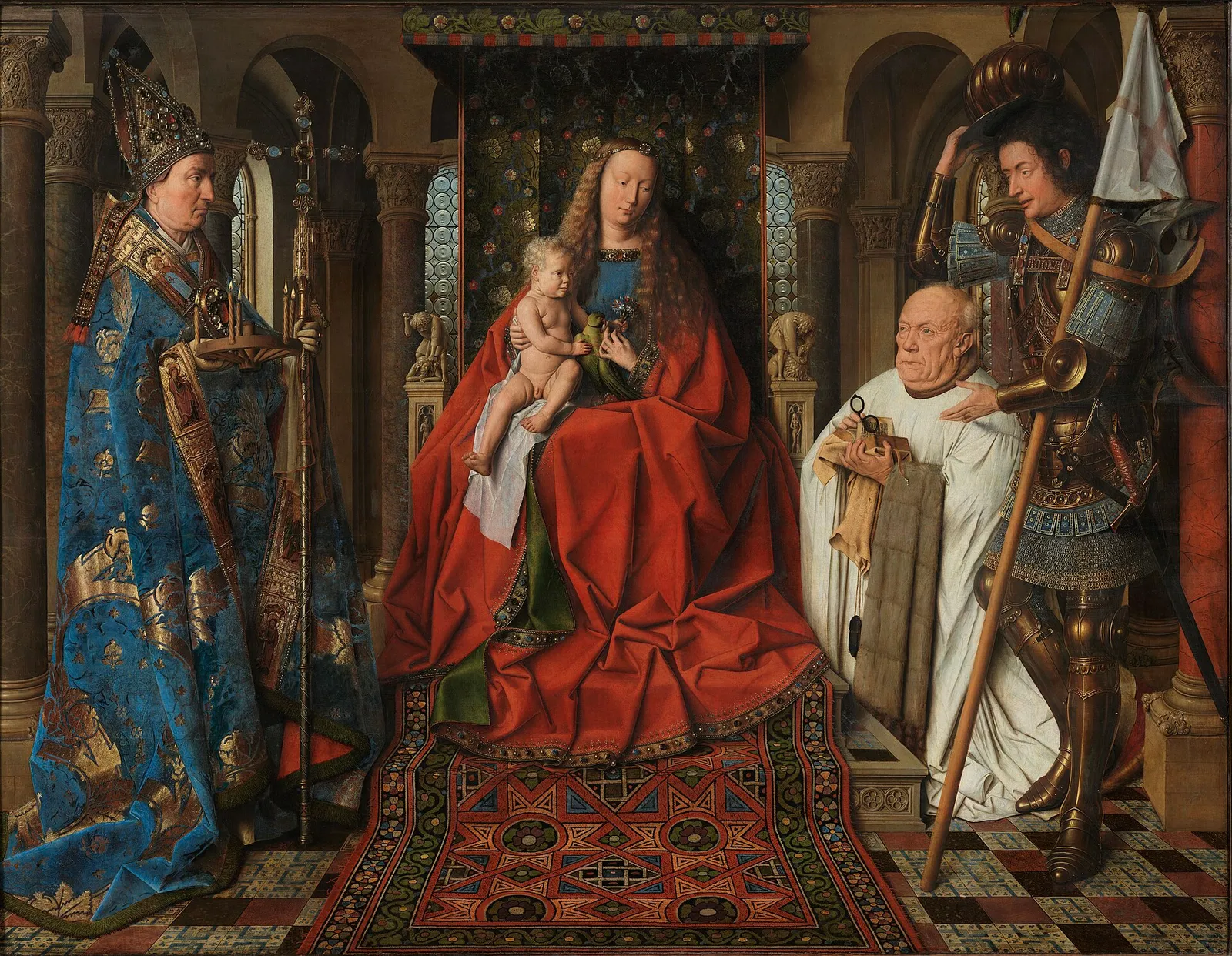
Jan van Eyck's Madonna with Canon Joris van der Paele is a large devotional panel from the 1430s in which an elderly cleric kneels before the enthroned Virgin and Child, introduced by two saints. It belongs to the Groeningemuseum, and its closely observed faces, fabrics and metal surfaces reward a slow, close look.
Where to see it
The painting is held by the Groeningemuseum as part of the Vlaamse Kunstcollectie (Flemish Art Collection). The collection record lists it in Room 1 of the Groeningemuseum, but hanging arrangements can change. Before you visit, check the Groeningemuseum's official website for current display status, opening hours and ticket information. The panel measures 124.5 cm high by 160 cm wide. It is large enough to read from across the room, but its finest details are best seen up close.
What to look for in person
The canon's face
Start with the kneeling man in a white surplice on the right. Van Eyck shows the donor, Canon Joris van der Paele, as an old man without flattery. Look at the creased skin, the thinning hair and the veins at his temple. He holds an open book and a pair of spectacles, which suggests both his learning and his failing sight. Few portraits of the period record ageing this directly. Step close and compare the soft, heavy texture of his face with the crisp folds of his linen.
Two saints, two kinds of surface
The canon is flanked by two saints. On the left stands St Donatian, patron saint of the Bruges church the canon served. He wears richly brocaded bishop's vestments and holds a wheel set with candles, his attribute. On the right, St George in armour raises his helmet and presents the kneeling donor to the Virgin. Compare how the painter handles the heavy, patterned cloth with the polished steel. Highlights and reflections play across the armour and make the metal look hard and cold.
Virgin, Child and setting
At the centre, the Virgin sits on a canopied throne with the Christ Child on her lap. The Child holds a parrot and a small posy of flowers. Beneath the throne lies a patterned carpet, painted knot by knot. Behind the group, a rounded, columned space recalls the east end of a Romanesque church. Look up at the carved column capitals, which carry small figurative scenes, and at the light falling across the stone. The setting turns a private act of devotion into a carefully staged sacred space.
About the painting
This panel is a votive painting, a picture commissioned to record a donor's devotion and to ask for heavenly favour. Its patron was Joris van der Paele, a canon of St Donatian's Church in Bruges. Van Eyck places him in the same space as the Virgin and Child, closer than a real worshipper could stand. The two saints do the work of introduction: St George as the canon's name saint, and St Donatian as the patron of his church. Together they turn the scene into a petition made in person.
The work dates from the 1430s, the decade in which Jan van Eyck produced many of his best-known panels. It shows the qualities for which he is admired: oil paint built up in thin layers, close study of how light strikes different materials, and a patient, inch-by-inch description of skin, wool, stone and metal. The composition is broad rather than tall, at 124.5 by 160 cm, so the figures spread across the panel in a shallow row. This asks the viewer to read it from side to side, from Donatian through the Virgin to George and the canon.
For visitors, the painting works on two scales. From a distance it is a calm, balanced arrangement of figures under an arch. Up close it becomes an inventory of textures: the carpet's pattern, the saints' gold thread, the reflections in the armour and, above all, the lined face of the old canon. Allow time to move between both views.
Key facts
| Artist | Jan van Eyck |
|---|---|
| Date | 1430s |
| Size | 124.5 × 160 cm |
| Medium | oil paint, panel |
| Collection | Groeningemuseum / Vlaamse Kunstcollectie |
How to visit: Groeningemuseum
Bruges, Belgium
Hours and prices can change. Please check the official website before you go.
