Art! Art! Art! › Works
Arnolfini Portrait
 Jan van Eyck, 1434
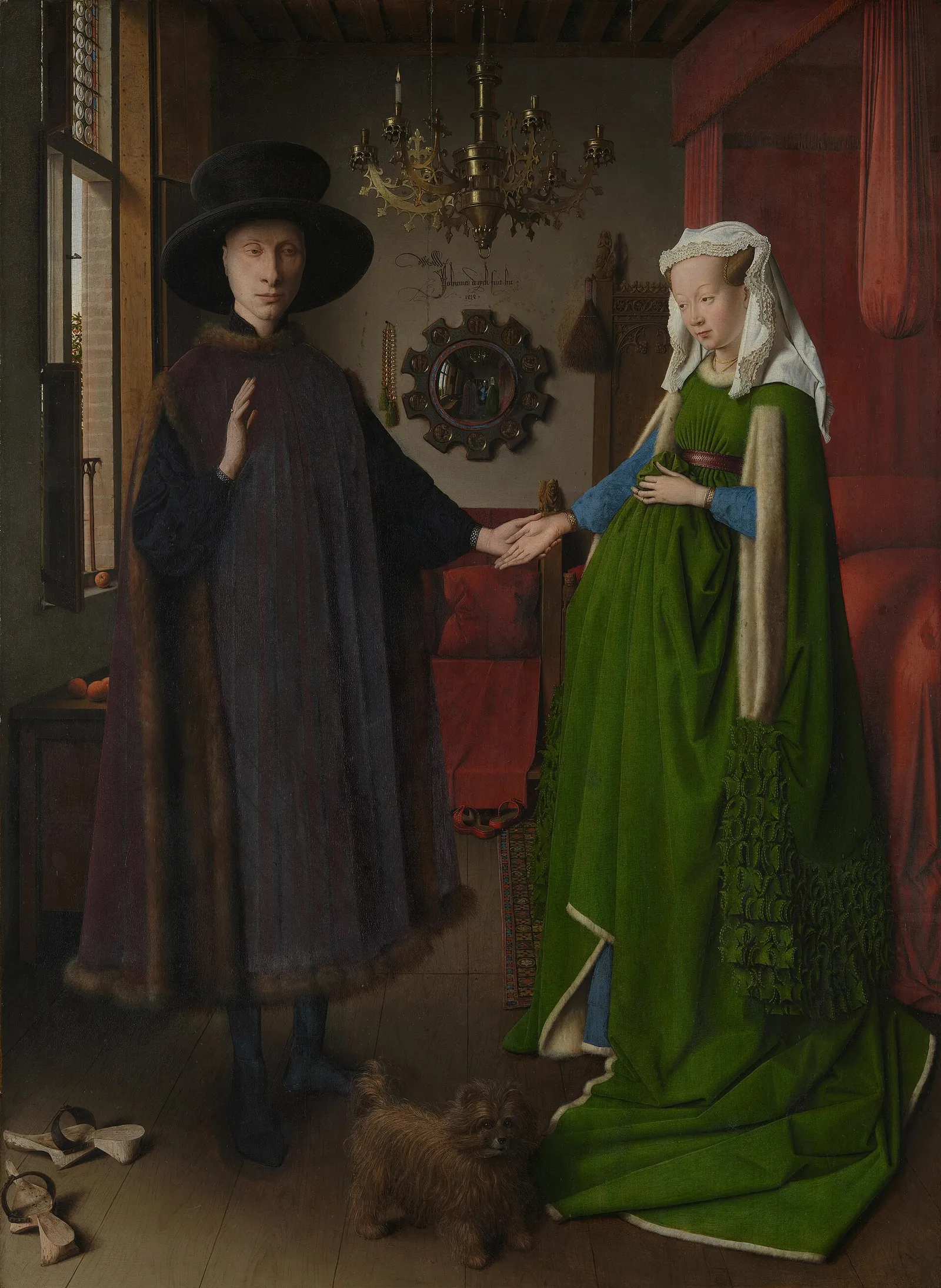
Jan van Eyck's Arnolfini Portrait, dated 1434, shows a richly dressed man and woman standing in a furnished room. It belongs to the National Gallery, and at 82.2 by 60 cm it is a painting that rewards close looking, as many of its details are very small.
Where to see it
The Arnolfini Portrait is in the collection of the National Gallery. The fact sheet records its location as Room 52 - Creating Illusion: Netherlandish Painting 1420–1480. Displays can change because of rehangs, conservation or loans, so check the National Gallery's official website for current display status and visiting information before you go. The painting measures 82.2 x 60 cm, so allow time to view it up close.
What to look for in person
The convex mirror
Look at the centre of the back wall, where a small round convex mirror hangs. Its curved surface reflects the room in reverse: the backs of the two main figures and, in the doorway, two further figures who appear to stand roughly where the viewer stands. The mirror's frame is set with small roundels showing scenes from the Passion of Christ. Step close to see how much detail van Eyck fitted into an area only a few centimetres across, and how convincingly he rendered the distortion of the curved glass.
The signature on the wall
Directly above the mirror, an inscription in ornate Latin script reads, in translation, 'Jan van Eyck was here 1434'. Rather than placing a discreet signature in a corner, the artist painted it as though it were written on the wall of the room itself, in an elaborate formal hand. It dates the painting and makes the artist's presence part of the scene. Read together with the figures reflected in the mirror, it encourages viewers to think about who is witnessing the moment shown.
Surfaces, objects and light
Van Eyck worked in oil paint, building up thin, translucent layers that let him imitate different materials with great precision. Spend time on the brass chandelier, which holds a single lit candle even though it is daytime; the fur trims of the clothing; the small dog in the foreground; the oranges near the window; and the wooden pattens left on the floor. Daylight enters from the window at the left and falls evenly across the room, creating a consistent and believable sense of space.
About the painting
The Arnolfini Portrait is one of the best-known works by Jan van Eyck, a painter active in the Low Countries in the first half of the fifteenth century. Dated 1434 by the inscription on its back wall, it is a full-length double portrait of a man and a woman in a domestic interior, painted in oil on an oak panel. Full-length portraits of private individuals set in their own surroundings were unusual at the time, which is part of why the work has attracted such sustained attention.
The man raises his right hand while holding the woman's hand in his left. Both wear expensive clothing trimmed with fur, and the room contains costly items such as the brass chandelier, the oriental carpet and the oranges, which were an imported luxury in northern Europe. These details are generally read as signs of the couple's wealth and status.
For visitors, the painting is a good example of what fifteenth-century Netherlandish artists achieved with oil paint: precise textures, subtle light, and a coherent sense of space built through observation rather than strict mathematical perspective. Its modest size of 82.2 by 60 cm means it is best experienced up close. Begin with the two figures, then let your eye move to the mirror and the inscription above it, and finally to the small objects scattered around the room. The meaning of the scene has been debated for a long time, and part of the pleasure of viewing it is weighing those interpretations for yourself.
Key facts
| Artist | Jan van Eyck |
|---|---|
| Date | 1434 |
| Size | 82.2 × 60 cm |
| Medium | oil paint, oak panel |
| Collection | National Gallery |
How to visit: National Gallery
London, United Kingdom · Museum guide
| Opening hours | Mon–Thu, Sat, Sun 10:00–18:00 Fri 10:00–21:00 (Friday late) |
|---|---|
| Closed | 24–26 December and 1 January. |
| Admission | General admission (collection) free; donations invited Some exhibitions are charged (e.g. Renoir and Love, until 31 Jan 2027) |
| Free entry | General admission is always free. |
| Booking | No reservation or timed entry is required. Free timed booking gives fast-track entry. |
Building work and improvements are under way: some rooms are closed and some paintings have moved, so check the floorplans or collection search before visiting. A new Research Centre is due to open in 2028. On 17 November only, some east wing rooms and the Espresso Bar close from 16:00.
Official ticket page
Official website
View on map
Hours and prices can change. Please check the official website before you go. (Checked on: 2026-11-11)
