Art! Art! Art! › Works
Madonna of St. Jerome
 Antonio Allegri da Correggio, 1520s
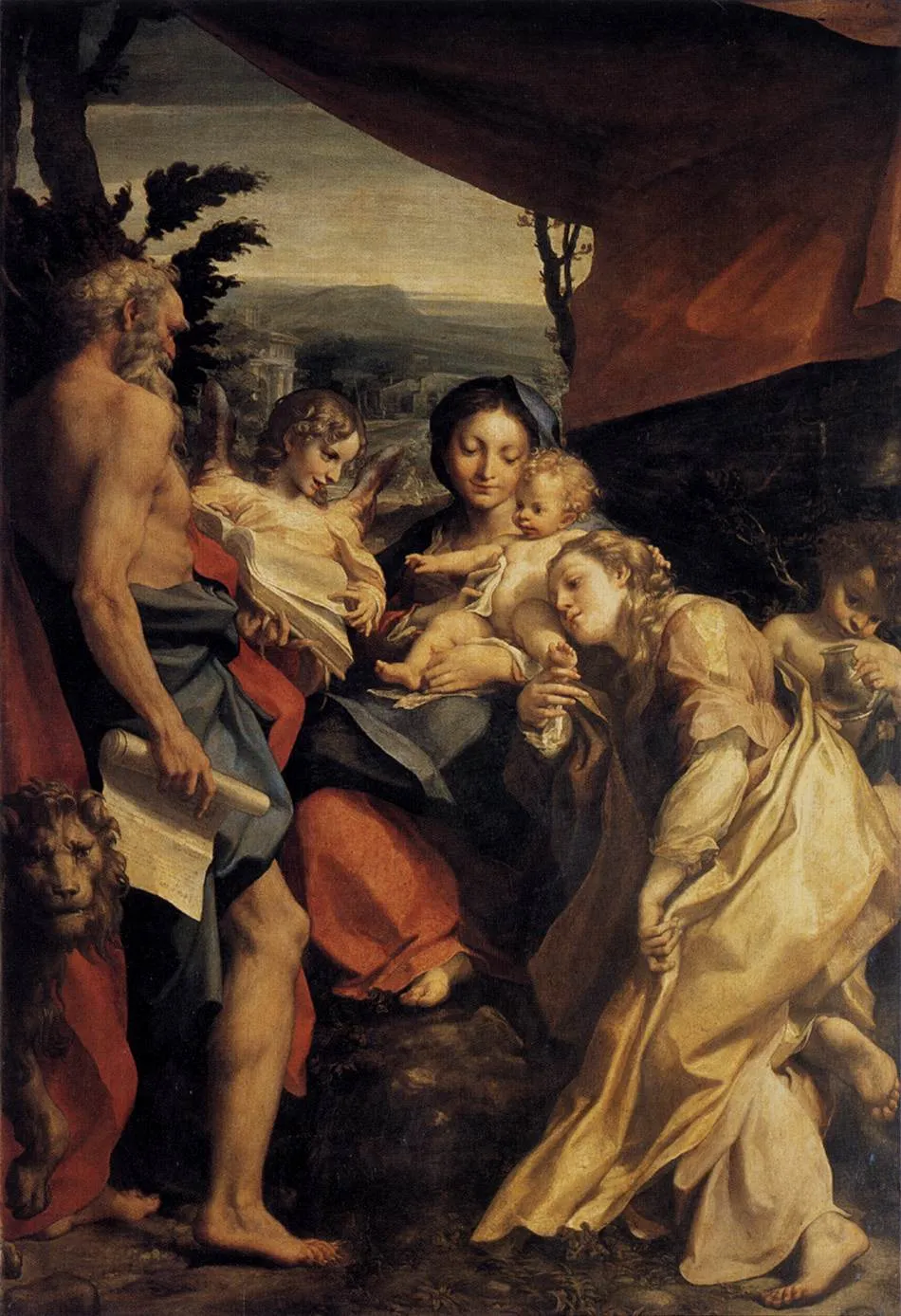
Antonio Allegri da Correggio's Madonna of St. Jerome, painted in the 1520s, belongs to the Galleria nazionale di Parma. The large altarpiece, 235 by 141 centimetres, brings the Virgin and Child together with St Jerome and Mary Magdalene in a warm, daylight-filled scene.
Where to see it
The Madonna of St. Jerome is in the collection of the Galleria nazionale di Parma, in Parma, Italy. Display arrangements, opening hours and ticketing can change, and works are sometimes moved for conservation or exhibitions. Check the museum's official website for current display status before you visit.
What to look for in person
St Jerome and his lion
On the left stands St Jerome, the scholar-saint, his tall, muscular body only partly covered by drapery. He holds a large scroll or volume, a reference to his translation of the Bible into Latin. Look down to find the lion at his feet, his traditional companion. Jerome's weathered, upright figure contrasts with the softer, youthful figures around him, and his stance anchors the left side of the composition while the rest of the group leans and turns toward the centre.
Mary Magdalene and the Child
On the right, Mary Magdalene leans in and rests her face against the Christ Child, her long golden hair falling over her shoulder. This is one of the most tender passages in the painting, so take time to follow the line from her face to the Child's body. Behind her, a small angel holds the jar of ointment that is her usual attribute. Notice how Correggio connects the figures through touch, glances and overlapping forms instead of setting them side by side in separate spaces.
Daylight and soft modelling
The painting has long been nicknamed 'Il Giorno' (The Day) for its bright, even light. Stand back first to see how warm light washes across skin and drapery, and how a sweep of fabric overhead frames the group against an open landscape. Then move closer to study Correggio's soft modelling: edges melt gently into shadow, giving faces and limbs a rounded, tactile quality. At 235 by 141 centimetres, the composition reads clearly from across the room, yet the surface rewards close, slow looking.
About the painting
Antonio Allegri, known as Correggio after the town where he was born, spent much of his career working in and around Parma. He is widely recognised for his dome frescoes in the city and for altarpieces in which sacred figures appear relaxed, emotionally warm and bathed in soft light. The Madonna of St. Jerome, dated to the 1520s, is one of his most admired works of this kind. The painting follows the tradition of the sacra conversazione, in which the Virgin and Child appear together with saints from different times, gathered in one shared space. Correggio loosens that formula. Instead of a stiff, symmetrical line-up, the figures lean, turn and touch, and the eye moves in a gentle circle from Jerome on the left, through the Virgin and Child, to the Magdalene on the right. The angel near the centre, holding a book, helps link the two sides. The work was made as an altarpiece for a church in Parma and is now one of the central works of the Galleria nazionale di Parma. Its popular name, 'Il Giorno', reflects its luminous daylight and is often contrasted with Correggio's night-time Adoration of the Shepherds, known as 'La Notte', which is held elsewhere. Like many Italian masterpieces, the painting was taken to France during the Napoleonic period and later returned to Parma. For visitors, the key pleasures are its scale, the warmth of its colour and the intimacy between the figures. Allow time to look both at the whole design and at individual faces, hands and hair, where Correggio's delicate handling is easiest to appreciate.
Key facts
| Artist | Antonio Allegri da Correggio |
|---|---|
| Date | 1520s |
| Size | 235 × 141 cm |
| Medium | oil paint, canvas |
| Collection | Galleria nazionale di Parma |
How to visit: Galleria nazionale di Parma
Parma, Italy
Hours and prices can change. Please check the official website before you go.
