Art! Art! Art! › Works
Danaë
 Antonio Allegri da Correggio, 1531
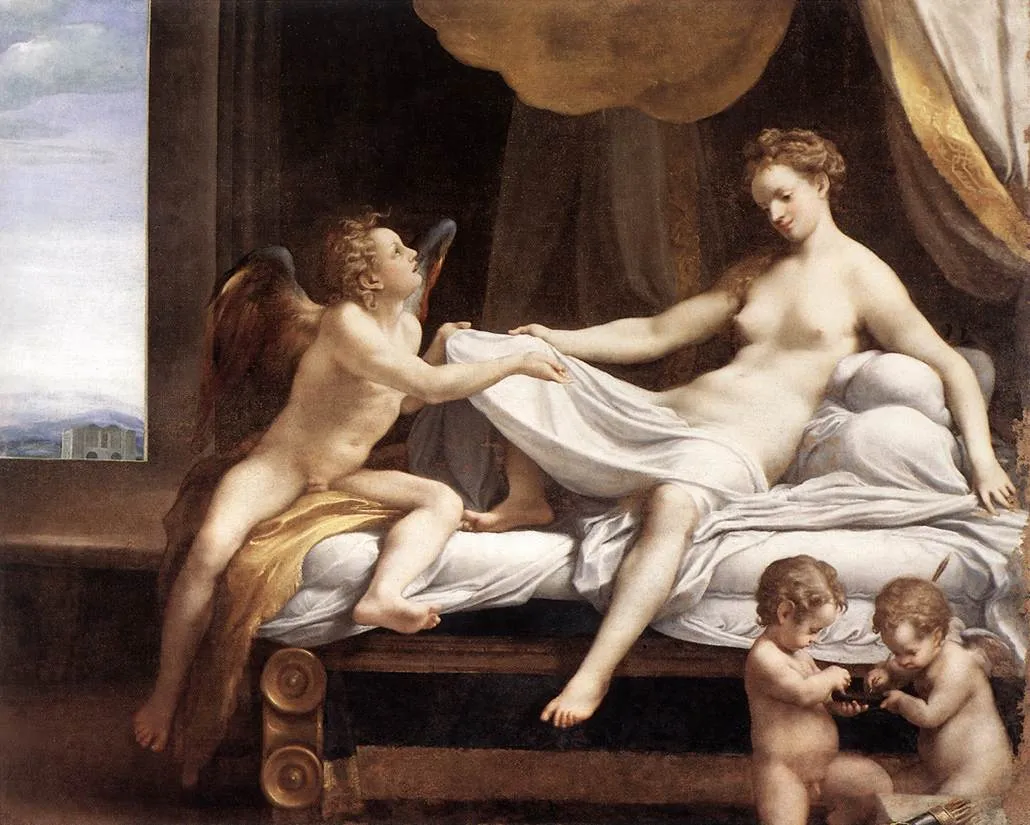
Correggio's Danaë, dated to 1531, belongs to the Borghese Collection and is held at the Galleria Borghese. The painting shows the mythological princess Danaë at the moment Jupiter reaches her as a shower of gold. At 158 by 189 cm, it is large enough to reward both a step back and a close look at its soft, luminous handling of figures and fabric.
Where to see it
Danaë is held by the Galleria Borghese as part of the Borghese Collection. Before you plan a trip around this painting, check the Galleria Borghese's official website for its current display status, opening hours, and any ticket or booking requirements, since works can be moved, lent, or temporarily withdrawn.
What to look for in person
The shower of gold and Cupid's help
Start at the top of the canvas, where a dark cloud releases drops of gold. This is the form Jupiter takes to reach Danaë, who was shut away from suitors. Then follow the gold down to the bed. A winged Cupid sits at its edge, drawing the white sheet across Danaë's lap as if to catch the falling gold. Danaë's head and gaze turn downward toward the sheet, linking her to the event above. Notice how the whole story is told through gestures and glances rather than dramatic action.
The two children at lower right
Move your eyes to the lower right corner, where two small winged children bend over an arrow and a stone. They are absorbed in their task and pay no attention to the scene on the bed, which gives the corner a quiet, almost playful mood of its own. Compare their small, rounded bodies with Danaë's reclining figure and with the older Cupid on the bed. Correggio repeats soft curves throughout the group, so that the children echo the main figures while remaining a separate episode within the picture.
Soft light and modelled flesh
Correggio is known for gentle transitions between light and shadow, and this canvas is a good place to see it. Look at how Danaë's skin seems to turn gradually from warm light into shade, without hard outlines. Contrast that with the crisper folds of the white sheet and the darker surrounding drapery and architecture. At 158 by 189 cm, the figures are close to life size, so try viewing first from a few steps back to read the diagonal of the reclining body, then move closer to study the surface.
About the painting
Antonio Allegri da Correggio was one of the leading painters of northern Italy in the early sixteenth century, working mainly in and around Parma. He is especially admired for the softness of his painted flesh, his tender, graceful figures, and his skill with light. Danaë, dated to 1531 in the fact sheet, is one of his best-known mythological works and is now held at the Galleria Borghese in the Borghese Collection.
The subject comes from classical mythology. Danaë's father, the king of Argos, locked her away after a prophecy warned that a grandson would kill him. Jupiter nonetheless reached her in the form of a shower of gold, and their son was the hero Perseus. Artists of the Renaissance and later returned often to this story, which allowed them to combine a reclining female figure with a moment of divine intervention.
The painting is generally grouped with Correggio's series known as the Loves of Jupiter, a set of canvases showing the god's encounters with mortal women and youths, associated with the patronage of Federico II Gonzaga of Mantua. Other subjects usually linked to the group include Io, Ganymede and Leda. Seen in that context, Danaë shows Correggio treating the theme with a light, intimate touch rather than grand drama: the event unfolds in a domestic setting, with Cupid and two small companions accompanying the princess.
For visitors, the painting offers a compact lesson in Correggio's style. Spend time with the transitions of light across the figures, the contrast of white linen against darker tones, and the way the composition leads the eye from the cloud down to the bed and across to the corner.
Key facts
| Artist | Antonio Allegri da Correggio |
|---|---|
| Date | 1531 |
| Size | 158 × 189 cm |
| Medium | oil paint, canvas |
| Collection | Galleria Borghese / Borghese Collection |
How to visit: Galleria Borghese
Rome, Italy · Museum guide
| Opening hours | Tue–Sun 09:00–19:00 (entry at the start of each hourly slot, max 180 visitors per slot; visits last 2 hours, last slot shorter) |
|---|---|
| Closed | Mondays; 25 December and 1 January |
| Last entry | 17:45 (some official information gives 17:50 for the last same-day slot) |
| Admission | Adults EUR 16 (plus EUR 2 reservation fee; may rise during temporary exhibitions) Adults, last time slot EUR 11 (plus reservation fee) Ages 18–25 EUR 2 (plus reservation fee; valid until 25th birthday) Under 18 free (EUR 2 reservation fee still applies) Reservation fee (all tickets) EUR 2 (mandatory, including free tickets) |
| Free entry | Free for under-18s, ICOM members, MiC staff, certain students and faculty (humanities, architecture, fine arts), EU school groups and authorised guides/interpreters. Free for everyone on the first Sunday of the month and on 25 Apr, 2 Jun and 4 Nov (EUR 2 reservation fee applies; tickets released 10 days ahead; no last-minute tickets). |
| Booking | Reservation is required for timed entry. Tickets for free days (first Sunday etc.) are released 10 days in advance. |
Official ticket page
Official website
View on map
Hours and prices can change. Please check the official website before you go. (Checked on: 2026-11-09)
