Art! Art! Art! › Works
Madonna del Prato
 Giovanni Bellini, 1500s
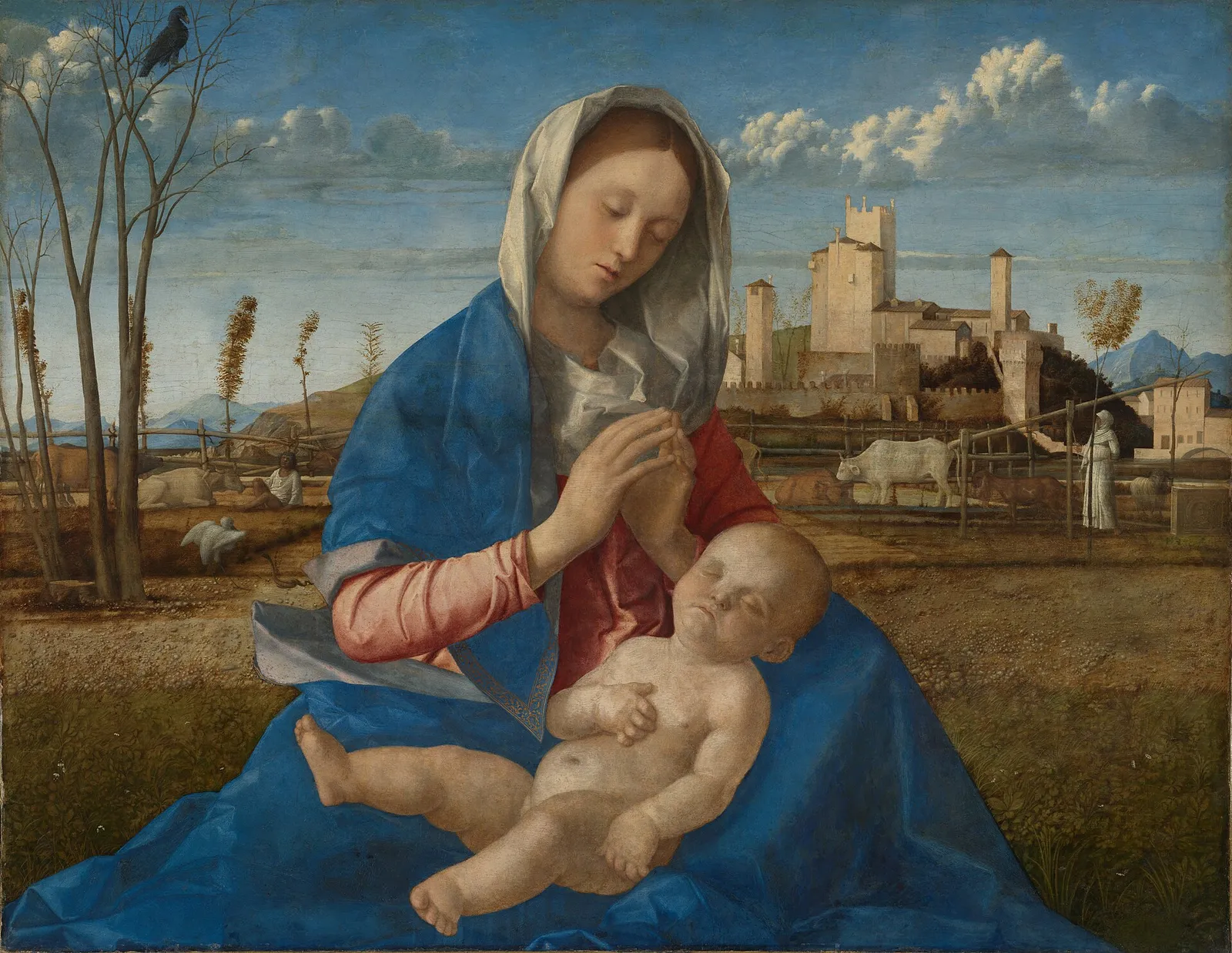
Giovanni Bellini's Madonna del Prato, painted in the 1500s, shows the Virgin Mary seated in an open meadow, praying over the sleeping Christ Child in her lap. The painting belongs to the National Gallery, where it is listed in a room devoted to painting in Venice. Its quiet figure group and closely observed landscape reward slow looking.
Where to see it
Madonna del Prato is in the collection of the National Gallery. The collection record lists it in Room 63, La Serenissima: Painting in Venice 1450–1500. Paintings can be moved, lent or taken off view for conservation, so check the National Gallery's official website for current display status before you visit. The panel measures 67.3 cm high by 86.4 cm wide. It is wider than it is tall, a horizontal format that leaves room for the landscape stretching behind the figures.
What to look for in person
The Virgin of Humility
Start with the central group. Instead of sitting on a raised throne, the Virgin sits directly on the ground of the meadow. This follows a type of devotional image known as the Virgin of Humility. Her eyes are closed and her hands are joined in prayer as she bends over the Christ Child, who lies asleep across her lap. Notice how still the pose is. Mother and child form a compact shape set low in the picture, with the open countryside spreading out around them on either side.
Life in the landscape
Step closer and look to the left side of the landscape. There is a small natural drama here that is easy to miss from a distance. A snake threatens a white wading bird, and a dark bird of prey perches in a tree. These details sit among fields, paths and hills that recede into the distance. Take time to follow the landscape from the foreground meadow back toward the horizon. Much of the painting's interest lies outside the figures, in this carefully built world.
Reading the surface
The painting has had a complicated physical history, and you can see some of it. Bellini painted it in oil and egg tempera on a wooden panel. In 1949 the paint was transferred from the panel to canvas. The surface has suffered losses, especially in the figures, and in places the lower layers of paint show through. Looking for these thinner areas can give you a sense of how the picture was built up in layers. It is also a useful reminder of how old paintings change over time.
About the painting
Madonna del Prato, whose title refers to the meadow where the Virgin sits, is now accepted as a work by Giovanni Bellini. That was not always the case, and its attribution history is part of its story. The National Gallery bought the painting in 1858 from Achille Farina, a painter from Faenza. At that time it was sold as a work by Marco Basaiti, and it kept that attribution for many years. Other scholars proposed that it came from Bellini's circle rather than his own hand. They suggested assistants or followers such as Vincenzo Catena and Francesco Bissolo. In 1928 the art historian Georg Gronau became the first to give the painting to Bellini himself. Bellini's authorship is the view reflected in the collection record today. The composition also exists in another version. A small workshop variant is held by the Yager Museum in Oneonta, New York. This suggests the design was valued enough to be repeated in Bellini's studio. In front of the painting, these debates can help you look more closely. The losses in the paint, especially in the figures, and the transfer from wood to canvas in 1949 have changed the surface. Even so, the essential design remains clear. The praying Virgin sits on the ground with the sleeping Child, set against a broad and detailed landscape. Seeing it among other Venetian paintings of the same period lets visitors compare how artists of the time combined devotional figures with observed countryside.
Key facts
| Artist | Giovanni Bellini |
|---|---|
| Date | 1500s |
| Size | 67.3 × 86.4 cm |
| Medium | oil paint, panel, transferred on canvas |
| Collection | National Gallery |
How to visit: National Gallery
London, United Kingdom · Museum guide
| Opening hours | Mon–Thu, Sat, Sun 10:00–18:00 Fri 10:00–21:00 (Friday late) |
|---|---|
| Closed | 24–26 December and 1 January. |
| Admission | General admission (collection) free; donations invited Some exhibitions are charged (e.g. Renoir and Love, until 31 Jan 2027) |
| Free entry | General admission is always free. |
| Booking | No reservation or timed entry is required. Free timed booking gives fast-track entry. |
Building work and improvements are under way: some rooms are closed and some paintings have moved, so check the floorplans or collection search before visiting. A new Research Centre is due to open in 2028. On 17 November only, some east wing rooms and the Espresso Bar close from 16:00.
Official ticket page
Official website
View on map
Hours and prices can change. Please check the official website before you go. (Checked on: 2026-11-11)
More by Giovanni Bellini


Sources
- Wikidata Q1115613
- Wikipedia (en) (CC BY-SA 4.0)
- Wikipedia (ja) (CC BY-SA 4.0)
- Wikipedia (it) (CC BY-SA 4.0)
- Wikipedia (fr) (CC BY-SA 4.0)
- www.nationalgallery.org.uk