Art! Art! Art! › Works
Holy Allegory
 Giovanni Bellini, 1490s
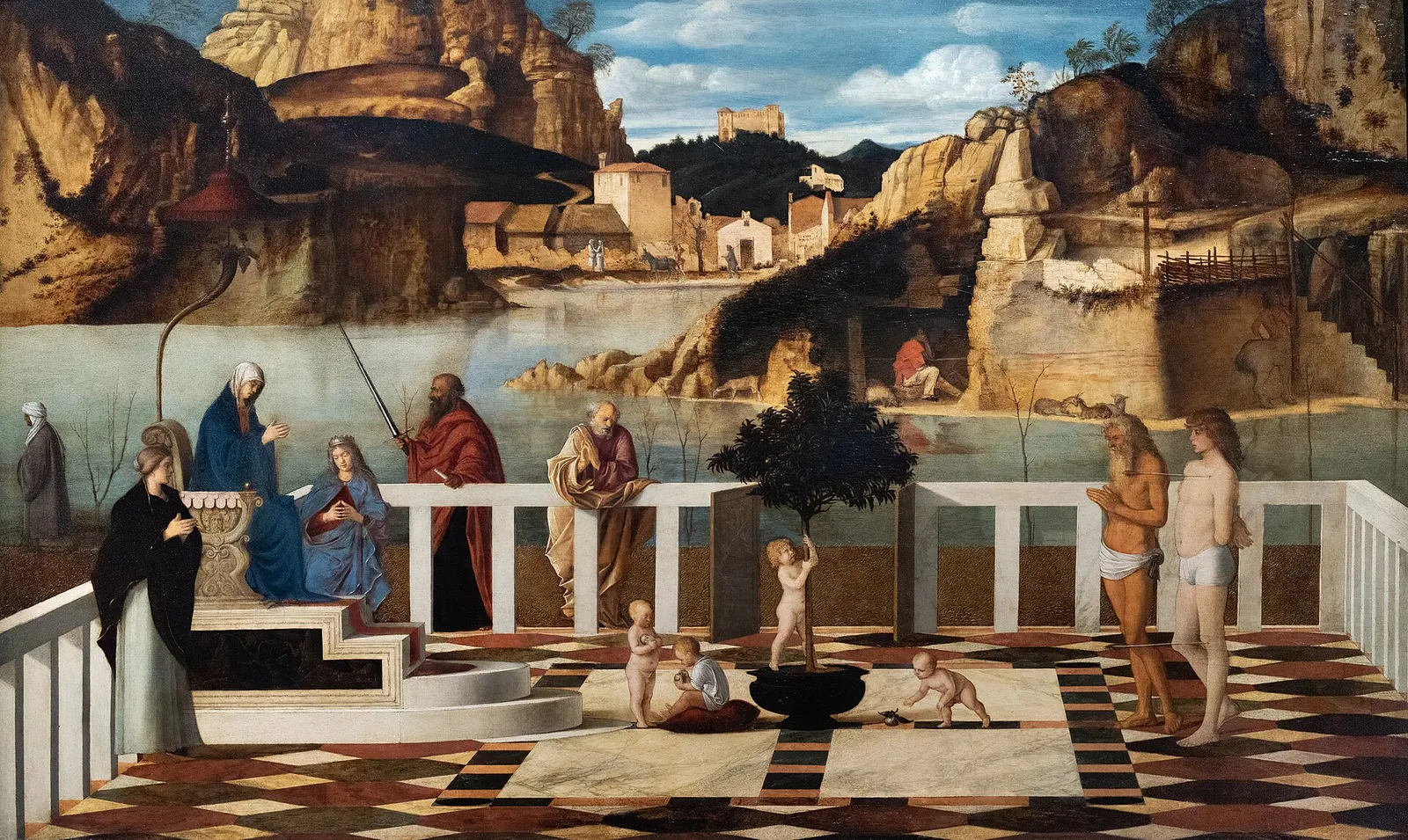
Giovanni Bellini's Holy Allegory is in the collection of the Uffizi Gallery. Painted in the 1490s, this wide, quiet scene of figures on a marble terrace beside a lake has puzzled viewers and scholars for generations. Bring patience: the picture rewards slow looking more than quick explanation.
Where to see it
Holy Allegory belongs to the Uffizi Gallery, which is also its recorded location. The painting measures 73 cm high by 119 cm wide, a modest horizontal format that you view at close range rather than from across a room. Displays can change because of rehanging, conservation or loans, so check the Uffizi Gallery's official website for current display status, opening hours and ticketing before you visit.
What to look for in person
The terrace and the children at the tree
Start at the centre. A patterned marble terrace, enclosed by a low balustrade, holds a small tree and a group of naked children who seem to be playing with it or gathering its fruit. Notice how calmly Bellini sets them out on the geometric floor, as if on a stage. The children give the scene its gentle movement, while the adults around them stand or sit almost motionless. Follow the lines of the pavement to see how carefully the space has been built.
Figures you can identify by their attributes
Look at the edges of the terrace for clues. At the left, a woman sits enthroned beneath a canopy, and she is generally identified as the Virgin Mary. On the right, look for a young man pierced by arrows: this is the traditional sign of Saint Sebastian. Near him stands an older, nearly unclothed man who is usually read as Job. Elsewhere, other figures, including a man holding a sword, are often linked to saints. Try naming the figures by what they carry or wear before reading any label.
The landscape across the water
Let your eye move past the balustrade to the far shore. Beyond a still stretch of water, rocky slopes, buildings and a soft sky fill the upper half of the panel. Bellini scatters tiny figures and animals through this landscape, and finding them is part of the pleasure of standing close. Compare the clear, even light here with the light on the terrace: the whole picture feels suspended in a single calm moment, which adds to its dreamlike mood.
About the painting
Holy Allegory is a work by Giovanni Bellini, the Venetian painter whose career did much to shape painting in Venice in the late fifteenth century. The fact sheet dates the picture to the 1490s, and it is now in the collection of the Uffizi Gallery. At 73 by 119 centimetres it is a fairly intimate, horizontal picture, suited to close and quiet viewing.
What makes the painting stand out is that its subject is not obvious. Unlike an altarpiece with a clearly defined religious story, it gathers holy figures, saints and children into one contemplative setting without showing a single recognisable event. Viewers can identify several individuals from their traditional attributes, such as Saint Sebastian with his arrows, but the meaning of the group as a whole remains open. Over time, scholars have proposed a range of readings, often linking the scene to ideas of paradise, salvation or religious meditation, and no one explanation has been universally accepted.
For a visitor, this uncertainty is part of the experience. Instead of searching for a single answer, it helps to look at how the picture is put together: the ordered marble terrace in front, the low balustrade that separates it from the water, and the wide landscape beyond. Bellini's even light and careful detail invite you to move slowly from figure to figure and from foreground to background. Spend a few minutes with the small details in the distance as well as the central group, and then step back to take in the stillness of the whole composition.
Key facts
| Artist | Giovanni Bellini |
|---|---|
| Date | 1490s |
| Size | 73 × 119 cm |
| Medium | oil paint, panel |
| Collection | Uffizi Gallery |
How to visit: Uffizi Gallery
Florence, Italy · Museum guide
| Opening hours | Tue–Sun 08:15–18:30 (visitors leave by 18:30) |
|---|---|
| Closed | Mondays, 1 January and 25 December. |
| Last entry | Ticket office closes at 17:30. |
| Admission | Regular, bought on the day EUR 25 Regular, bought in advance EUR 29 Regular, entry from 16:00 (from 1 January 2026) EUR 16 Reduced (EU citizens aged 18–25; citizens of Switzerland, Norway, Liechtenstein, Uruguay etc.; ID required) EUR 2 Under 18 free (under 12s must be accompanied) Uffizi + Vasari Corridor EUR 43 on the day / EUR 47 in advance; named ticket, reservation required, non-refundable PassePartout 5 days (Uffizi, Pitti Palace, Boboli) EUR 40 (EUR 58 with Vasari Corridor) Audio guide EUR 6 |
| Free entry | Free for under-18s; disabled visitors plus one companion; tour guides and interpreters, ICOM members, certain journalists, and university teachers/students on the official list. Admission is free on the first Sunday of each month (national museums), when reservations are not possible. |
| Booking | Reservation is not required, except for the Uffizi + Vasari Corridor ticket, which must be reserved. |
Restoration and rearrangement works mean some rooms are temporarily closed and some artworks are not on display. A staff assembly on 11–12 November 2026 may change opening times.
Official ticket page
Official website
View on map
Hours and prices can change. Please check the official website before you go. (Checked on: 2026-11-12)

