Art! Art! Art! › Works
Jupiter and Callisto
 François Boucher, 1744
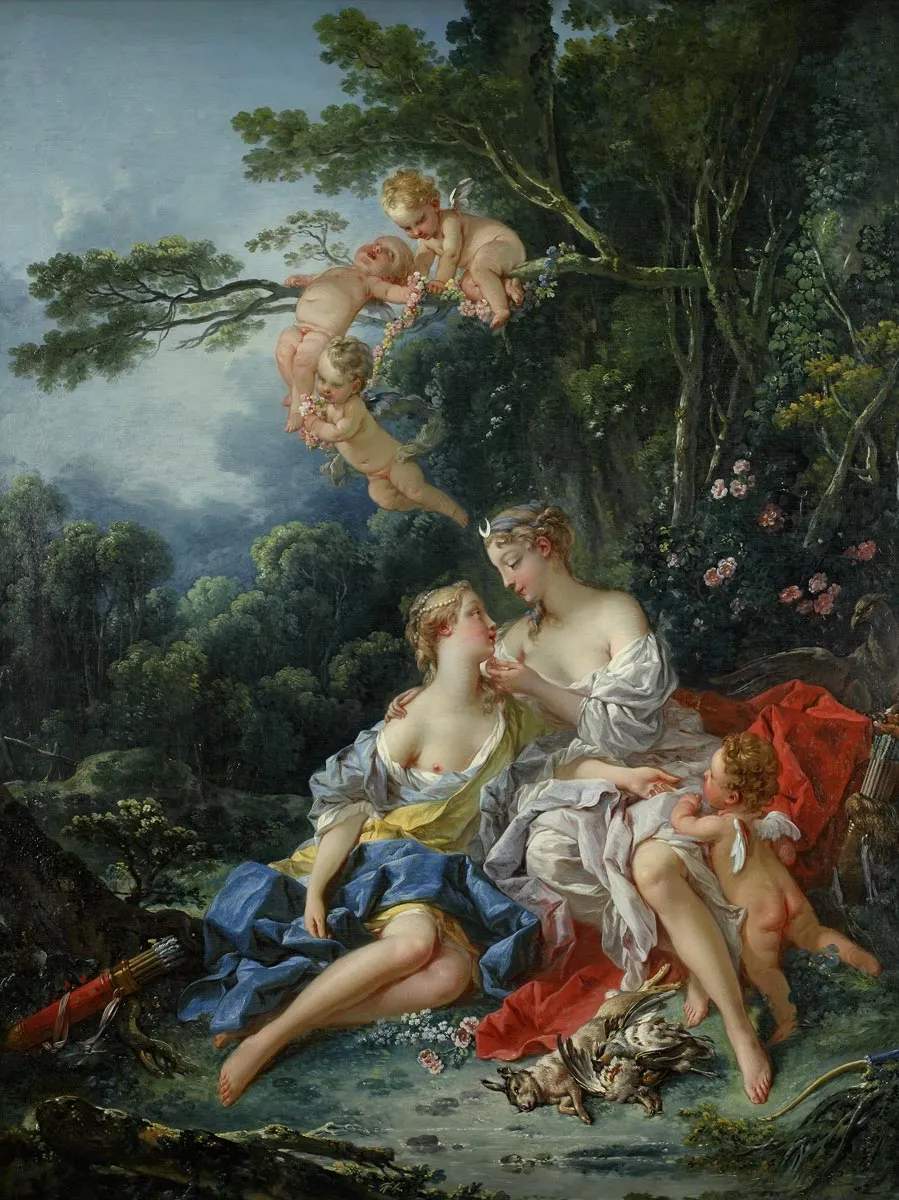
François Boucher's Jupiter and Callisto, painted in 1744, belongs to the Pushkin Museum of Fine Arts in Moscow. The oil on canvas retells a story from Ovid's Metamorphoses, in which the king of the gods takes on the appearance of the goddess Diana to approach the nymph Callisto. It is a compact canvas, so it rewards a close, unhurried look at its symbols and gestures.
Where to see it
Jupiter and Callisto is held by the Pushkin Museum of Fine Arts in Moscow. Works in a museum collection can be moved between galleries, placed in storage, lent to other institutions or taken off view for conservation, so check the Pushkin Museum's official website for current display status, opening hours and ticketing before you plan your visit.
What to look for in person
Spot the disguise
At first glance this looks like a scene between two women, and that is the point of the story. Look at the head of the standing goddess: she wears a crescent-moon crown, the sign by which viewers recognized Diana, goddess of the hunt and the moon. Then look behind her. An eagle, the bird associated with Jupiter, spreads its wings in the background. Boucher lets both identities sit in the same figure, giving the attentive viewer the clue that this Diana is really Jupiter in borrowed form.
Follow the gesture
The emotional centre of the picture lies in the hands and eyes. The disguised goddess rests a hand on Callisto's shoulder and lifts her chin lightly with one finger, while Callisto turns her face upward to meet her gaze. Stand still for a moment and trace the line between their faces; the whole composition is built around this exchange. The intimacy is gentle rather than dramatic, and the nymph's trusting expression hints at the deception she does not yet suspect, which gives the tender scene an undercurrent of unease.
Look up and around the edges
Once you have read the two main figures, let your eye travel outward. Putti drift in the sky above the pair, a familiar device in Boucher's work that adds movement and a playful, airborne lightness to the scene. Nearby, roses are in bloom, a flower long linked with love and desire. These details frame the encounter as an amorous one and soften its setting into a decorative, idyllic landscape. Noticing how these small elements echo the central gesture helps explain how carefully the canvas is arranged at about 98 by 72 centimetres.
About the painting
François Boucher painted Jupiter and Callisto in 1744, working in oil on canvas on a fairly modest scale of 98 by 72 centimetres. The subject comes from Ovid's Metamorphoses, the collection of mythological transformation tales that supplied European painters with subjects for centuries. In the story, Callisto is a nymph in the company of Diana, whose followers were expected to remain chaste. Jupiter, wishing to win her, takes on Diana's appearance so that the nymph will not be wary of him. Boucher chose the moment of approach rather than any later consequence, keeping the scene quiet and intimate.
Because the god appears in female form, the work has sometimes been known as Diana and Callisto. The painting itself resolves the ambiguity for a careful viewer: the crescent moon signals Diana, while the eagle behind the figure reveals Jupiter. This double coding is part of the pleasure of looking, inviting the viewer to read symbols and recognize the trick.
Boucher returned to the same subject later in his career; the Wallace Collection in London holds another version by him dated 1769. Seeing images of the two side by side is a useful way to compare how he handled the theme across a quarter of a century.
The Moscow canvas has a notable history of ownership. It was at one time in the possession of Prince Felix Yusupov, a member of one of Russia's wealthiest aristocratic families, before it came to the Pushkin Museum of Fine Arts. Today it offers visitors to Moscow a clear example of the mythological painting for which Boucher is best known.
Key facts
| Artist | François Boucher |
|---|---|
| Date | 1744 |
| Size | 98 × 72 cm |
| Medium | oil paint, canvas |
| Collection | Pushkin Museum of Fine Arts |
How to visit: Pushkin Museum of Fine Arts
Moscow, Russia
Hours and prices can change. Please check the official website before you go.
More by François Boucher


Sources
- Wikidata Q11345762
- Wikipedia (en) (CC BY-SA 4.0)
- Wikipedia (ja) (CC BY-SA 4.0)
- Wikipedia (fr) (CC BY-SA 4.0)