Art! Art! Art! › Works
Diana leaving her Bath
 François Boucher, 1742
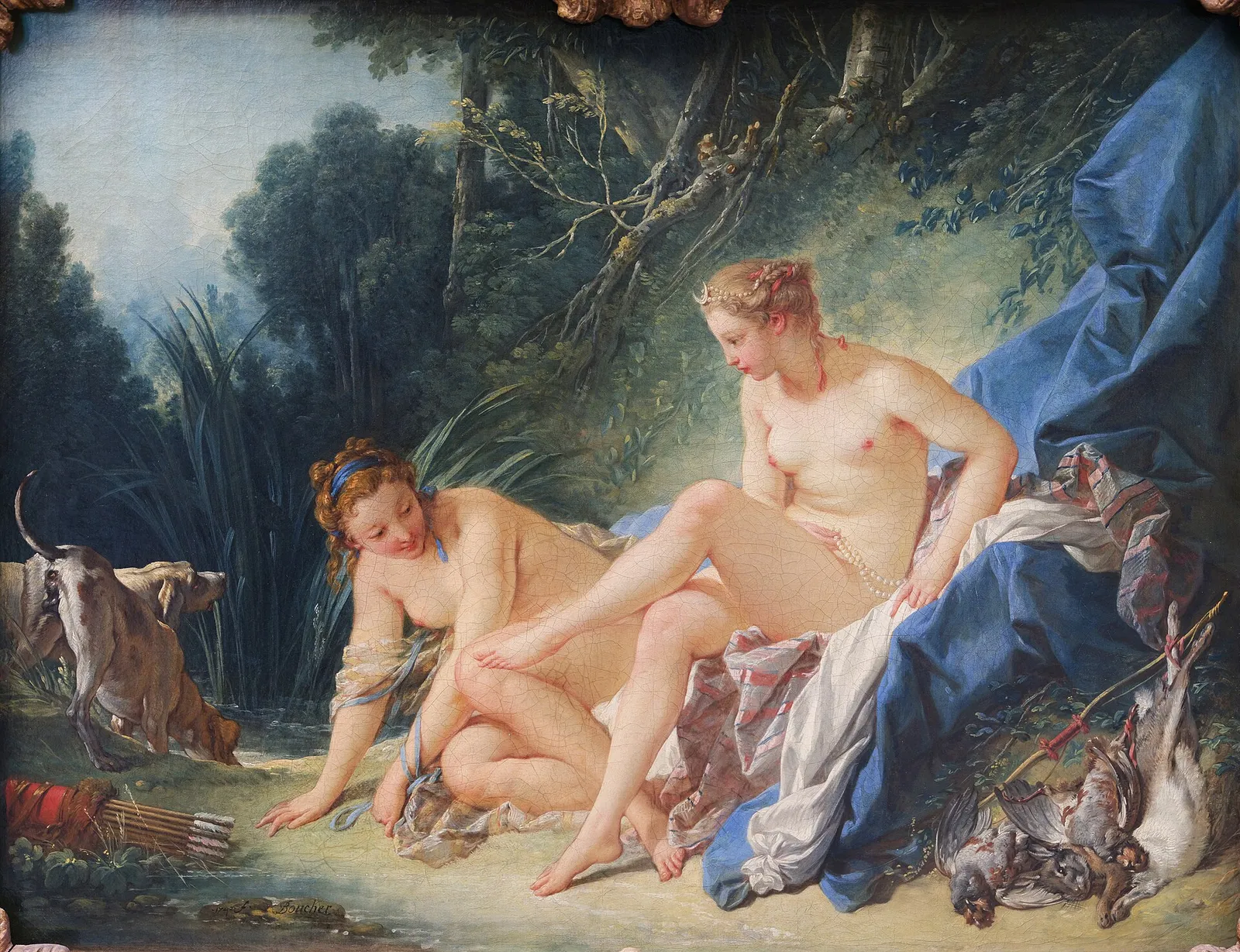
François Boucher's Diana leaving her Bath, dated 1742, shows the goddess of the hunt resting at the water's edge with a companion, her weapons and the day's game set aside. It belongs to the Department of Paintings of the Louvre. At 56 by 73 cm it is a modest-sized canvas that rewards close, unhurried looking.
Where to see it
Diana leaving her Bath is held by the Department of Paintings of the Louvre, and the fact sheet lists its location as Room 919. Displays can change because of rehanging, conservation or loans, so check the Louvre's official website for the painting's current display status and room before you visit. When you find it, allow time to step close. The canvas measures 56 cm high by 73 cm wide, and much of its interest lies in small details and surface handling that are easy to miss from across the room.
What to look for in person
The crescent moon in her hair
Look first at Diana's head. A small crescent moon sits among her pinned-up hair. This is the traditional attribute that identifies her as the goddess linked with the moon, and it is easy to overlook at this scale. Boucher does not rely on a grand setting or dramatic action to tell you who she is. Instead, a few signs do the work: the crescent, the hunting equipment nearby and the dogs. Spotting these clues is part of the pleasure of reading a mythological painting from this period.
The hunt set aside
Turn to the edges of the composition. Diana's bow and quiver of arrows lie close by, and the game from the hunt, including birds and a hare, is laid out on the ground. Her hunting dogs drink or wait at the water. These elements remind the viewer that this is a pause between activities, not a portrait of idleness. Notice how the textures of fur and feathers are painted differently from skin and cloth. Boucher uses the hunting still life to frame the two figures and to balance the brighter centre of the picture.
Skin, fabric and landscape
The central figures are lit with pale, warm flesh tones set against deep blue and white drapery and a dark, leafy landscape. Stand close and follow how soft strokes model the bodies, while the trees and foliage behind are handled more loosely. The contrast between the luminous figures and the shadowed setting pulls your eye to Diana's pose, with one foot extended toward the water. This careful control of colour and light, applied on a canvas of 56 by 73 cm, is typical of the refined decorative style associated with Boucher.
About the painting
François Boucher was one of the leading French painters of the eighteenth century and is closely associated with the Rococo, a style known for light colours, graceful figures and decorative charm. He painted mythological scenes, pastoral subjects and designs for tapestries and interiors, and later in his career he became First Painter to the King. Diana leaving her Bath, dated 1742, comes from a productive period in which he developed the polished treatment of the nude for which he is widely known.
The subject is drawn from classical mythology. Diana, goddess of the hunt and of the moon, was a popular theme for artists because her stories combined the outdoors, the female figure and recognisable attributes. Boucher chose a quiet moment rather than a dramatic episode: there is no intruder and no narrative crisis, only the goddess and a companion seated by the water after bathing, surrounded by signs of the chase.
The painting's scale, 56 by 73 cm, suits close viewing in a private room rather than a large public wall, and it rewards attention to surface and detail. Today it is part of the collection of the Department of Paintings of the Louvre, where it can be compared with other French painting of the period. For visitors, it offers a compact introduction to Boucher's approach: a classical subject treated with lightness, careful colour harmonies and an emphasis on the beauty of the figure over storytelling.
Key facts
| Artist | François Boucher |
|---|---|
| Date | 1742 |
| Size | 56 × 73 cm |
| Medium | oil paint, canvas |
| Collection | Department of Paintings of the Louvre |
| Gallery | Room 919, Sully wing, level 2 Checked in the museum's open data on 2026-11-12 (galleries can change) Source |
How to visit: Louvre Museum
Paris, France · Museum guide
| Opening hours | Mon, Thu, Sat, Sun 09:00–18:00 Wed, Fri 09:00–21:00 (evening opening) Rooms are cleared 30 minutes before closing |
|---|---|
| Closed | Every Tuesday; 1 January, 1 May and 25 December. Other public holidays are open unless they fall on a Tuesday. |
| Last entry | 1 hour before closing |
| Admission | Adult (non-EEA visitors) EUR 32 Adult (EEA citizens and residents) EUR 22 Under 18 free (ID required) EEA citizens/residents under 26 free (photo ID; residents also need a residence permit of over 90 days) Audio guide rental EUR 6 (can be booked in advance online) Rates apply from 14 January 2026 |
| Free entry | Free for under-18s, EEA citizens/residents under 26, all visitors on the first Friday of the month after 18:00 (except July and August) and on 14 July, and disabled visitors plus one carer. Also free with proof for EEA art and art-history teachers, ICOM members, journalists, EEA job seekers and EEA residents on income support. |
| Booking | Entry is by timed slot, and booking in advance is recommended. |
The Cour Carrée entrance is currently closed. On Thursday 12 November 2026 the museum may open later and some exhibition rooms may remain closed.
Official ticket page
Official website
View on map
Hours and prices can change. Please check the official website before you go. (Checked on: 2026-11-11)

