Art! Art! Art! › Works
Frederick the Great Playing the Flute at Sanssouci
 Adolph Menzel, 1852
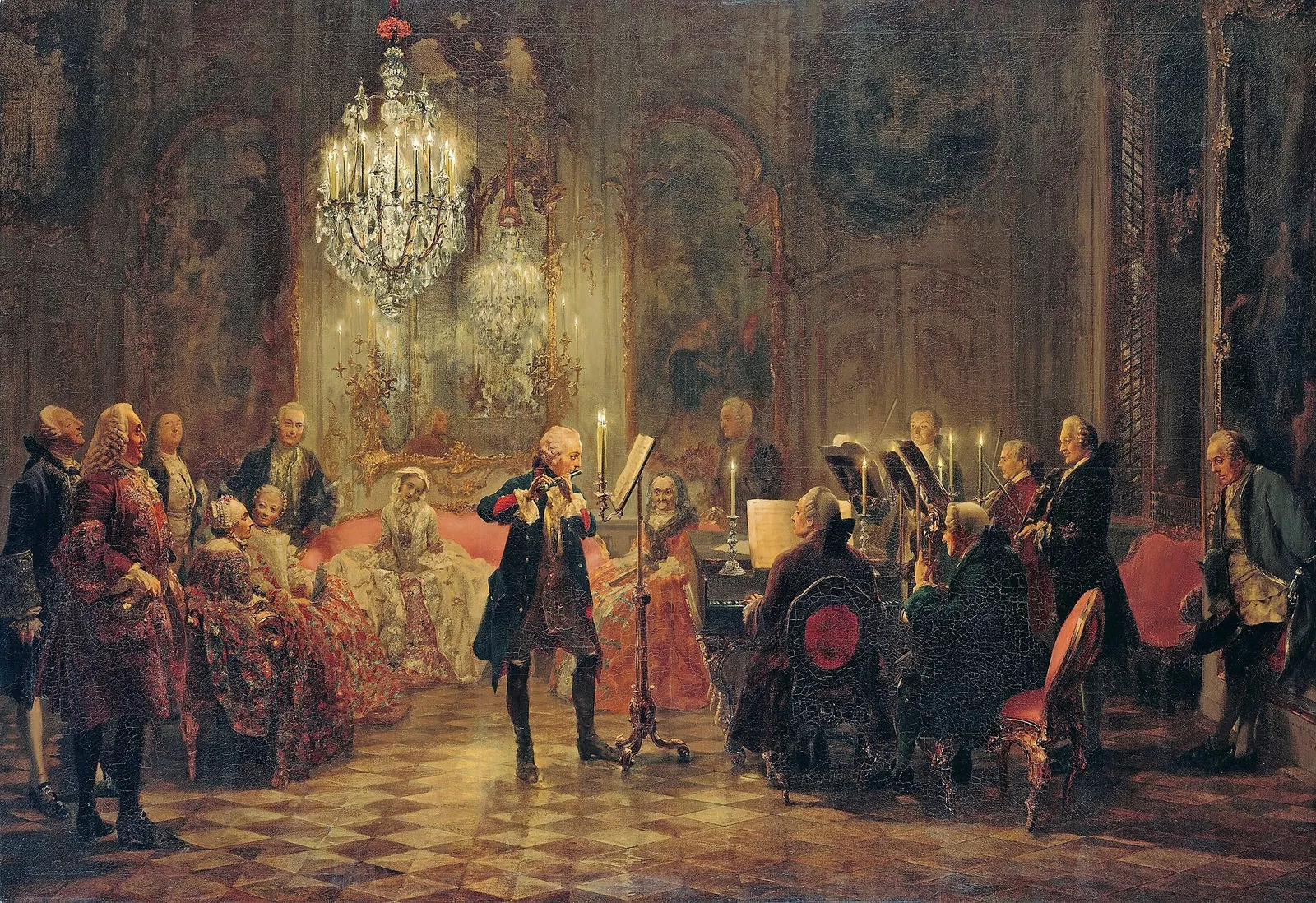
Adolph Menzel's Frederick the Great Playing the Flute at Sanssouci, dated 1852, is part of the collection of the Alte Nationalgalerie. The large canvas shows the Prussian king performing as a flautist at an evening concert in his palace, lit by candlelight. It reconstructs an 18th-century scene in the 19th century, and much of its effect comes from how Menzel handles light.
Where to see it
The painting is held by the Alte Nationalgalerie, which is also given as its location. Display arrangements can change because of rehangings, conservation or loans, so check the Alte Nationalgalerie's official website for current display status, opening hours and ticket information before you visit.
What to look for in person
Candlelight as the Main Subject
Start with the light rather than the people. A chandelier and candles provide the only illumination, and Menzel lets it fall unevenly across the room. Look at how it catches gilded rococo ornament, mirrors and wall surfaces with small, quick touches of paint, while corners and parts of the audience slip into shadow. Stepping back helps: from a distance the flickers resolve into a convincing warm glow. Up close, notice how loosely many of these highlights are painted compared with the careful construction of the room itself.
The King as Performer
Frederick stands in the brightest area, flute raised, reading from a music stand. Menzel presents him here not on a battlefield or throne but as a musician absorbed in playing, which was a well-known side of the king's life. Notice that he is placed slightly off-centre rather than in a formal state-portrait pose. The musicians accompanying him and the seated listeners all orient themselves toward him, so the composition guides your eye to the flute even though the room is full of other detail.
Faces in the Audience
Spend time on the listeners and accompanists, each given a distinct posture and expression. Some lean in attentively, others appear lost in thought, and a figure standing near the right edge seems to follow the performance closely. The harpsichordist is commonly identified as Carl Philipp Emanuel Bach, who served at Frederick's court, and the standing man at right as the king's flute teacher Johann Joachim Quantz. Comparing these reactions gives the scene the feel of a single observed moment rather than a staged group portrait.
About the painting
Adolph Menzel completed this painting in 1852, and it measures 142 by 205 centimetres, a size that lets the music room read almost at life scale when you stand before it. The subject is Frederick II of Prussia, known as Frederick the Great, who was a keen flautist and composer and held regular evening concerts at Sanssouci, his palace. Menzel was born decades after the king's death, so the scene is a historical reconstruction rather than something he witnessed. Before turning to oil paintings of Frederick's life, Menzel had become closely associated with the king as a subject through his extensive illustrations for Franz Kugler's history of Frederick, work that required close study of 18th-century costume, interiors and personalities. That research shows in the convincing period detail of this canvas. What distinguishes the picture from many history paintings of its time is its quiet, informal mood. Instead of a heroic or ceremonial event, Menzel chose a private cultural occasion and made artificial light the real protagonist. The handling of candlelight, with its scattered reflections and soft shadows, is often cited as one of the most striking aspects of his painting. For visitors, the work rewards a two-step approach: view it first from across the room to take in the overall glow and arrangement of figures, then move closer to examine the brushwork in the chandelier, the gilded decoration and the faces of the audience. It forms part of a group of paintings Menzel devoted to episodes from Frederick's reign.
Key facts
| Artist | Adolph Menzel |
|---|---|
| Date | 1852 |
| Size | 142 × 205 cm |
| Medium | oil paint, canvas |
| Collection | Alte Nationalgalerie |
How to visit: Alte Nationalgalerie
Berlin, Germany
Hours and prices can change. Please check the official website before you go.
