Art! Art! Art! › Works
Et in Arcadia ego
 Nicolas Poussin, 1638
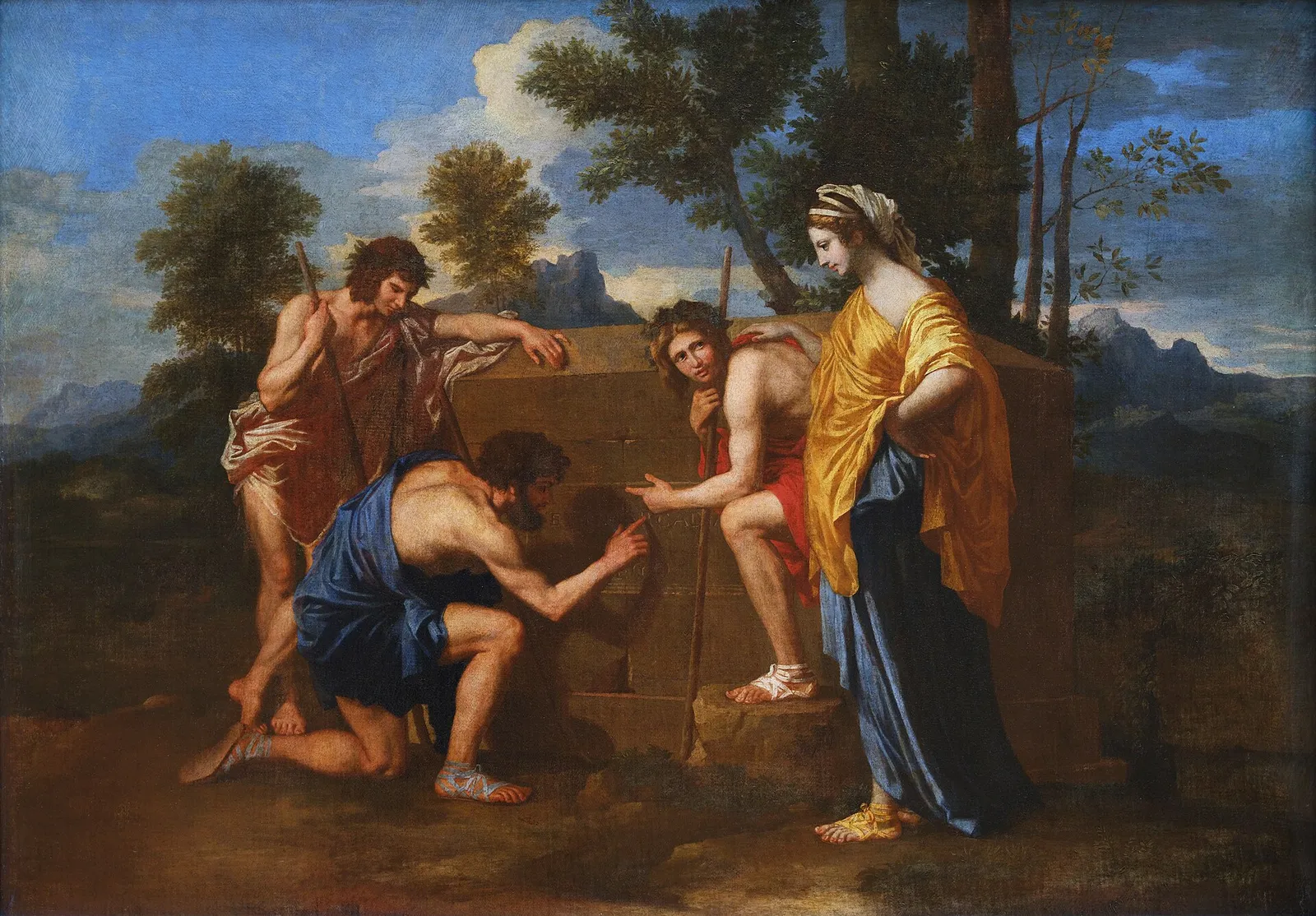
Nicolas Poussin's Et in Arcadia ego, also known as The Arcadian Shepherds, is held by the Department of Paintings of the Louvre in Paris. Painted in 1638, it shows three shepherds and a woman gathered around a stone tomb, puzzling over the words carved on it. It is a quiet, carefully balanced picture that rewards slow looking.
Where to see it
The painting belongs to the Department of Paintings of the Louvre in Paris, and the museum's records list it in Room 825. Displays change and works are sometimes moved or lent, so check the Louvre's official website for current display status, opening hours and ticketing before you visit. The canvas measures 85 cm high and 121 cm wide, a modest size, so allow time to stand close enough to read the inscription and study the figures' gestures.
What to look for in person
The finger on the inscription
Start with the kneeling shepherd at the centre of the group. He leans toward the face of the tomb and traces the carved letters with his index finger, as if spelling them out for the first time. Follow the line of his arm and you will see how the whole composition guides your eye to the words 'Et in Arcadia ego'. Then look at his companions, who lean in or turn toward one another, so that the act of reading becomes a shared moment of discovery rather than a private one.
A figure drawn from ancient sculpture
Take a step back and look at the woman standing among the shepherds. Her figure is based on an ancient statue known as the 'Cesi Juno', and once you know this, her calm posture and the weighty fall of her drapery read almost like marble brought to life. Compare her stillness with the more active poses of the men around her. The contrast is typical of Poussin, who often looked to classical sculpture to give his figures dignity and clarity, and it helps anchor the group visually.
Wreaths, staffs and a missing skull
Look at the details that set the scene: the shepherds wear wreaths and carry staffs, and the group is placed in front of a rocky background that frames the tomb. What you will not find is a skull. Poussin painted this subject twice, and in the earlier version, now at Chatsworth House in Derbyshire, a skull appears. Its absence here shifts attention away from a blunt symbol of death and toward the figures themselves and the inscription they are trying to understand.
About the painting
Et in Arcadia ego is an oil painting on canvas by the French artist Nicolas Poussin, dated 1638 in the museum's record. It is also known by the title The Arcadian Shepherds, or Les Bergers d'Arcadie in French. The canvas measures 85 by 121 cm.
The subject is a pastoral one: in the idealised countryside of Arcadia, a group of shepherds and a woman come upon a large stone tomb bearing the Latin words 'Et in Arcadia ego'. The same inscription had already appeared in an earlier painting of the theme by Guercino. Poussin returned to the subject more than once, and the Louvre picture is the second of his two versions; the first is at Chatsworth House in Derbyshire. The later composition is calmer and more ordered, and it omits the skull seen in the Chatsworth painting.
How to read the inscription has long interested viewers. Poussin's biographer André Félibien understood it to mean that the person buried in the tomb had once lived in Arcadia, a reading that turns the scene into a reflection on a life now ended in a place associated with happiness.
The painting has a distinguished history of ownership. It first belonged to Cardinal Giulio Rospigliosi, who later became pope. In 1685 it entered the collection of King Louis XIV of France, and it is now part of the Department of Paintings of the Louvre in Paris.
Key facts
| Artist | Nicolas Poussin |
|---|---|
| Date | 1638 |
| Size | 85 × 121 cm |
| Medium | oil paint, canvas |
| Collection | Department of Paintings of the Louvre |
| Gallery | Room 825, Richelieu wing, level 2 Checked in the museum's open data on 2026-11-12 (galleries can change) Source |
How to visit: Louvre Museum
Paris, France · Museum guide
| Opening hours | Mon, Thu, Sat, Sun 09:00–18:00 Wed, Fri 09:00–21:00 (evening opening) Rooms are cleared 30 minutes before closing |
|---|---|
| Closed | Every Tuesday; 1 January, 1 May and 25 December. Other public holidays are open unless they fall on a Tuesday. |
| Last entry | 1 hour before closing |
| Admission | Adult (non-EEA visitors) EUR 32 Adult (EEA citizens and residents) EUR 22 Under 18 free (ID required) EEA citizens/residents under 26 free (photo ID; residents also need a residence permit of over 90 days) Audio guide rental EUR 6 (can be booked in advance online) Rates apply from 14 January 2026 |
| Free entry | Free for under-18s, EEA citizens/residents under 26, all visitors on the first Friday of the month after 18:00 (except July and August) and on 14 July, and disabled visitors plus one carer. Also free with proof for EEA art and art-history teachers, ICOM members, journalists, EEA job seekers and EEA residents on income support. |
| Booking | Entry is by timed slot, and booking in advance is recommended. |
The Cour Carrée entrance is currently closed. On Thursday 12 November 2026 the museum may open later and some exhibition rooms may remain closed.
Official ticket page
Official website
View on map
Hours and prices can change. Please check the official website before you go. (Checked on: 2026-11-11)
More by Nicolas Poussin

Sources
- Wikidata Q1140358
- Wikipedia (ja) (CC BY-SA 4.0)
- Wikipedia (es) (CC BY-SA 4.0)
- www.louvre.fr
- contact.louvre.fr