Art! Art! Art! › Works
A Dance to the Music of Time
 Nicolas Poussin, 1630s
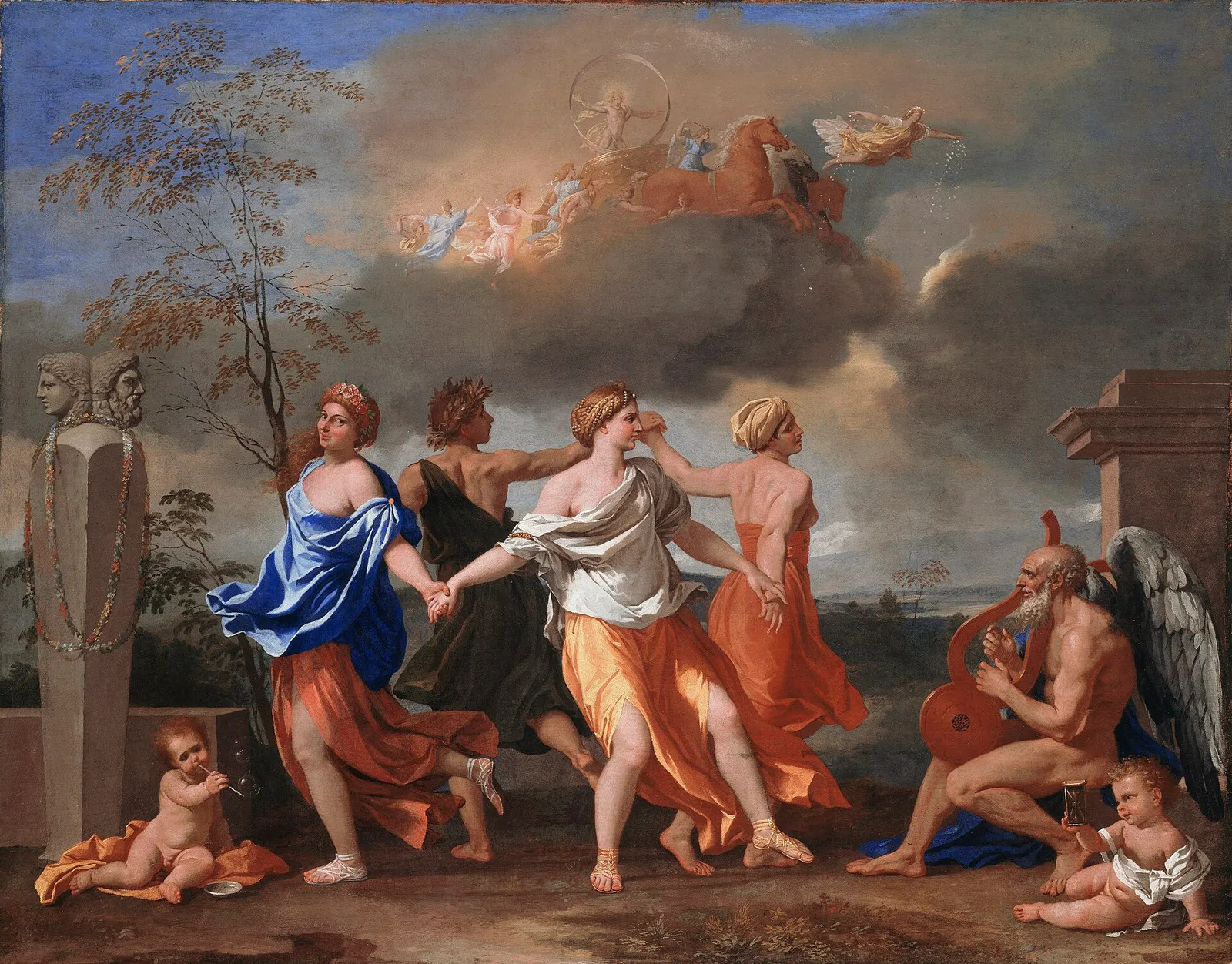
Nicolas Poussin's A Dance to the Music of Time is in the Wallace Collection. Painted in the 1630s, it shows a ring of dancers moving to music played by the winged figure of Time, a compact meditation on change and the turning of fortune.
Where to see it
A Dance to the Music of Time belongs to the Wallace Collection, and the fact sheet gives its location as the Wallace Collection. Display arrangements can change, so check the museum's official website for current display status, opening hours and visitor information before you go. The canvas measures 82.5 x 104 cm, a modest size, so expect to step close to read the details.
What to look for in person
The circle of dancers
Start with the four figures at the centre, holding hands as they turn in a ring. Their faces and gestures differ, and their clothing shifts in colour and texture from one to the next. They are traditionally read as stages in a cycle of human fortune. Notice how Poussin balances the group: some figures face you while others turn away, and that alternation sets up the sense of rotation. Follow the linked hands around the circle and the composition seems to keep moving.
Time and his reminders
To the right sits an old, bearded, winged man playing a lyre. This is Father Time, and the dance follows his music. Look at the small children placed near the edges. One holds an hourglass, a familiar emblem of passing time. Another, on the left, blows bubbles, an image long linked with how fragile and brief life is. Nearby stands a stone herm with two faces, one young and one old, looking toward both past and future. Taken together, these props spell out the painting's theme quietly, without any text.
The procession in the sky
Raise your eyes above the dancers. Across the upper part of the canvas, the sun god Apollo drives his chariot through the clouds, led by a female figure strewing flowers, generally identified as Aurora, the dawn. A ring of figures accompanies the chariot. This heavenly procession echoes the circle below: the daily course of the sun mirrors the endless round of human life. Compare the warm, glowing light of the sky with the more grounded colours of the landscape and figures beneath it.
About the painting
Nicolas Poussin, the French painter who spent most of his working life in Rome, painted A Dance to the Music of Time in the 1630s. In this period he often turned to classical mythology and allegory, building carefully ordered compositions in which every figure and object carries meaning. The painting is an allegory rather than a story: there is no single event, but an idea made visible, that human life moves in a cycle governed by time. The dancing group is traditionally explained, following an early account of the picture, as personifications of conditions such as Poverty, Labour, Wealth and Pleasure, each leading to the next in an endless round. Around them, Poussin adds the winged figure of Time with his lyre, children with an hourglass and bubbles, and a two-faced herm, all familiar symbols of passing time and transience. Overhead, Apollo's chariot crosses the sky, linking the human cycle to the rhythm of day and night. The painting is generally associated with Cardinal Giulio Rospigliosi, later Pope Clement IX, a patron of Poussin who is often credited with devising the subject. For visitors, the pleasure lies in the clarity of the design. The canvas measures 82.5 x 104 cm, so the figures are small, and the work rewards slow looking: the rhythm of the hands, the varied poses, the contrast between the earthly dance and the celestial procession. The painting later gave its title to Anthony Powell's twelve-volume novel sequence, which opens with a description of the picture.
Key facts
| Artist | Nicolas Poussin |
|---|---|
| Date | 1630s |
| Size | 82.5 × 104 cm |
| Medium | oil paint, canvas |
| Collection | Wallace Collection |
How to visit: Wallace Collection
London, United Kingdom
Hours and prices can change. Please check the official website before you go.
