Art! Art! Art! › Works
Venus and Cupid
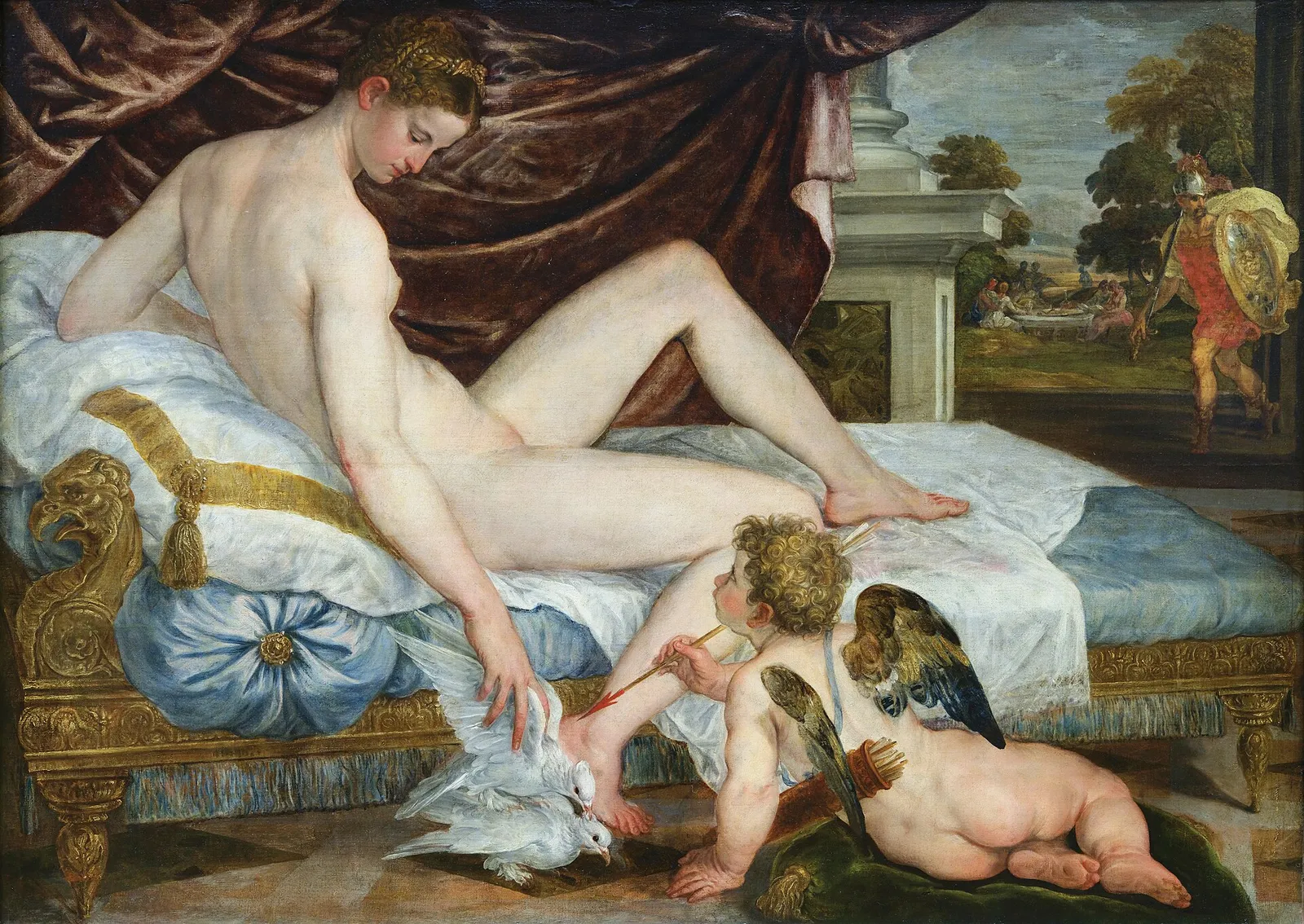
Venus and Cupid is an oil on canvas by Lambert Sustris, painted in the 1550s while he worked as an assistant in Titian's studio. It belongs to the Department of Paintings of the Louvre, which records its location as the Salle des États. Look for the goddess on her bed, a pair of doves under Cupid's arrow and Mars approaching from the distance.
Where to see it
Venus and Cupid is held by the Department of Paintings of the Louvre, and its recorded location is the Salle des États, Louvre. Displays can change because of rehanging, conservation or loans, so check the Louvre's official website for the painting's current display status before you visit. When planning your route, you can search the museum's collection database using the inventory number INV 1978.
What to look for in person
Venus, the doves and Cupid's arrow
Start with the left side of the canvas, where Venus lies nude and half-reclining on a bed. Her hand rests on two doves, and the birds are shown trying to mate. Next to her, Cupid, nude and winged with a quiver, holds an arrow ready to prick the male dove. Follow the line from the goddess's hand to the birds and then to the arrow's point. This small, carefully staged action sits at the centre of the picture's subject, so it is worth looking at closely before you step back.
A curtain that splits the scene
Step back and notice how a reddish curtain divides the composition. To the left, Venus fills almost the whole space, so her body and bed command the foreground. To the right, the picture opens out into a different area. Watch how the curtain controls where your eye travels. It frames the goddess as the main subject, then lets your gaze move past her into the depth of the scene. Seen from a few metres away, this division is one of the clearest ways to read the painting.
Mars and the banquet beyond
Take time with the background, where the details are easy to miss. Mars, the god of war, is shown approaching to join Venus, which links the distant figure to the goddess in the foreground. Further back, you can make out couples seated at a banquet. These small figures add a second, social scene that echoes the theme of love in the front of the picture. Moving your eye from the nearby figures to the far ones shows how Sustris builds the story in layers of depth.
About the painting
Lambert Sustris painted Venus and Cupid in the 1550s. He made it during the period when he worked as a studio assistant to Titian, so the picture comes from that workshop environment. It is an oil on canvas of a substantial size, 132 cm high and 184 cm wide. The wide horizontal format suits its subject: a reclining goddess on the left and a scene that opens into depth on the right, with Mars on his way and banqueting couples in the distance.
The painting's history before it reached the Louvre involves several notable owners. Nicolas Fouquet acquired it from the collector Everhard Jabach. After Fouquet's fall from power, the work was placed in the keeping of the painter Charles Le Brun in 1662. Nine years later, in 1671, it was taken into the French royal collection of Louis XIV. That royal ownership is why the picture is now among the holdings of the Department of Paintings of the Louvre, where it carries the inventory number INV 1978.
For visitors, the painting rewards slow looking. The main action is a small gesture: Cupid aiming his arrow at a dove that Venus is stroking. The reddish curtain divides the canvas and guides the eye from the goddess to the background figures. If you see it in person, look first at the foreground group, then let the curtain lead you across to the right side and into the distance.
Key facts
| Artist | Lambert Sustris |
|---|---|
| Date | 1550s |
| Size | 132 × 184 cm |
| Medium | oil paint, canvas |
| Collection | Department of Paintings of the Louvre |
How to visit: Louvre Museum
Paris, France · Museum guide
| Opening hours | Mon, Thu, Sat, Sun 09:00–18:00 Wed, Fri 09:00–21:00 (evening opening) Rooms are cleared 30 minutes before closing |
|---|---|
| Closed | Every Tuesday; 1 January, 1 May and 25 December. Other public holidays are open unless they fall on a Tuesday. |
| Last entry | 1 hour before closing |
| Admission | Adult (non-EEA visitors) EUR 32 Adult (EEA citizens and residents) EUR 22 Under 18 free (ID required) EEA citizens/residents under 26 free (photo ID; residents also need a residence permit of over 90 days) Audio guide rental EUR 6 (can be booked in advance online) Rates apply from 14 January 2026 |
| Free entry | Free for under-18s, EEA citizens/residents under 26, all visitors on the first Friday of the month after 18:00 (except July and August) and on 14 July, and disabled visitors plus one carer. Also free with proof for EEA art and art-history teachers, ICOM members, journalists, EEA job seekers and EEA residents on income support. |
| Booking | Entry is by timed slot, and booking in advance is recommended. |
The Cour Carrée entrance is currently closed. On Thursday 12 November 2026 the museum may open later and some exhibition rooms may remain closed.
Official ticket page
Official website
View on map
Hours and prices can change. Please check the official website before you go. (Checked on: 2026-11-11)
Sources
- Wikidata Q2513064
- Wikipedia (en) (CC BY-SA 4.0)
- Wikipedia (it) (CC BY-SA 4.0)
- Wikipedia (fr) (CC BY-SA 4.0)
- Wikipedia (nl) (CC BY-SA 4.0)
- www.louvre.fr
- contact.louvre.fr