Art! Art! Art! › Works
The Window at La Goulette
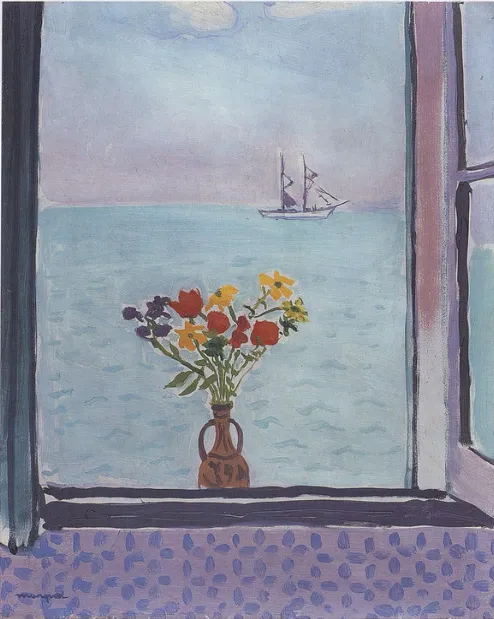
The Window at La Goulette is a 1926 painting by Albert Marquet in the collection of the Musée des Beaux-Arts de Bordeaux. It is a small, upright picture, 41.1 cm high and 32.5 cm wide, and its title names La Goulette, the port town on the coast near Tunis. It belongs to the window views that Marquet returned to again and again throughout his career.
Where to see it
The Window at La Goulette is held by the Musée des Beaux-Arts de Bordeaux, in Bordeaux, France. Works in museum collections are not always on show, because they may be rotated, in storage, under conservation or lent elsewhere. Before you plan a visit around this painting, check the Musée des Beaux-Arts de Bordeaux's official website or contact the museum directly to confirm whether it is currently on display.
What to look for in person
A view framed by a window
As the title signals, the picture is organised around a window. Marquet often painted from an interior looking out, so that the window's edges, frame or sill become part of the composition and separate the room from the world beyond. In front of the painting, notice how the near elements frame the distant view and how the eye passes from inside to outside. Ask yourself how much of the room Marquet chooses to show and how much he leaves out, and how that choice affects the sense of looking out from a fixed spot.
An intimate, upright format
At 41.1 by 32.5 centimetres, this is a modest painting, taller than it is wide. The vertical shape suits a window view, echoing the proportions of the opening itself rather than the wide sweep of a panorama. Its size invites you to step close. From near, you can study how the surface is handled; from a few steps back, you can see how the main shapes and tones hold together. Trying both distances is a good way to understand how a small canvas can still convey a sense of open space.
Light and a restrained palette
Marquet is known for simplified forms and a carefully limited range of colour, especially in his views of harbours and water. Rather than looking for fine detail, look at how broad areas of tone describe light, air and distance. Pay attention to the relationship between the darker foreground and the lighter view beyond, and to how few elements are needed to suggest a place. This economy of means is one of the qualities most often associated with his landscapes and port scenes, and it rewards slow, careful looking.
About the painting
Albert Marquet (1875–1947) was a French painter associated early in his career with the Fauves, the group around Henri Matisse whose strong colour caused a stir in Paris in the first decade of the twentieth century. Over time Marquet developed a quieter, more restrained manner, and he became especially known for views of ports, rivers and coastlines, many of them painted from a window or a raised vantage point. He travelled widely, and North Africa was among the places that drew him, which is where La Goulette comes in: it is a port on the Tunisian coast, close to Tunis. The Window at La Goulette, dated 1926, fits within this long-running interest. The window motif allowed Marquet to combine an interior viewpoint with an open view, and to study light and atmosphere in a controlled, framed setting. The painting's small, vertical format is typical of the intimate scale at which he often worked. Today the painting belongs to the Musée des Beaux-Arts de Bordeaux. Marquet was born in Bordeaux, which gives the work an added local resonance for visitors to the city. When you visit, it is worth seeing the painting as part of a broader conversation about how early modern French painters treated the view through a window, a subject that let artists explore the boundary between private space and the outside world. Because this page draws only on a short fact sheet, details such as the painting's medium, its exact subject matter and how it came to the museum are not given here; the museum itself is the best source for those.
Key facts
| Artist | Albert Marquet |
|---|---|
| Date | 1926 |
| Size | 41.1 × 32.5 cm |
| Medium | oil paint, panel |
| Collection | Musée des Beaux-Arts de Bordeaux |
How to visit: Musée des Beaux-Arts de Bordeaux
, France
Hours and prices can change. Please check the official website before you go.


