Art! Art! Art! › Works
The Vision to the Youth Bartholomew
 Mikhail Nesterov, 1880s
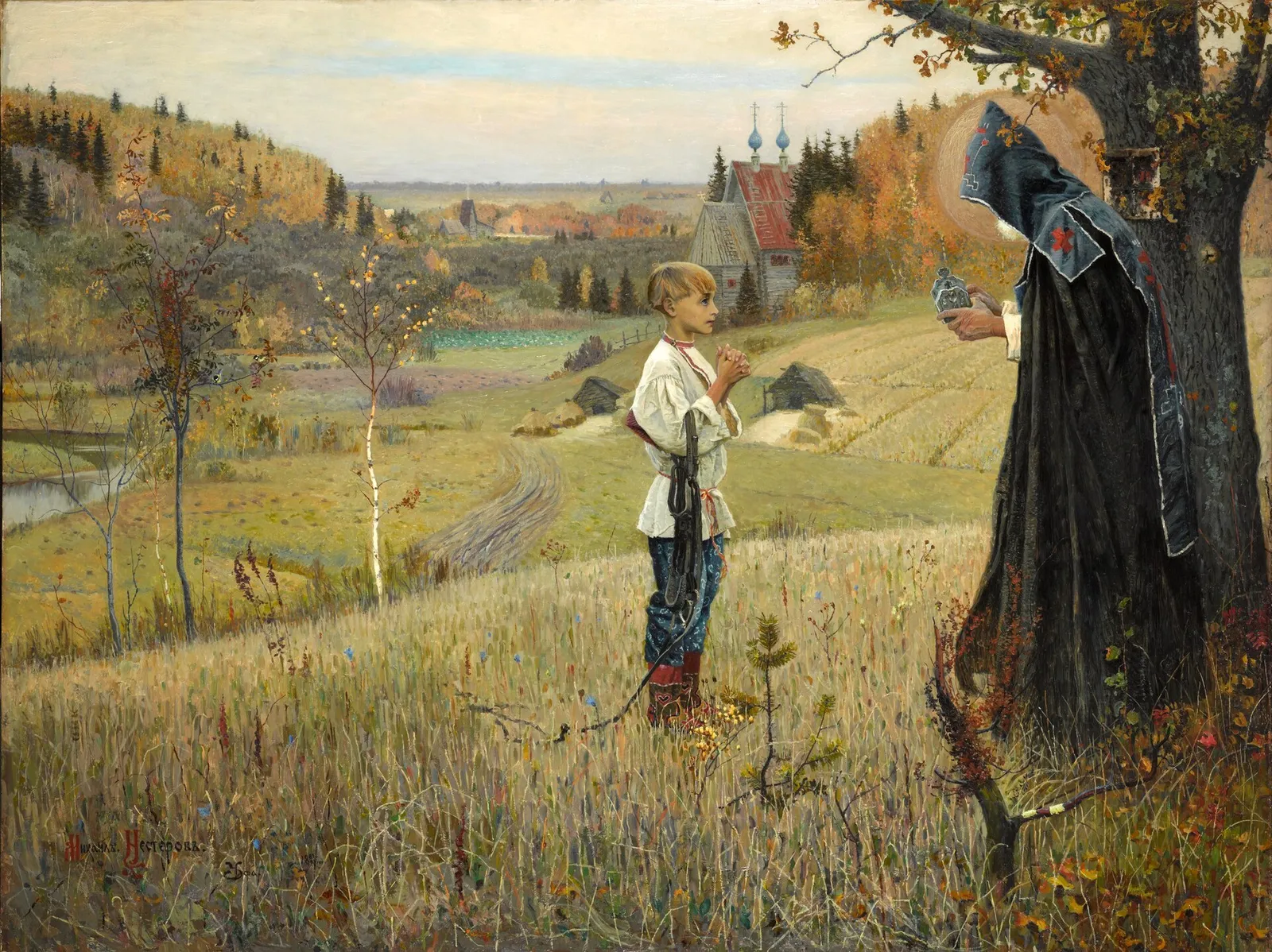
Mikhail Nesterov's The Vision to the Youth Bartholomew is held by the Tretyakov Gallery. Painted in the 1880s and measuring 160 by 211 centimetres, it shows a quiet encounter between a boy and a mysterious elder in an open northern landscape. Its strength lies in stillness rather than drama, so it rewards a slow look.
Where to see it
The painting is in the collection of the Tretyakov Gallery, which is also its listed location. The fact sheet does not give a room or display status, and works can be moved, rotated or lent. Check the Tretyakov Gallery's official website for current display information, opening hours and tickets before you plan your visit.
What to look for in person
The meeting under the tree
Begin with the two figures. On one side stands the young Bartholomew, the boy who, according to the traditional life of the saint, would later become Sergius of Radonezh. Facing him is a robed elder whose face is partly hidden by his hood, with a faint halo around the head. Notice how little action there is: no grand gestures, just a boy standing with folded hands before a holy stranger. Nesterov lets the meaning rest in posture and silence rather than in a dramatic event.
A landscape that carries the mood
Step back and let the landscape take over. Much of the large canvas is given to a gently rolling countryside of meadows, slender young trees and distant buildings, painted in muted, cool tones. Rather than serving as a backdrop, the land seems to share the stillness of the scene. Look at the thin trunks and the pale, open sky, and see how they echo the frailty and attentiveness of the boy. This blending of figure and setting into a single quiet mood is central to how the picture works.
The boy's face and hands
Move closer to study Bartholomew himself. His thin figure, wide eyes and slightly parted lips suggest wonder and absorption rather than fear. His clasped hands give him a prayerful, receptive air. Compare his rapt expression with the hidden, inward-looking elder: one is open and searching, the other withdrawn and mysterious. This contrast between the visible, earthly child and the half-concealed visitor is the emotional centre of the painting, and it is easy to miss from a distance.
About the painting
The Vision to the Youth Bartholomew is a work by the Russian painter Mikhail Nesterov, dated to the 1880s and now in the collection of the Tretyakov Gallery. At 160 by 211 centimetres, it is a substantial canvas, and its scale lets the landscape surround the viewer as much as the figures do. The subject comes from the traditional life of Saint Sergius of Radonezh, one of the most venerated saints in Russian Orthodox tradition, whose childhood name was Bartholomew. In the story, the boy, who has struggled to learn to read, meets a holy elder in the fields; after the encounter he is granted the understanding he had prayed for. Nesterov paints the moment of meeting itself, not a miracle in progress, which gives the picture its hushed, contemplative character. The painting is widely regarded as a key early work in Nesterov's approach to religious themes, in which spiritual feeling is expressed through a lyrical, often understated treatment of the Russian landscape. Instead of the gold backgrounds of icons or the theatrical staging of history painting, he places a sacred encounter in an ordinary countryside, inviting viewers to sense the holy within the everyday. For visitors, the work is best approached in two stages: first from a distance, to take in the harmony of land, sky and figures, and then up close, to read the faces, the hands and the delicate rendering of the trees and grasses. Allow time for both, as much of the painting's effect comes from details that only appear on a longer look.
Key facts
| Artist | Mikhail Nesterov |
|---|---|
| Date | 1880s |
| Size | 160 × 211 cm |
| Medium | oil paint, canvas |
| Collection | Tretyakov Gallery |
How to visit: Tretyakov Gallery
Moscow, Russia
Hours and prices can change. Please check the official website before you go.