Art! Art! Art! › Works
The Three Graces
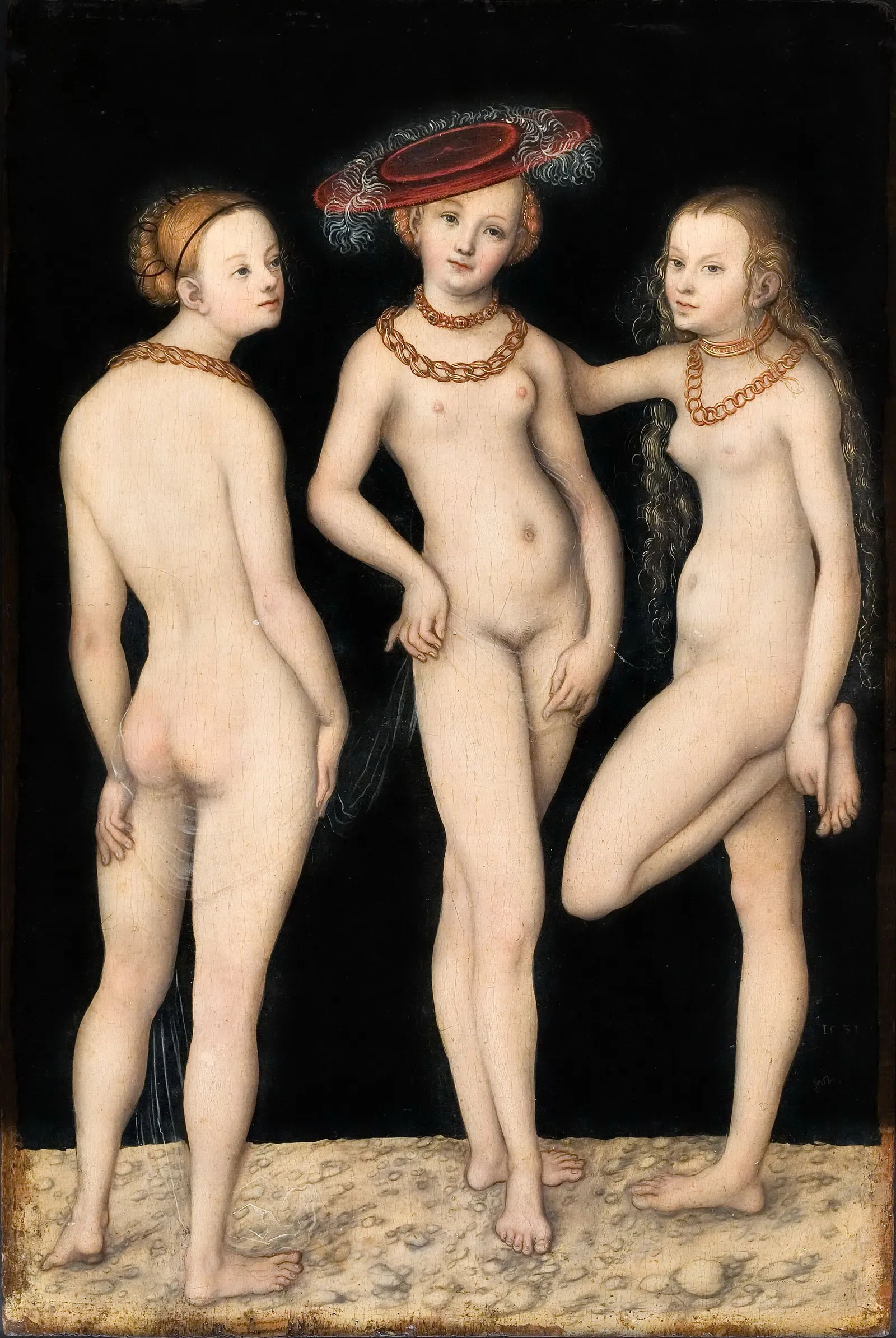
Lucas Cranach the Elder painted The Three Graces in 1531, a small panel showing the three mythological goddesses together. The work belongs to the Department of Paintings of the Louvre, which acquired it after a public fundraising campaign. At just 36 by 24 cm, it is a painting to study up close.
Where to see it
The Three Graces is held by the Department of Paintings of the Louvre. Collection records list its location as Room 810, a room associated with Lucas Cranach the Elder. Museum displays change because of rehangings, conservation work and loans, so check the Louvre's official website for the painting's current display status before you visit.
What to look for in person
Three Views of One Ideal
Cranach arranges the goddesses so that one is seen from the front, one from the side and one from the back. Let your eye travel across the group from left to right: the effect is close to walking around a single sculpted figure. Showing the Graces from several angles is a long-standing tradition in European art, and Cranach fits it onto a very small panel. Notice how the poses and gestures connect the three bodies, so that they read as one linked group rather than three separate figures.
A Painting to Approach Closely
At 36 cm high and 24 cm wide, this panel is not much larger than a sheet of office paper. It rewards a slow, close look rather than a glance from across the room. Cranach and his workshop were known for smooth surfaces and crisp, precise outlines, and the small format makes those qualities easy to see. If the room is busy, wait for a gap, then step in to study how the contours of the figures stand out against the background and how finely the skin is modelled.
Cranach's Distinctive Nudes
The slender, elongated bodies, small heads and gently swaying stances are hallmarks of Cranach's mature style. They differ clearly from the fuller, classically proportioned nudes painted in Italy during the same years. Cranach returned to mythological subjects many times, and he painted the Three Graces more than once. Other versions are dated 1530 and 1535. With that in mind, look at how this panel favours elegance and stylisation over anatomical realism, and how the figures seem designed to please a viewer at close range.
About the painting
In classical mythology the Three Graces were goddesses associated with beauty, charm and joy, and artists have long shown them as a group of three nude women. Lucas Cranach the Elder, a leading painter of the German Renaissance and court artist to the Electors of Saxony, painted this version in 1531. He treated the same theme on other occasions. A version dated 1530 is in a private collection, and one dated 1535 belongs to the Nelson-Atkins Museum of Art in Kansas City. The Louvre panel's modern history is unusual. The painting remained in private hands for a long time. It was declared a French national treasure, which meant it could not be exported. Its owners set a price of 4,000,000 euros and gave a deadline of the end of January 2011 for the sum to be raised. The Louvre covered three-quarters of the price from its own funds and with donations from two French companies. To find the remaining 1,000,000 euros, the museum launched a public appeal called "Tous mécènes" ("Everyone a patron") on 13 November 2010. About 7,000 people contributed, and the full amount was reached on 17 December 2010. The painting was first shown to the public in 2011 and was given the inventory number RF 2011-1. For visitors, that history adds another layer to the visit: this is a painting that thousands of members of the public helped to bring into a national collection.
Key facts
| Artist | Lucas Cranach the Elder |
|---|---|
| Date | 1531 |
| Size | 36 × 24 cm |
| Medium | oil paint, panel |
| Collection | Department of Paintings of the Louvre |
How to visit: Louvre Museum
Paris, France · Museum guide
| Opening hours | Mon, Thu, Sat, Sun 09:00–18:00 Wed, Fri 09:00–21:00 (evening opening) Rooms are cleared 30 minutes before closing |
|---|---|
| Closed | Every Tuesday; 1 January, 1 May and 25 December. Other public holidays are open unless they fall on a Tuesday. |
| Last entry | 1 hour before closing |
| Admission | Adult (non-EEA visitors) EUR 32 Adult (EEA citizens and residents) EUR 22 Under 18 free (ID required) EEA citizens/residents under 26 free (photo ID; residents also need a residence permit of over 90 days) Audio guide rental EUR 6 (can be booked in advance online) Rates apply from 14 January 2026 |
| Free entry | Free for under-18s, EEA citizens/residents under 26, all visitors on the first Friday of the month after 18:00 (except July and August) and on 14 July, and disabled visitors plus one carer. Also free with proof for EEA art and art-history teachers, ICOM members, journalists, EEA job seekers and EEA residents on income support. |
| Booking | Entry is by timed slot, and booking in advance is recommended. |
The Cour Carrée entrance is currently closed. On Thursday 12 November 2026 the museum may open later and some exhibition rooms may remain closed.
Official ticket page
Official website
View on map
Hours and prices can change. Please check the official website before you go. (Checked on: 2026-11-11)
Sources
- Wikidata Q3235872
- Wikipedia (en) (CC BY-SA 4.0)
- Wikipedia (ja) (CC BY-SA 4.0)
- Wikipedia (it) (CC BY-SA 4.0)
- Wikipedia (fr) (CC BY-SA 4.0)
- www.louvre.fr
- contact.louvre.fr