Art! Art! Art! › Works
The Third-Class Carriage
 Honoré Daumier, 1868
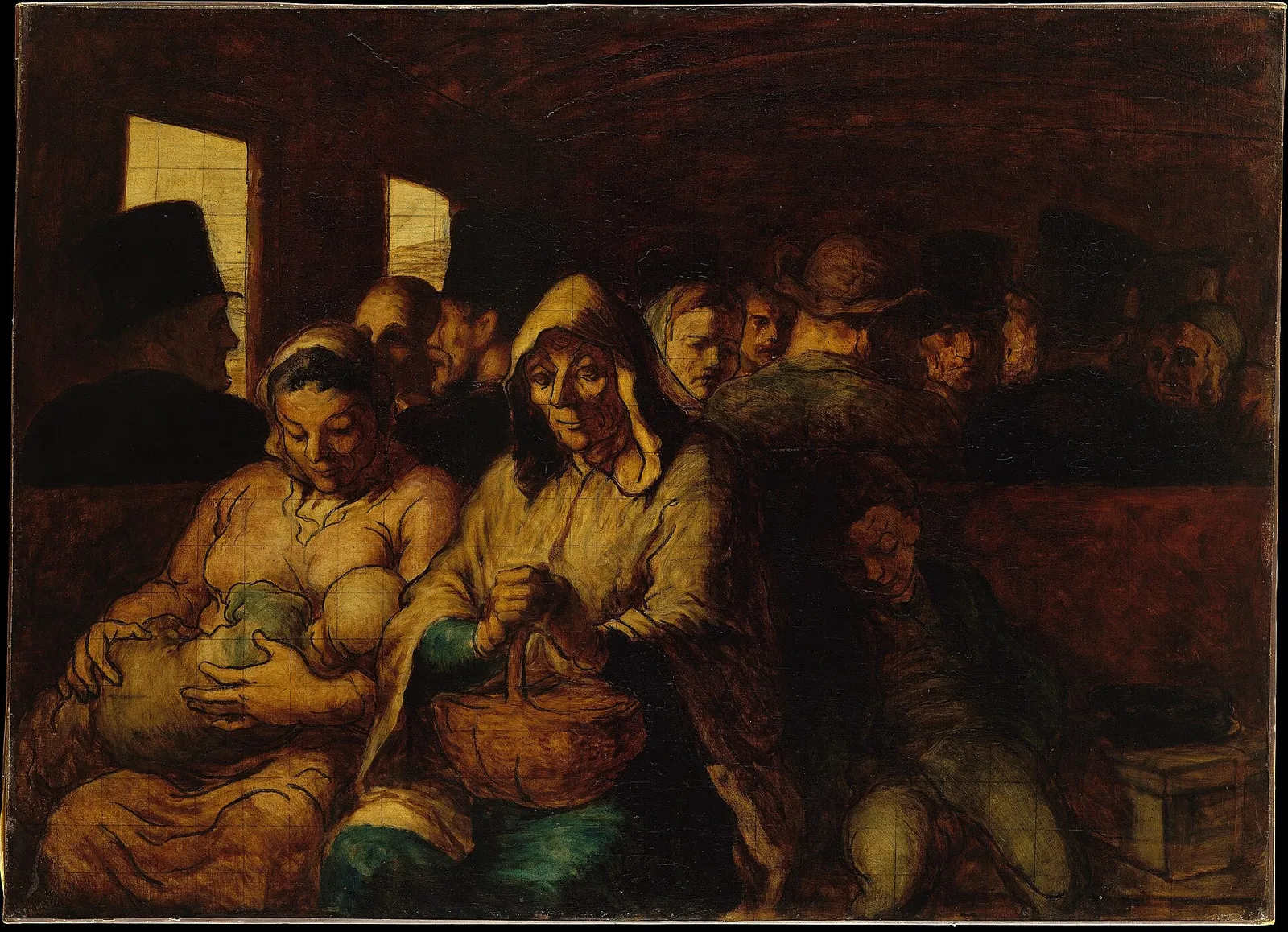
The Third-Class Carriage is Honoré Daumier's quiet, closely observed scene of ordinary passengers sharing a cramped railway compartment. It belongs to the Metropolitan Museum of Art, where visitors can study how a few hunched figures and a dim, crowded interior convey the experience of everyday travel in nineteenth-century France.
Where to see it
The Third-Class Carriage is in the collection of the Metropolitan Museum of Art, and that is where the painting is located. Display arrangements can change because of rehangs, conservation or loans, so check the Metropolitan Museum of Art's official website for current display status before you plan your visit.
What to look for in person
The family on the front bench
Start at the bottom of the canvas, where three figures sit closest to you: an older woman with her hands resting on a basket, a young mother holding an infant, and a boy slumped asleep beside them. Daumier gives them almost no conversation and very few gestures. Notice how their weight seems to sink into the hard wooden seat, and how the older woman's gaze turns inward rather than toward anyone around her. The group reads less as a portrait of particular people than as a study of patience and endurance on an ordinary journey.
The crowd packed in behind
Lift your eyes past the front bench and the carriage fills with passengers in rows that recede toward the back of the compartment. Many faces are only roughly indicated, some in profile, some turned away, and several men wear the hats and caps of city workers and tradespeople. Look at how the backs of the benches form horizontal bands that organise the crowd into layers. The effect is of people pressed physically together yet largely isolated, each absorbed in private thought, a mood Daumier explored often in his images of modern urban life.
Light, line and paint handling
Daylight enters through the windows along the upper part of the scene and falls unevenly across faces and shoulders, leaving much of the interior in warm, brownish shadow. Step closer to see how freely the paint is applied: contours are drawn with dark, searching lines, and forms are built up in broad patches rather than polished detail. This draughtsman's approach reflects Daumier's long career as a lithographer, where expressive line carried the meaning. At 65.4 by 90.2 centimetres, the canvas is modest in size, so it rewards viewing at close range as well as from a few steps back.
About the painting
Honoré Daumier is best known today for the thousands of lithographs he produced for French satirical newspapers, in which he mocked politicians, lawyers and the middle classes of Paris. Alongside this printed work he painted, largely away from public view, and his paintings share the sharp observation of his caricatures while setting aside their humour. The Third-Class Carriage, dated 1868 in the record used here, is one of his most familiar subjects. The railway was still a relatively new part of daily life in France, and the cheapest carriages carried working people, families and travellers of modest means. Daumier returned to railway compartments several times in prints, drawings and paintings, contrasting the different classes of travel. Here he concentrates on the poorest passengers. He does not dramatise their situation or tell a story; instead he records stillness, fatigue and the strange intimacy of strangers forced to sit side by side. For visitors, the painting is a useful example of how nineteenth-century artists began to treat ordinary modern life as a serious subject for painting, a concern shared by the Realist movement with which Daumier is often associated. The canvas measures 65.4 by 90.2 centimetres. When you stand in front of it, give yourself time to move between the three clearly defined figures in the foreground and the more summarily painted crowd behind them. That shift, from close, weighty presence to a dim mass of faces, is central to how the picture works, and it is easier to feel in person than in reproduction.
Key facts
| Artist | Honoré Daumier |
|---|---|
| Date | 1868 |
| Size | 65.4 × 90.2 cm |
| Medium | oil paint, canvas |
| Collection | Metropolitan Museum of Art |
| Gallery | Gallery 812 Checked in the museum's open data on 2026-11-12 (galleries can change) Source |
How to visit: Metropolitan Museum of Art
New York City, United States · Museum guide
| Opening hours | Sun, Mon, Tue, Thu 10:00–17:00 Fri, Sat 10:00–21:00 |
|---|---|
| Closed | Wednesdays; Thanksgiving Day, 25 December, 1 January and the first Monday in May |
| Admission | Adults USD 30 Seniors (65 and over) USD 22 Visitors with a disability (in person only) USD 22 Students USD 17 Children (12 and under) free Care partners of visitors with a disability (in person only) free New York State residents; NY, NJ and CT students: pay what you wish (minimum USD 0.01). Online requires a NY State billing address; NJ/CT students in person with student ID |
| Free entry | Free for children 12 and under, Members and Patrons, and care partners of visitors with a disability. Pay what you wish for New York State residents and NY/NJ/CT students. |
| Booking | No reservation is required and there is no timed entry. |
The Cantor Roof Garden, the Modern and Contemporary Galleries, and the Ancient West Asia and Ancient Cyprus Galleries are closed for renovation.
Official ticket page
Official website
View on map
Hours and prices can change. Please check the official website before you go. (Checked on: 2026-11-09)