Art! Art! Art! › Works
The Librarian
 Giuseppe Arcimboldo, 1556
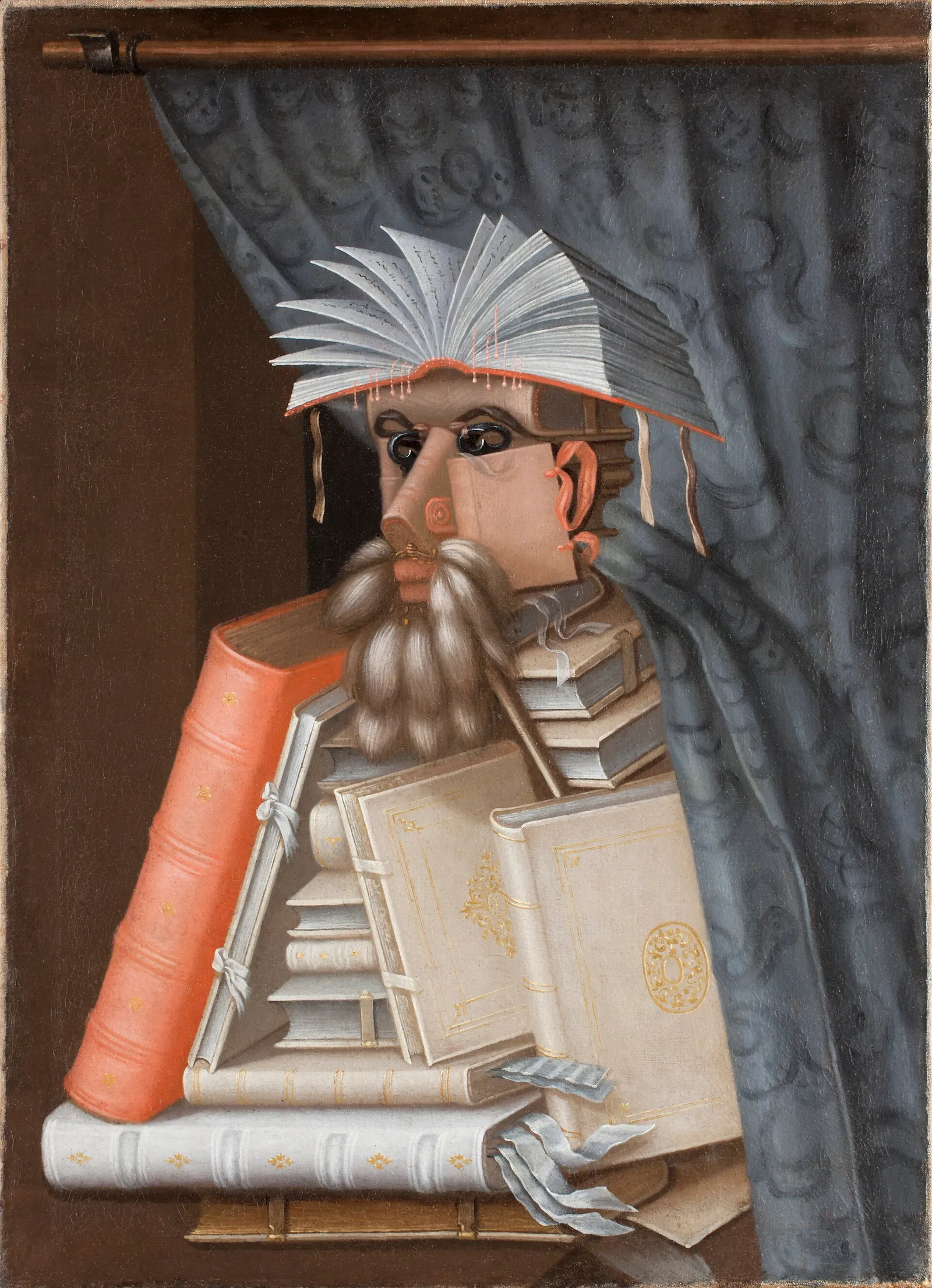
The Librarian is Giuseppe Arcimboldo's portrait of a figure made almost entirely out of books. It belongs to the collection of Skokloster Castle. From a distance it reads as a stiff, upright bust, and up close it breaks apart into volumes, pages and the everyday tools of a book room.
Where to see it
The Librarian is held by Skokloster Castle, which is listed as both its collection and its location. Display arrangements at historic houses can change because of conservation work, seasonal opening, guided-tour-only access or loans. Check Skokloster Castle's official website for current display status, opening hours, tour requirements and travel directions before you visit.
What to look for in person
A body stacked from books
Start by stepping back. At a normal viewing distance you should see a half-length figure with shoulders, chest and a raised head. Then move closer and watch the figure turn into stacked and propped volumes. Arcimboldo builds the torso and arms from closed books laid at different angles, so their spines and covers act as folds and contours. Notice how the shading on each book follows a single light source. That consistency is what lets the pile of objects hold together as one believable body.
The head and the open book
Look at the top of the figure, where an open book with fanned pages takes the place of hair. The curve of the pages imitates the volume of a head of hair or a cap, and the way they splay outward gives the figure a lively, slightly ruffled outline. Follow the face itself and try to find where the features come from. Arcimboldo usually chooses each object for its shape first, and part of the pleasure is identifying which item stands in for which feature.
Between portrait and joke
Ask how you react to the figure. It sits in the pose of a formal court portrait, yet it is made from the contents of a library. This double reading is central to Arcimboldo's composite heads. The painting rewards a wit that recognises both the person and the objects at once. Viewers have long read it as gently mocking a certain kind of learning: someone defined by owning or arranging books rather than by reading them. Consider whether you see satire, affection or simply a clever puzzle.
About the painting
Giuseppe Arcimboldo is best known for his composite heads, in which fruit, vegetables, animals, flowers or manufactured objects are arranged so that together they form a human likeness. These paintings sit at the meeting point of portraiture, still life and visual riddle. They depend on careful observation of each individual object and on the viewer's ability to switch between seeing the parts and seeing the whole. The Librarian applies this method to the world of scholarship. Instead of natural produce, Arcimboldo uses books and the furnishings of a study, and he turns the trappings of learning into the substance of a person. The fact sheet gives the painting's inception as 1556. This guide notes below that the date should be checked against the castle's own records. For visitors, the work is worth taking slowly. Begin far enough away to read it as a single figure, then move in and let it dissolve into objects, then step back again. Pay attention to how the painter handles edges. Where two books meet, the junction often doubles as an anatomical line, such as a shoulder, a jaw or the edge of a sleeve. The restrained colour of bindings and paper keeps the figure sober and dignified, which sharpens the humour of the concept. Seeing the painting at Skokloster Castle also places it in the setting of a historic collection rather than a modern white-walled gallery. Because access and display at such a site can vary, plan ahead using the castle's official information.
Key facts
| Artist | Giuseppe Arcimboldo |
|---|---|
| Date | 1556 |
| Size | 980 × 710 cm |
| Medium | oil paint, canvas |
| Collection | Skokloster Castle |
How to visit: Skokloster Castle
Håbo Municipality, Sweden
Hours and prices can change. Please check the official website before you go.