Art! Art! Art! › Works
The Immaculate Conception of Los Venerables
 Bartolomé Esteban Perez Murillo, 1660s
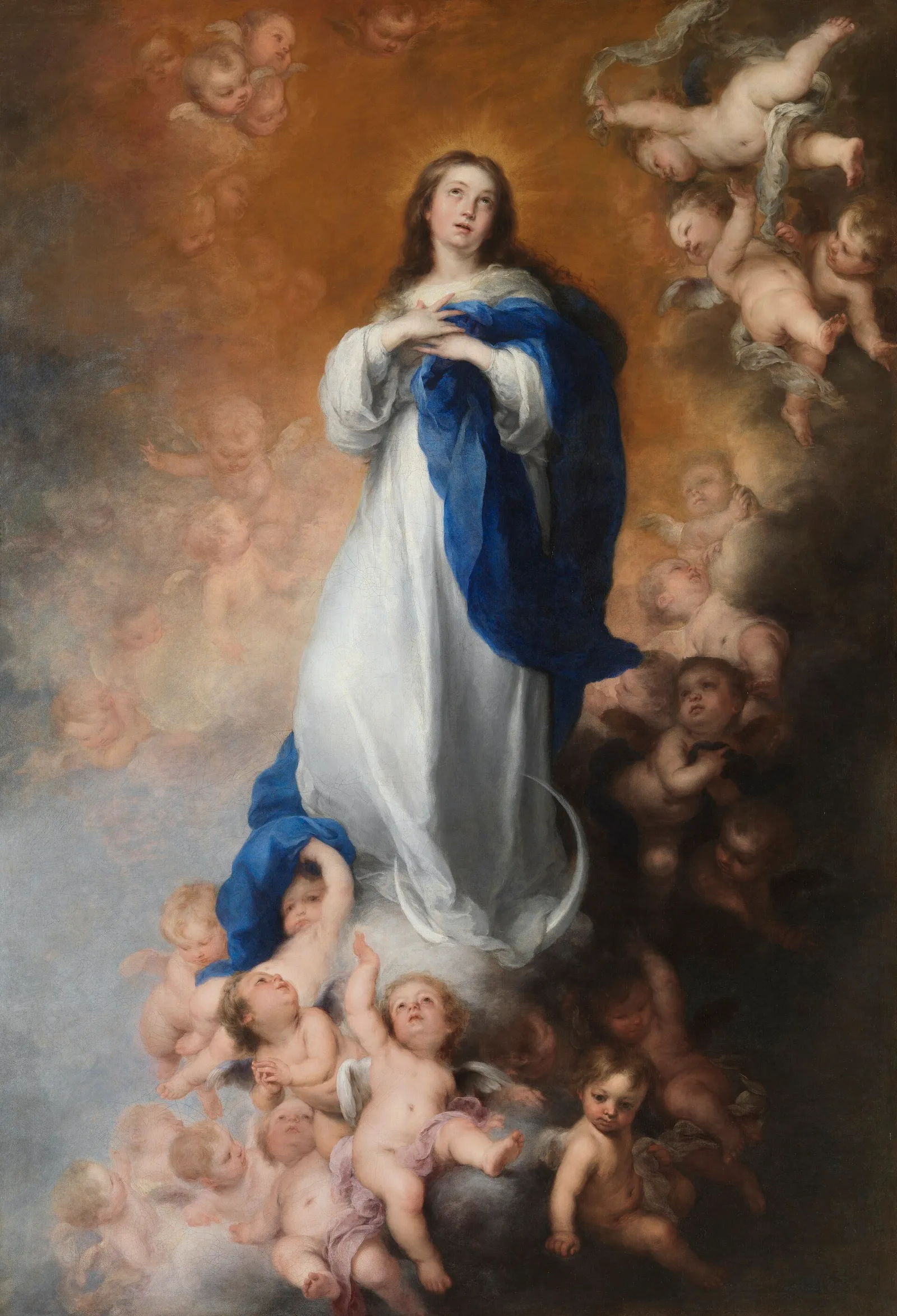
The Immaculate Conception of Los Venerables is a large altarpiece by the Seville painter Bartolomé Esteban Perez Murillo, dated to the 1660s. It belongs to the Museo del Prado, and in person its scale, at 274 by 190 cm, and its soft, glowing light are what most visitors notice first.
Where to see it
The painting is in the collection of the Museo del Prado in Madrid, Spain. The Prado holds one of the main collections of Spanish painting, so this work can be seen alongside other Spanish masters. Displays change and works are sometimes moved, so check the Museo del Prado's official website for current display status, opening hours and ticket information before you visit.
What to look for in person
The upward-gazing Virgin
Start with the figure of Mary at the centre. She stands in a white robe and a blue mantle, the colours traditionally linked to the Immaculate Conception, with her hands crossed over her chest and her eyes turned up toward the light. Notice how youthful and calm her face is. Murillo avoids hard outlines, so her features seem to dissolve gently into the surrounding glow. Step back and then come closer: the softness that reads as serenity from a distance becomes visible, loose brushwork up close.
A swirl of angels
Look below and around the Virgin at the crowd of small angels, or putti, tumbling through the clouds. Some are only faintly sketched into the haze, while others are fully modelled and seem to tip toward you. Several hold objects; take time to pick them out, since flowers and branches of this kind were used as symbols of Mary's purity. The way the angels cluster at the base and thin out toward the top helps carry your eye upward, reinforcing the sense that the whole group is rising.
Light, movement and scale
Notice how the composition seems to move. The blue mantle billows as if caught by a wind, and the figure is set slightly on a diagonal rather than standing stiffly upright. Behind her, warm golden light fills the sky instead of a defined setting, so there is no landscape to anchor the scene. At 274 by 190 cm, the canvas was designed to be read from below and from a distance, as an altarpiece would be. Try viewing it from several metres away to see the effect.
About the painting
Bartolomé Esteban Perez Murillo was one of the leading painters of seventeenth-century Seville, and images of the Immaculate Conception were among the subjects he returned to most often. The doctrine that Mary was conceived free from original sin was strongly championed in Seville in this period, and painters developed a recognisable way of showing it: a young Virgin in white and blue, set against a heavenly sky, often standing above a crescent moon and surrounded by angels. Murillo's versions became especially popular and helped fix this image in the minds of viewers in Spain and beyond. This painting, dated to the 1660s in the fact sheet used here, takes its name from the Hospital de los Venerables in Seville, a residence for elderly priests for which it was made. Its later history is part of its story. The work was removed from Spain during the Napoleonic period and entered French hands, later hanging in the Louvre in Paris for many years before it returned to Spain through an exchange between the two countries and came to the Museo del Prado. Because of this, it is also sometimes referred to by the name of the French marshal associated with its removal, Soult. For visitors, the painting is a clear example of Murillo's mature manner: warm, diffused light, soft transitions between forms, and a gentle, approachable sense of devotion rather than drama. It rewards slow looking, both for the overall upward movement of the composition and for the many small details among the angels and clouds.
Key facts
| Artist | Bartolomé Esteban Perez Murillo |
|---|---|
| Date | 1660s |
| Size | 274 × 190 cm |
| Medium | oil paint, canvas |
| Collection | Museo del Prado |
How to visit: Museo del Prado
Madrid, Spain · Museum guide
| Opening hours | Mon–Sat 10:00–20:00 Sun and public holidays 10:00–19:00 6 Jan, 24 Dec, 31 Dec 10:00–14:00 (limited opening) |
|---|---|
| Closed | Closed on 1 January, 1 May and 25 December. |
| Last entry | Last entry 30 minutes before closing; visitors are asked to leave the galleries 10 minutes before closing. |
| Admission | General EUR 15 (includes the Collection and temporary exhibitions) Reduced (over 65, youth card holders, members of large families) EUR 7.5 Under 18, students aged 18–25, people with a disability of 33% or more, and other listed groups: free (official proof required at the ticket office on the day) Audio guide EUR 5 (added to the ticket; over 250 works in 15 languages) |
| Free entry | The Collection is free during the last two hours before closing (tickets at the ticket office, subject to capacity; 50% off temporary exhibitions). Always free for under-18s, students aged 18–25 and other listed groups with official proof at the ticket office. |
| Booking | Entry is by timed ticket. |
Official ticket page
Official website
View on map
Hours and prices can change. Please check the official website before you go. (Checked on: 2026-11-11)