Art! Art! Art! › Works
The Hay Wain
 John Constable, 1821
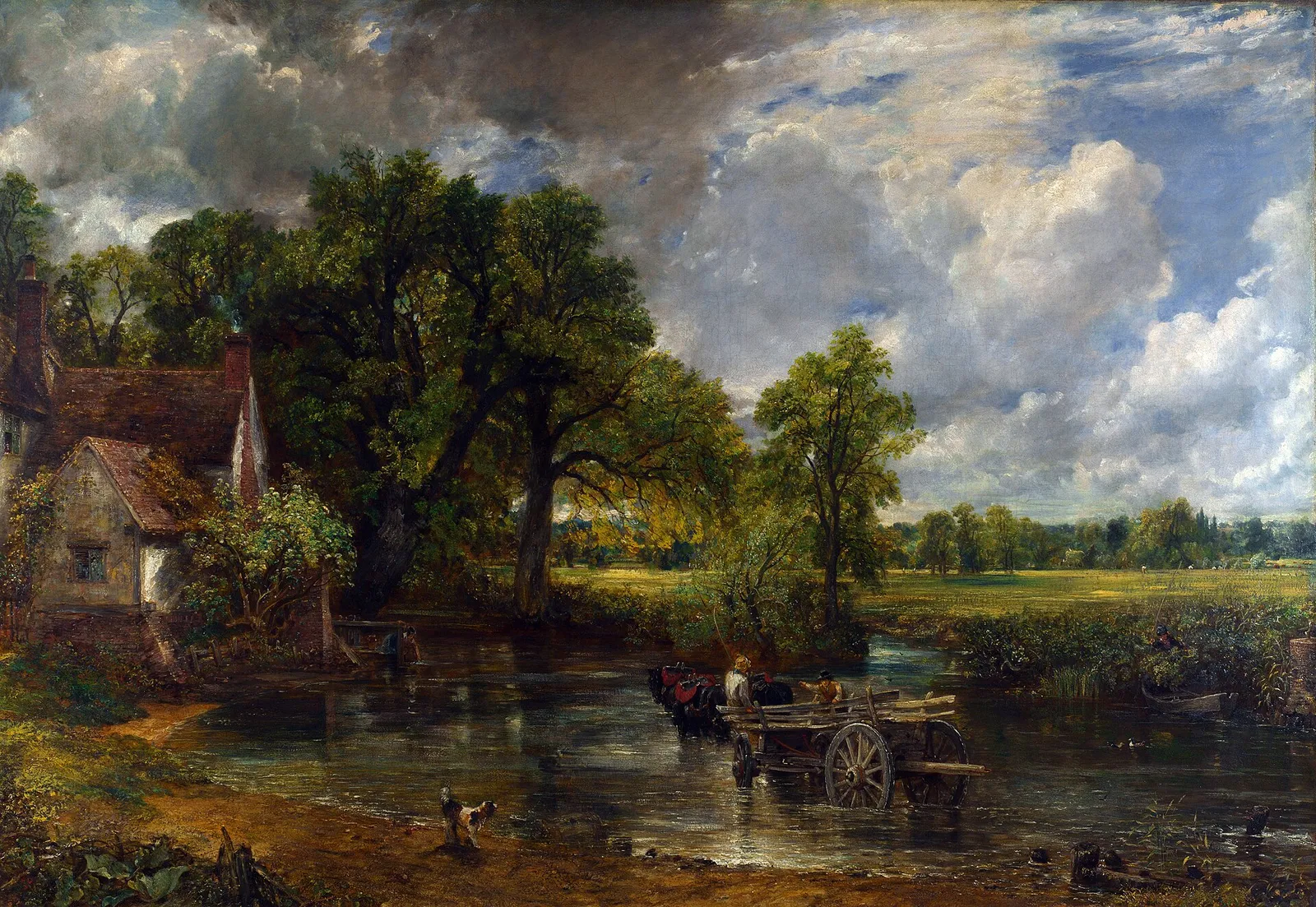
The Hay Wain is John Constable's 1821 painting of a horse-drawn cart pausing in a shallow river beneath a broad, changeable sky. It belongs to the collection of the National Gallery, where visitors can see up close how Constable built an ordinary working landscape from flecks of paint and shifting light.
Where to see it
The Hay Wain is in the collection of the National Gallery, which is also listed as its location. Before you travel, check the National Gallery's official website to confirm that the painting is currently on display. Works can be moved, lent or taken off view for conservation. The canvas measures 130.2 cm high by 185.4 cm wide, large enough to read across a room. It is worth looking from a distance first, then stepping closer to see the brushwork.
What to look for in person
The cart in the river
Start with the wooden hay wain at the centre. It is empty and stands in the shallow water, pulled by horses, with figures on board. Carts were driven into rivers so that the water would swell their wooden wheels and cool the horses' legs. Notice how still the scene feels: nothing dramatic is happening. Constable gives an everyday moment of rural work the scale usually reserved for history painting, and asks you to pay attention to it.
Small details at the edges
Look along the banks for the smaller figures that are easy to miss. On the left, a cottage sits by the water, with a woman at the river's edge. A dog stands on the near bank and looks toward the cart. In the far distance on the right, across the sunlit meadow, you can make out haymakers working in the field. These details tie the painting to a specific place and to the rhythms of farm labour, rather than to an imagined ideal landscape.
Sky, light and broken brushwork
Step back to take in the sky, which fills much of the canvas. Constable studied clouds closely, and here they are full of movement, with patches of sunlight falling unevenly across the fields. Then move nearer to the foliage and water. You will see small touches of white and pale colour scattered over leaves and surfaces to suggest glinting light and moisture. Up close the marks look loose; from further away they resolve into a fresh, damp, breezy day.
About the painting
John Constable painted The Hay Wain in 1821. It shows a stretch of the River Stour on the Suffolk-Essex border, the countryside around Flatford where Constable grew up and where his father owned mills. The cottage on the left is usually identified as the home of a local farmer, Willy Lott, and Constable returned to this area again and again in his work. Rather than painting outdoors on this scale, he worked up the large canvas in his studio, drawing on sketches and studies made from nature. The Hay Wain is one of a series of large river scenes, often called his 'six-footers', with which he aimed to show that English landscape could carry the weight of a major exhibition picture. He first exhibited it at the Royal Academy in 1821 under the title Landscape: Noon. It found more enthusiasm in France than in England at first: shown at the Paris Salon in 1824, it won Constable a gold medal and attracted the attention of French artists, who admired its freshness and its direct treatment of light and weather. For visitors today, the painting rewards slow looking. The composition is calm and balanced, with the dark trees on the left, the open meadow on the right, and the cart linking the two. What gives it life is the handling: the restless sky, the reflections in the water and the bright flecks of paint that catch the light. It is a picture of an ordinary working day, painted with close attention to how a particular place looked and felt.
Key facts
| Artist | John Constable |
|---|---|
| Date | 1821 |
| Size | 130.2 × 185.4 cm |
| Medium | oil paint, canvas |
| Collection | National Gallery |
How to visit: National Gallery
London, United Kingdom · Museum guide
| Opening hours | Mon–Thu, Sat, Sun 10:00–18:00 Fri 10:00–21:00 (Friday late) |
|---|---|
| Closed | 24–26 December and 1 January. |
| Admission | General admission (collection) free; donations invited Some exhibitions are charged (e.g. Renoir and Love, until 31 Jan 2027) |
| Free entry | General admission is always free. |
| Booking | No reservation or timed entry is required. Free timed booking gives fast-track entry. |
Building work and improvements are under way: some rooms are closed and some paintings have moved, so check the floorplans or collection search before visiting. A new Research Centre is due to open in 2028. On 17 November only, some east wing rooms and the Espresso Bar close from 16:00.
Official ticket page
Official website
View on map
Hours and prices can change. Please check the official website before you go. (Checked on: 2026-11-11)
