Art! Art! Art! › Works
The Cradle
 Berthe Morisot, 1872
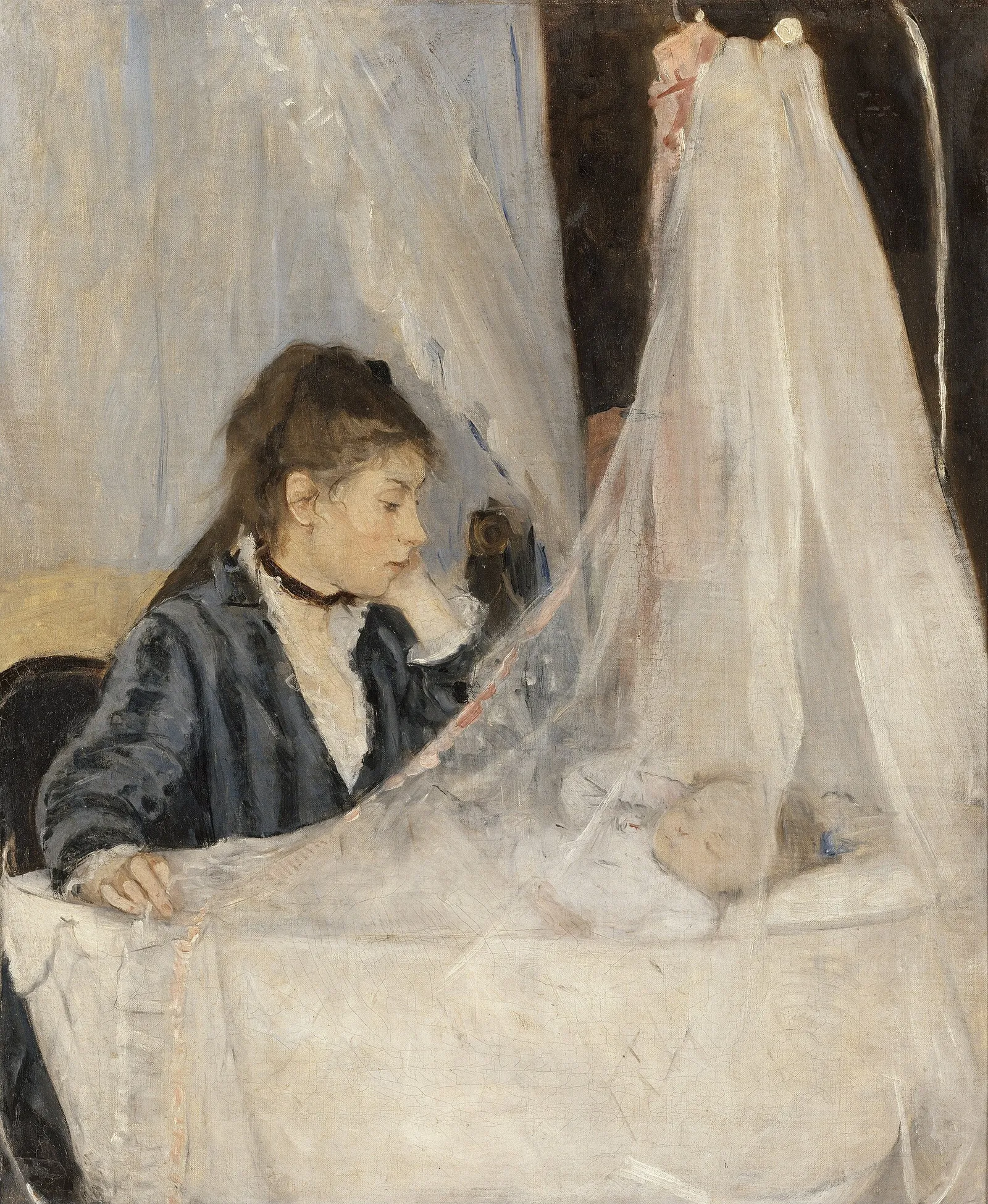
Berthe Morisot's The Cradle, painted in 1872, shows a young mother keeping watch over a sleeping baby behind a veil of sheer fabric. The painting belongs to the Musée d'Orsay, and it rewards slow, close looking at its brushwork and its quiet, carefully balanced composition.
Where to see it
The Cradle is in the collection of the Musée d'Orsay. The fact sheet also lists the Galerie nationale du Jeu de Paume as a location associated with the work. Displays change, and works can be moved, rotated or lent, so check the Musée d'Orsay's official website for current display status before you visit.
What to look for in person
The veil over the cradle
Much of the right side of the picture is taken up by the sheer fabric draped over the cradle. Look at how Morisot builds it with light, quick strokes of white and grey, so the sleeping baby is seen as if through a soft haze. The mother holds the edge of this veil with one hand, which makes the fabric both a screen and a point of contact between her and the child. Stand close to see how loosely it is painted, then step back and watch the transparency come together.
Echoing lines and a watchful gaze
Follow the mother's line of sight down to the baby. Her head rests on her hand, and her bent arm forms a diagonal that leads the eye toward the cradle. The baby's own arm, raised near its head, loosely repeats the mother's pose, quietly linking the two figures. Nothing dramatic happens here; the subject is the act of watching itself. Notice how the composition is divided between the darker, solid figure on the left and the pale, airy cradle on the right.
A restrained palette at intimate scale
The painting is modest in size, at 56 x 46.5 cm, so it is best seen up close. Look at the contrast between the mother's dark dress and the many whites around the cradle, warmed by touches of soft pink. In the background, a drawn curtain closes off the room, keeping attention on the two figures. The limited range of colours gives the scene its calm, hushed mood, and lets small shifts of tone carry the light across the surface.
About the painting
Berthe Morisot was a founding member of the group of artists who came to be known as the Impressionists, and one of the few women among its core exhibitors. The Cradle, dated 1872, is one of her best-known works and was shown at the group's first independent exhibition. It is widely identified as a portrait of her sister Edma, herself a trained painter who largely stopped painting after her marriage, watching over her newborn child. For visitors, the painting offers a good introduction to themes that run through Morisot's work: everyday domestic life, the private spaces of women and children, and a fluent, open brushwork that leaves visible traces of the painter's hand. Rather than presenting motherhood as a grand or sentimental subject, she shows a quiet, ordinary moment of attention, with the mother's expression left open to interpretation. The work measures 56 x 46.5 cm, a size suited to a domestic interior and to close viewing. It belongs to the collection of the Musée d'Orsay. The fact sheet also lists the Galerie nationale du Jeu de Paume as a location associated with the painting. When planning a visit, use the Musée d'Orsay's official website to confirm whether the painting is currently on view, and allow time to stand both near and at a distance from it: the brushwork reads very differently from each position, and the shift between the two is part of what makes the picture worth seeing in person.
Key facts
| Artist | Berthe Morisot |
|---|---|
| Date | 1872 |
| Size | 56 × 46.5 cm |
| Medium | oil paint, canvas |
| Collection | Musée d'Orsay |
How to visit: Musée d'Orsay
Paris, France · Museum guide
| Opening hours | Tue–Wed, Fri–Sun 09:30–18:00 (galleries close at 17:30) Thu 09:30–21:45 (late opening; galleries close at 21:15) |
|---|---|
| Closed | Every Monday, 1 May and 25 December. |
| Last entry | 17:00 (exhibitions 17:15); Thursdays 21:00 |
| Admission | Full rate, online EUR 16 Full rate, at the museum EUR 14 Reduced rate (on site only) EUR 11 Enfant & Cie, online EUR 13 Enfant & Cie, at the museum EUR 11 Night rate (Thursday), online EUR 12 Night rate (Thursday), at the museum EUR 10 Under 18s; EEA residents under 26 free |
| Free entry | Free for under 18s and residents of the European Economic Area under 26. Free on the first Sunday of the month, with booking required. |
| Booking | Booking is strongly recommended. Entry is by timed slot. |
The museum stays open and all collections and exhibitions remain accessible, but entrances have changed: timed-ticket holders use Entrance 1 (Quay); priority visitors, reseller voucher holders, visitors without tickets and groups use Entrance 2 (Forecourt). Arrive at least 15 minutes before your time slot.
Official ticket page
Official website
View on map
Hours and prices can change. Please check the official website before you go. (Checked on: 2026-11-11)