Art! Art! Art! › Works
The Child's Bath
 Mary Cassatt, 1893
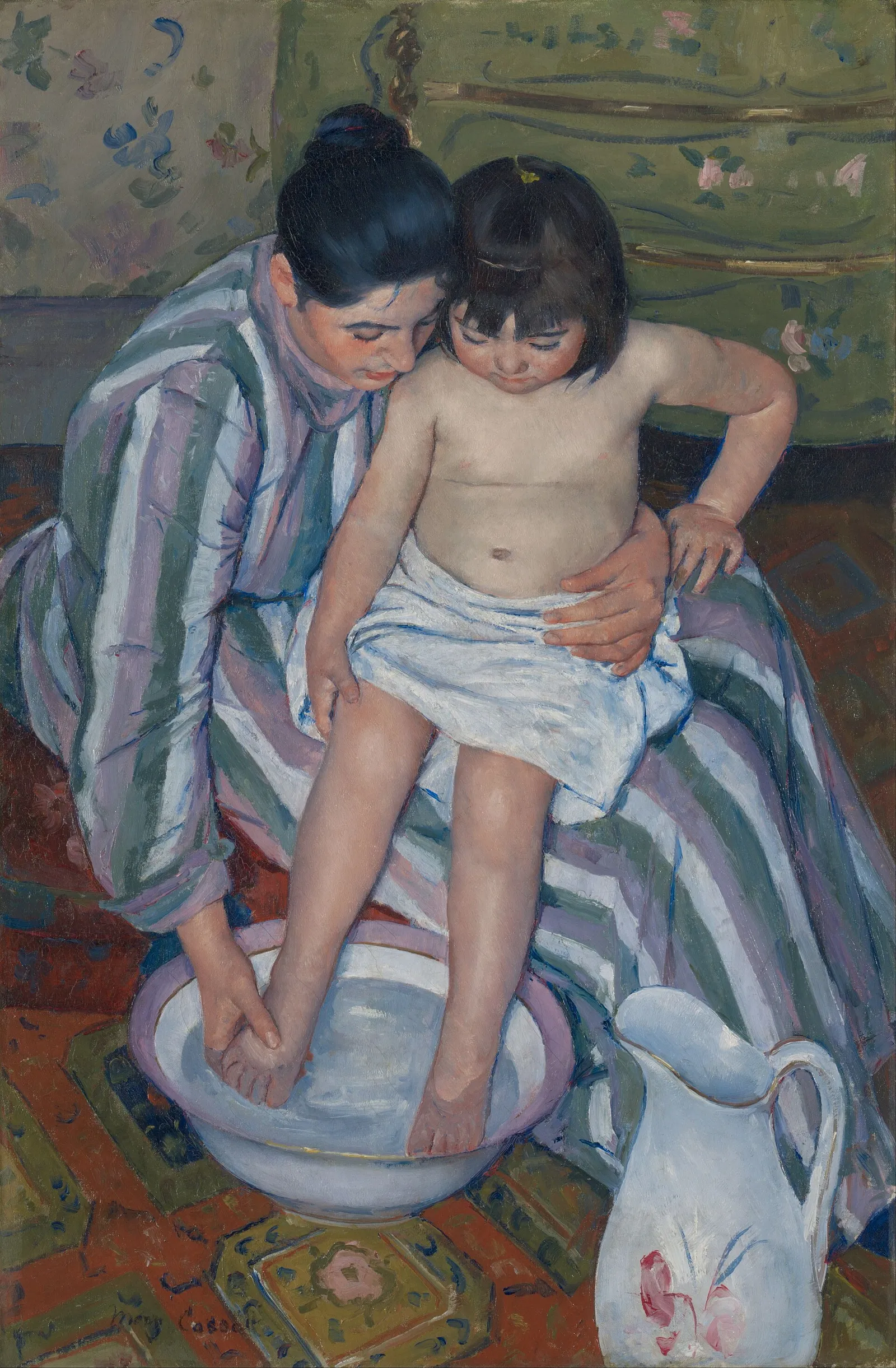
Mary Cassatt's The Child's Bath, dated 1893, belongs to the Art Institute of Chicago. It shows a woman washing a young child's feet, seen from above, and is one of the clearest examples of how Cassatt turned an everyday domestic moment into a carefully designed composition.
Where to see it
The Child's Bath is in the collection of the Art Institute of Chicago, and the work is located at the Art Institute of Chicago. Works in permanent collections can be moved, rotated off view, or lent to other institutions, so check the Art Institute of Chicago's official website for current display status, opening hours and ticket information before you visit.
What to look for in person
The view from above
Stand back first and notice where Cassatt places you. The scene is seen from a high vantage point, so the floor tilts up behind the figures and the basin, pitcher and rug read almost like flat shapes. This raised, steep viewpoint is widely linked to Cassatt's study of Japanese woodblock prints in the early 1890s. It pulls you into the space as if you were standing right beside the pair, looking down at the child's feet in the water.
Pattern against pattern
Look at how many patterns compete in a small area: the bold stripes of the woman's dress, the decorated rug, the painted wallpaper or furniture at the edges. Instead of blending them, Cassatt lets them sit side by side, which flattens the picture surface. Against this busy background, the plain skin of the child and the woman's arms stands out. Following the stripes downward is a good way to see how they lead your eye toward the basin and the child's feet.
Two heads, one gaze
Move closer and focus on the faces. The woman's head and the child's head are placed close together, and both look down at the same point: the foot being washed in the basin. Their shared gaze is what holds the composition together. Notice too how the woman's hand steadies the child's leg while the child's own hand rests on her. Cassatt keeps the emotion quiet, letting gesture and attention, rather than expression, carry the sense of closeness.
About the painting
Mary Cassatt was an American painter who spent most of her working life in France and exhibited with the Impressionists in Paris, where she became closely associated with Edgar Degas. Like several of her colleagues, she was interested in modern, everyday subjects rather than history or mythology, and she became especially known for scenes of women and children in domestic settings. The Child's Bath, dated 1893, is a well-known example of this focus.
The early 1890s were an important moment in Cassatt's development. Art historians widely connect her work of this period to her encounter with Japanese woodblock prints, which were highly fashionable in Paris at the time. From these prints she drew ideas about cropping, steep viewpoints, flat areas of pattern and firm outlines. You can see those ideas at work here: the tilted floor, the strong stripes of the dress and the decorated rug all push the image toward the flat surface, while the figures remain solid and carefully modelled.
What makes the painting rewarding in person is the balance between that decorative design and the tenderness of the subject. Bathing a child is an ordinary task, yet Cassatt arranges it so that every line points toward the small foot in the basin. The result is calm and concentrated rather than sentimental.
When you visit, give yourself time to look at the picture from a distance, to take in its overall pattern, and then up close, to study the hands, faces and handling of paint. The Art Institute of Chicago holds the work, so check the museum's website before your trip to confirm whether it is currently on view.
Key facts
| Artist | Mary Cassatt |
|---|---|
| Date | 1893 |
| Size | 1003 × 661 cm |
| Medium | oil paint, canvas |
| Collection | Art Institute of Chicago |
| Gallery | Gallery 184 Checked in the museum's open data on 2026-11-12 (galleries can change) Source |
How to visit: Art Institute of Chicago
Chicago, United States · Museum guide
| Opening hours | Mon, Wed, Fri, Sat, Sun 11:00–17:00 (10:00–11:00 members only) Thu 11:00–20:00 (10:00–11:00 members only) |
|---|---|
| Closed | Closed on Tuesdays, Thanksgiving, Christmas and New Year's Day. |
| Admission | General adult USD 32 (seniors 65+, students, teens 14–17: USD 26) Chicago residents adult USD 20 (seniors/students: USD 14; teens 14–17: free; proof of residence required) Illinois residents adult USD 27 (seniors/students/teens: USD 21; proof of residence required) Fast Pass adult USD 40 (seniors/students/teens: USD 34; skips general admission lines, expedited access to ticketed exhibitions) Children under 14 free Special exhibition add-on (Mary Cassatt: After Impressionism, through 3 Jan) USD 7 (in addition to general admission) |
| Free entry | Free every day for children under 14, Chicago teens under 18, LINK and WIC cardholders, Illinois educators and University Partner students; active-duty military and families from Armed Services Day to Labor Day. Free for Illinois residents on the third Thursday of each month 17:00–20:00, Wed 11 Nov 11:00–17:00, and weekdays 2–18 Dec 11:00–17:00 (Thu until 20:00). |
| Booking | Booking is recommended; there is no timed entry. |
Arts of the Americas galleries 162–179, 265 and 271 are closed during construction of the Grainger Center for Conservation and Science (the Nighthawks and American Gothic galleries remain open). Galleries 136–137 are now Regenstein Hall (Zurbarán: Divine Light from 28 Feb 2027). Currently off view include Monet's Water Lilies (1906) and Water Lily Pond (1900) and Picasso's The Old Guitarist.
Official ticket page
Official website
View on map
Hours and prices can change. Please check the official website before you go. (Checked on: 2026-11-09)
