Art! Art! Art! › Works
The 1821 Derby at Epsom
 Théodore Géricault, 1821
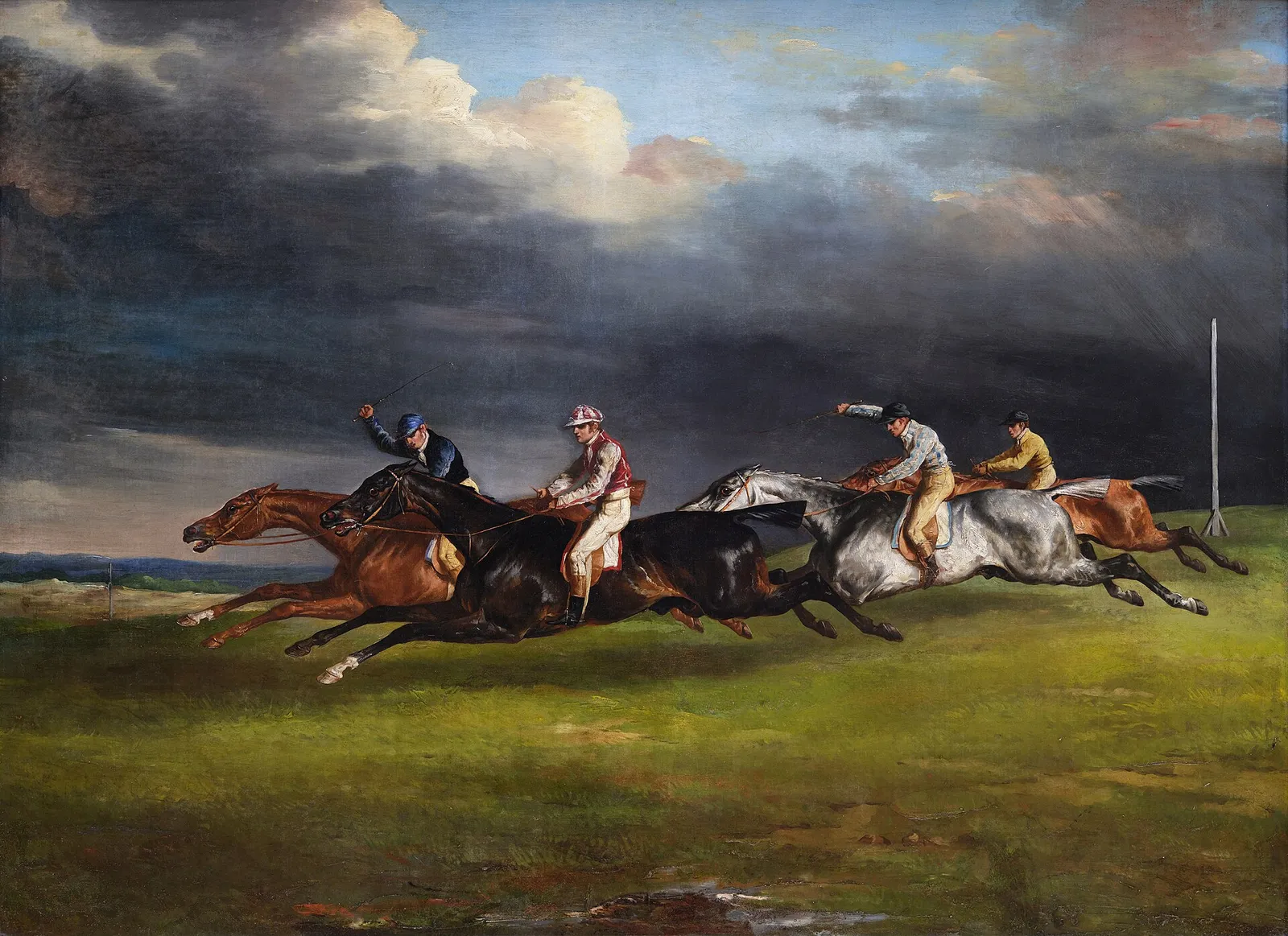
Théodore Géricault's The 1821 Derby at Epsom shows four racehorses stretched out at full speed beneath a heavy, clouded sky. Painted in 1821, it belongs to the Department of Paintings of the Louvre. It is a compact canvas that rewards a close look at how the artist conveyed motion.
Where to see it
The painting is held by the Louvre, in its Department of Paintings. The fact sheet lists its location as Room 941. Museums regularly rehang galleries, renumber rooms, lend works to other institutions or take paintings off view for conservation, so check the Louvre's official website for current display status and location before you visit. The canvas measures 92 × 122.5 cm, so it is easy to view up close rather than from across the room.
What to look for in person
The 'flying gallop'
Look at the horses' legs. Each animal is shown with its forelegs reaching forward and its hind legs stretched back, all four hooves clear of the ground. This pose was a long-standing artistic convention for depicting speed. Photographic studies of moving horses, made decades later by Eadweard Muybridge, showed that a galloping horse never actually takes this position. Standing in front of the canvas, notice how the convention still works visually: the elongated bodies read as pure forward momentum, almost as if the horses were skimming over the turf.
A brooding sky and low horizon
Géricault sets the horizon low, so the horses are silhouetted largely against the sky rather than the land. That sky is not a calm summer backdrop: look for the dark, heavy clouds pressing down on the scene and the contrast between them and the lighter areas near the horizon. The landscape itself is kept simple, with few distracting details. This restraint focuses attention on the horses while the weather adds tension and drama, a mood often associated with Romantic painting.
Riders, silks and a frieze of horses
Move closer to study the jockeys. Their brightly coloured silks give small, sharp accents against the brown and grey tones of the horses and land. The four horses are spaced closely and run almost in parallel, arranged across the picture like a frieze, which makes the composition easy to read at a glance. Notice the slender legs and small heads of the animals, characteristic of the English racehorse type. Horses were a lifelong subject for Géricault, and his attention to their build and bearing is evident here.
About the painting
Théodore Géricault was a French painter closely associated with the Romantic movement and best known for The Raft of the Medusa. Around 1820 to 1821 he spent time in Britain, where that large painting was exhibited. During this stay he encountered English horse racing and the British tradition of sporting art, and The 1821 Derby at Epsom, dated 1821, comes from this period. The Derby is run on the downs at Epsom, and the subject reflects the artist's fascination with both British racing culture and the horse as a subject.
The canvas measures 92 × 122.5 cm, a moderate size well suited to close viewing. It is best understood not as a documentary record of a particular race but as a study in the sensation of speed. The horses' outstretched 'flying gallop' pose follows an established pictorial convention, later shown to be anatomically inaccurate by photographic studies of animal motion. That later discovery has made the painting a frequently cited example in discussions of how artists represented movement before photography.
The work also shows features often associated with Géricault's Romanticism: a charged, stormy sky, a strong sense of energy and an emphasis on the physical power of animals. At the same time, the composition is orderly, with the horses arranged in a clear horizontal band.
Géricault died in 1824, only a few years after painting this scene, which makes his British works part of a relatively short late phase of his career. Today the painting belongs to the Department of Paintings of the Louvre.
Key facts
| Artist | Théodore Géricault |
|---|---|
| Date | 1821 |
| Size | 92 × 122.5 cm |
| Medium | oil paint, canvas |
| Collection | Department of Paintings of the Louvre |
| Gallery | Room 941, Sully wing, level 2 Checked in the museum's open data on 2026-11-12 (galleries can change) Source |
How to visit: Louvre Museum
Paris, France · Museum guide
| Opening hours | Mon, Thu, Sat, Sun 09:00–18:00 Wed, Fri 09:00–21:00 (evening opening) Rooms are cleared 30 minutes before closing |
|---|---|
| Closed | Every Tuesday; 1 January, 1 May and 25 December. Other public holidays are open unless they fall on a Tuesday. |
| Last entry | 1 hour before closing |
| Admission | Adult (non-EEA visitors) EUR 32 Adult (EEA citizens and residents) EUR 22 Under 18 free (ID required) EEA citizens/residents under 26 free (photo ID; residents also need a residence permit of over 90 days) Audio guide rental EUR 6 (can be booked in advance online) Rates apply from 14 January 2026 |
| Free entry | Free for under-18s, EEA citizens/residents under 26, all visitors on the first Friday of the month after 18:00 (except July and August) and on 14 July, and disabled visitors plus one carer. Also free with proof for EEA art and art-history teachers, ICOM members, journalists, EEA job seekers and EEA residents on income support. |
| Booking | Entry is by timed slot, and booking in advance is recommended. |
The Cour Carrée entrance is currently closed. On Thursday 12 November 2026 the museum may open later and some exhibition rooms may remain closed.
Official ticket page
Official website
View on map
Hours and prices can change. Please check the official website before you go. (Checked on: 2026-11-11)