Art! Art! Art! › Works
Saint Nicholas of Myra saves three innocents from death
 Ilya Repin, 1888
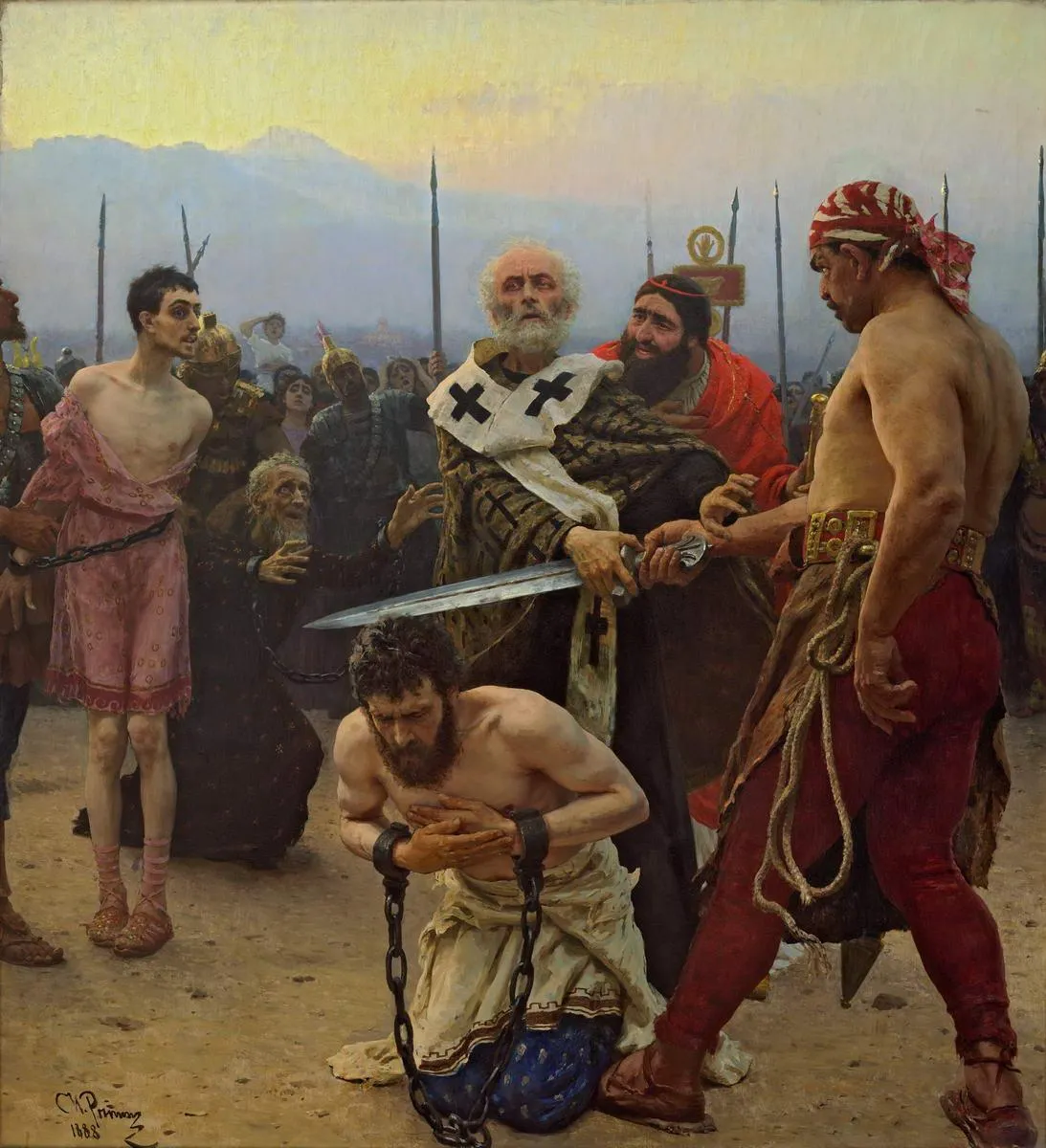
Ilya Repin's Saint Nicholas of Myra saves three innocents from death, dated 1888, is in the collection of the Russian Museum. The canvas shows the moment a bishop-saint halts an execution by seizing the executioner's sword. At 215 by 196 cm it is a large painting that rewards both a step back and a closer look at the faces.
Where to see it
The painting belongs to the Russian Museum. Works in large collections can be moved, rehung or sent out on loan, so check the Russian Museum's official website for current display status, opening hours and ticket information before you visit.
What to look for in person
The hand on the blade
Start with the central action. Saint Nicholas does not argue or plead; he physically intervenes, taking hold of the sword just as it is about to fall. Notice how Repin places this gesture near the centre of the composition, so that everything else seems arranged around it. Look at the tension between the saint's calm, authoritative bearing and the executioner's interrupted motion. The drama comes from a single frozen instant, and the painting asks you to read the reactions spreading outward from that point.
The three condemned men
Turn next to the prisoners, the innocents of the title. Repin gives each a distinct response to the same moment, rather than treating them as a single group. Take time to compare their postures and expressions, and how they relate to the saint who has just saved them. Repin was known for his close attention to individual faces and psychological states, and this part of the canvas is a good place to see that skill at work. Standing nearer to the painting helps you appreciate the detail.
Witnesses and scale
The painting measures 215 by 196 cm, nearly square and large enough that the main figures approach life size. Step back to see how the onlookers and surrounding figures frame the event and turn a private rescue into a public scene. Watch how the eye travels from the crowd to the sword and back again. Viewing from a distance and then up close gives two different experiences: first the overall staging of the drama, then the handling of paint, costume and individual characters.
About the painting
Ilya Repin is one of the best-known Russian painters of the nineteenth century, admired especially for his realist portraits and large narrative canvases. This work, dated 1888, takes its subject from the traditional life of Saint Nicholas of Myra, a fourth-century bishop venerated widely in the Orthodox world. According to that tradition, Nicholas learned that three innocent men had been unjustly condemned to death, hurried to the place of execution, and stopped the executioner by grasping his sword. Repin chose the most dramatic instant of the story, the second in which death is averted. Rather than presenting a static devotional image, he stages the episode as a scene of human reactions, a choice that reflects the realist approach for which he is known. The saint, the executioner, the prisoners and the crowd each respond to the same event, and much of the painting's interest lies in comparing them. For visitors, the canvas offers a useful contrast with Repin's portraits and scenes of contemporary life: here he applies the same observational skill to a religious and historical subject. The painting is 215 cm high and 196 cm wide, so it is easy to spot in a gallery, but give yourself time to look beyond the central gesture. Faces, hands and the arrangement of figures carry the story as much as the action itself. The work is held by the Russian Museum. Because display arrangements change, confirm on the museum's official website whether the painting is currently on view before planning a trip specifically to see it.
Key facts
| Artist | Ilya Repin |
|---|---|
| Date | 1888 |
| Size | 215 × 196 cm |
| Medium | oil paint, canvas |
| Collection | Russian Museum |
How to visit: Russian Museum
Saint Petersburg, Russia
Hours and prices can change. Please check the official website before you go.


