Art! Art! Art! › Works
Saint Jerome in His Study
 Antonello da Messina, 1474
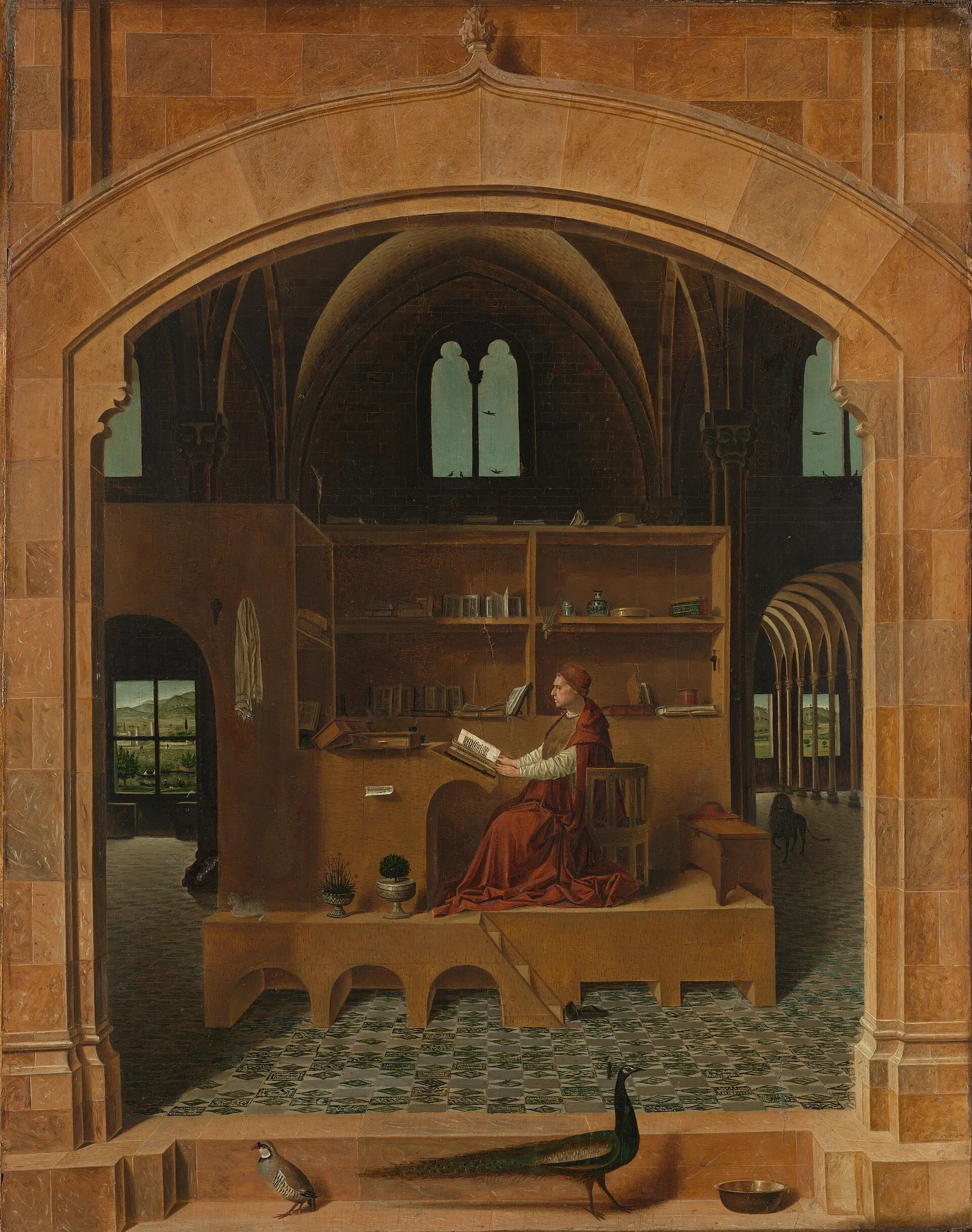
Antonello da Messina's Saint Jerome in His Study, dated 1474, is in the collection of the National Gallery. Measuring just 45.7 by 36.2 cm, it packs a whole architectural world into a small panel and rewards anyone willing to stand close and look slowly.
Where to see it
Saint Jerome in His Study is held by the National Gallery, which is listed as both its collection and its location. Paintings can be moved, rehung, taken off view for conservation or lent to other institutions, so check the National Gallery's official website for the painting's current display status before you plan your visit. Because the work is small (45.7 x 36.2 cm), allow time to view it at close range; many of its most interesting details are only a few millimetres across.
What to look for in person
The stone arch: a threshold into the scene
The picture opens with a painted stone archway, as if you are standing at the doorway of a building and looking in. On the ledge in the foreground sit birds, including a peacock and a partridge, beside a metal basin. Begin by standing back and letting the arch frame the whole composition. Then move closer and follow the path the painter sets out: from the ledge, across the tiled floor, and up to the raised wooden study where the saint sits at the centre of the hall.
Jerome at work in his wooden study
Saint Jerome sits reading at a sloping desk inside a wooden study built within a much larger vaulted interior. Look at the shelves holding books and small objects, the potted plants set along the edge of the platform, and the pair of shoes left at the foot of the steps. Behind him lies the red cardinal's hat, a traditional attribute of Jerome in paintings. A cat rests on the platform and is easy to overlook. Each item is painted with a separate, careful attention to texture and surface.
Light, the lion and the views beyond
Light enters from the front and through the windows, picking out wood, stone and cloth and leaving the side aisles in shadow. In the dim aisle on the right, look for a lion walking toward you; the lion is Jerome's long-standing companion in art, linked to the legend that he removed a thorn from its paw. Then look through the windows at the back: tiny landscapes open up, with distant details and birds in flight. These miniature views show off the precision of the oil technique Antonello used.
About the painting
Antonello da Messina was a painter from Sicily who is widely recognised as one of the first Italian artists to adopt the oil-painting methods developed in the Netherlands. Oil paint allowed fine, translucent layers and very precise detail, and Saint Jerome in His Study is often cited as a clear example of how Antonello combined that Netherlandish attention to small things with an Italian interest in ordered space and perspective. The fact sheet dates the painting to 1474 and gives its size as 45.7 by 36.2 cm, so it is a small work intended for close viewing rather than display at a distance. Its subject, Saint Jerome, was one of the early Fathers of the Church and a scholar best known for translating the Bible into Latin. Painters often showed him either as a penitent in the wilderness or, as here, as a learned man in his study, surrounded by books. In front of the painting, notice how the composition works in layers: the stone arch in the foreground, the tiled floor, the wooden study furniture, and finally the windows that open onto landscape. The receding floor tiles and the columns of the hall guide your eye inward, while the objects around Jerome invite you to look more slowly. Many of the details, such as the birds, plants and the lion, have been read by scholars as carrying symbolic meaning, though interpretations vary. The painting is in the collection of the National Gallery, where it can be compared with other fifteenth-century works. As with any visit, confirm on the museum's official website that it is currently on display.
Key facts
| Artist | Antonello da Messina |
|---|---|
| Date | 1474 |
| Size | 45.7 × 36.2 cm |
| Medium | oil paint, lime panel |
| Collection | National Gallery |
How to visit: National Gallery
London, United Kingdom · Museum guide
| Opening hours | Mon–Thu, Sat, Sun 10:00–18:00 Fri 10:00–21:00 (Friday late) |
|---|---|
| Closed | 24–26 December and 1 January. |
| Admission | General admission (collection) free; donations invited Some exhibitions are charged (e.g. Renoir and Love, until 31 Jan 2027) |
| Free entry | General admission is always free. |
| Booking | No reservation or timed entry is required. Free timed booking gives fast-track entry. |
Building work and improvements are under way: some rooms are closed and some paintings have moved, so check the floorplans or collection search before visiting. A new Research Centre is due to open in 2028. On 17 November only, some east wing rooms and the Espresso Bar close from 16:00.
Official ticket page
Official website
View on map
Hours and prices can change. Please check the official website before you go. (Checked on: 2026-11-11)
