Art! Art! Art! › Works
Reception of a Venetian Delegation in Damascus in 1511
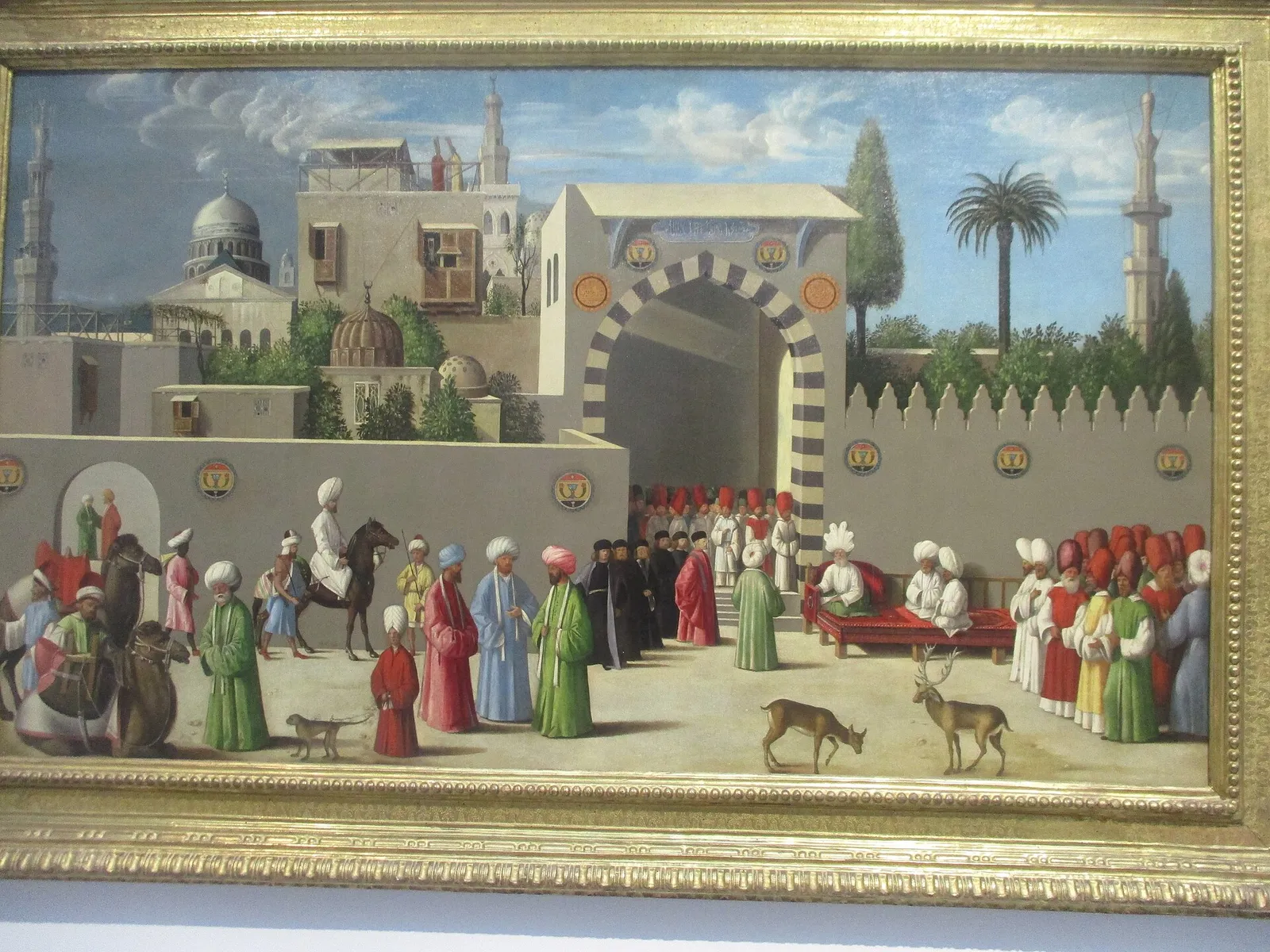
Reception of a Venetian Delegation in Damascus in 1511 is a large 16th-century canvas by an unnamed Venetian painter. It belongs to the Department of Paintings of the Louvre, and its listed location is Louvre Abu Dhabi. It shows a meeting between Venetian envoys and local officials in a Middle Eastern city.
Where to see it
The painting is part of the collection of the Department of Paintings of the Louvre, and its recorded location is Louvre Abu Dhabi. Because works can move between galleries, go into storage or travel, check the official Louvre Abu Dhabi and Louvre websites for current display status before planning a visit.
What to look for in person
A meeting of two worlds
Start by comparing the two groups of people. The visiting Venetians and their hosts are set apart by their clothing, headwear and posture, and the painter uses these differences to make the diplomatic encounter easy to read across the canvas. Take time to notice how the figures are grouped, who appears seated or elevated and who approaches, and how gesture and placement suggest rank and ceremony. The scene is less about a single dramatic moment than about the formal choreography of an official reception.
The city as a stage
Look past the figures to the setting. The background is filled with buildings, walls and open space that turn the city itself into a backdrop for the event. Venetian painters of this period often built their narrative scenes around carefully described urban settings, and this work follows that approach. Notice how the architecture frames the gathering and how the painter balances the crowd in the foreground against the structures behind it. Step back to see how the composition holds together, then move closer to study individual buildings and details.
Scale and storytelling detail
At 175 cm high and 201 cm wide, the canvas is broad enough to reward slow looking. Rather than focusing on one figure, the painter spreads interest across the whole surface, inviting the eye to travel from group to group. Look for small incidental details in the crowd and in the spaces around the main gathering, which add a sense of everyday life to an official occasion. This descriptive, panoramic manner is characteristic of Venetian narrative painting of the time and helps convey the experience of a distant place to a home audience.
About the painting
This painting records a diplomatic reception: a Venetian delegation received in Damascus in 1511, as its title states. The fact sheet identifies the work only as the creation of a Venetian painter and dates it to the 16th century; the artist's name is not given. It measures 175 by 201 centimetres and is held by the Department of Paintings of the Louvre, with its location recorded as Louvre Abu Dhabi.
The subject reflects the long commercial and diplomatic ties between the Republic of Venice and the eastern Mediterranean. Venice depended heavily on trade with the region, and its merchants and envoys maintained regular contact with cities such as Damascus, which in 1511 lay within the Mamluk Sultanate. Official missions of this kind involved formal ceremony, and the painting presents that ceremony as a carefully arranged public scene.
Around 1500, several Venetian painters produced large narrative canvases set in or inspired by the eastern Mediterranean, filled with costumes, buildings and crowds that would have looked exotic to viewers in Venice. This work belongs to that wider interest. For visitors, its value lies in the way it blends documentary curiosity with the conventions of Venetian storytelling: a broad stage, many figures and an emphasis on describing the setting.
When you stand in front of it, allow time to read it like a panorama. Move between the overall composition and the smaller details, and consider how a Venetian audience might have used such an image to imagine a distant city and the diplomacy that connected it to their own.
Key facts
| Artist | Venetian painter |
|---|---|
| Date | 16th century |
| Size | 175 × 201 cm |
| Medium | oil paint, canvas |
| Collection | Department of Paintings of the Louvre |
How to visit: Louvre Museum
Paris, France · Museum guide
| Opening hours | Mon, Thu, Sat, Sun 09:00–18:00 Wed, Fri 09:00–21:00 (evening opening) Rooms are cleared 30 minutes before closing |
|---|---|
| Closed | Every Tuesday; 1 January, 1 May and 25 December. Other public holidays are open unless they fall on a Tuesday. |
| Last entry | 1 hour before closing |
| Admission | Adult (non-EEA visitors) EUR 32 Adult (EEA citizens and residents) EUR 22 Under 18 free (ID required) EEA citizens/residents under 26 free (photo ID; residents also need a residence permit of over 90 days) Audio guide rental EUR 6 (can be booked in advance online) Rates apply from 14 January 2026 |
| Free entry | Free for under-18s, EEA citizens/residents under 26, all visitors on the first Friday of the month after 18:00 (except July and August) and on 14 July, and disabled visitors plus one carer. Also free with proof for EEA art and art-history teachers, ICOM members, journalists, EEA job seekers and EEA residents on income support. |
| Booking | Entry is by timed slot, and booking in advance is recommended. |
The Cour Carrée entrance is currently closed. On Thursday 12 November 2026 the museum may open later and some exhibition rooms may remain closed.
Official ticket page
Official website
View on map
Hours and prices can change. Please check the official website before you go. (Checked on: 2026-11-11)