Art! Art! Art! › Works
Portrait of Eleanor of Toledo and her son Giovanni de' Medici
 Agnolo Bronzino, 1540s
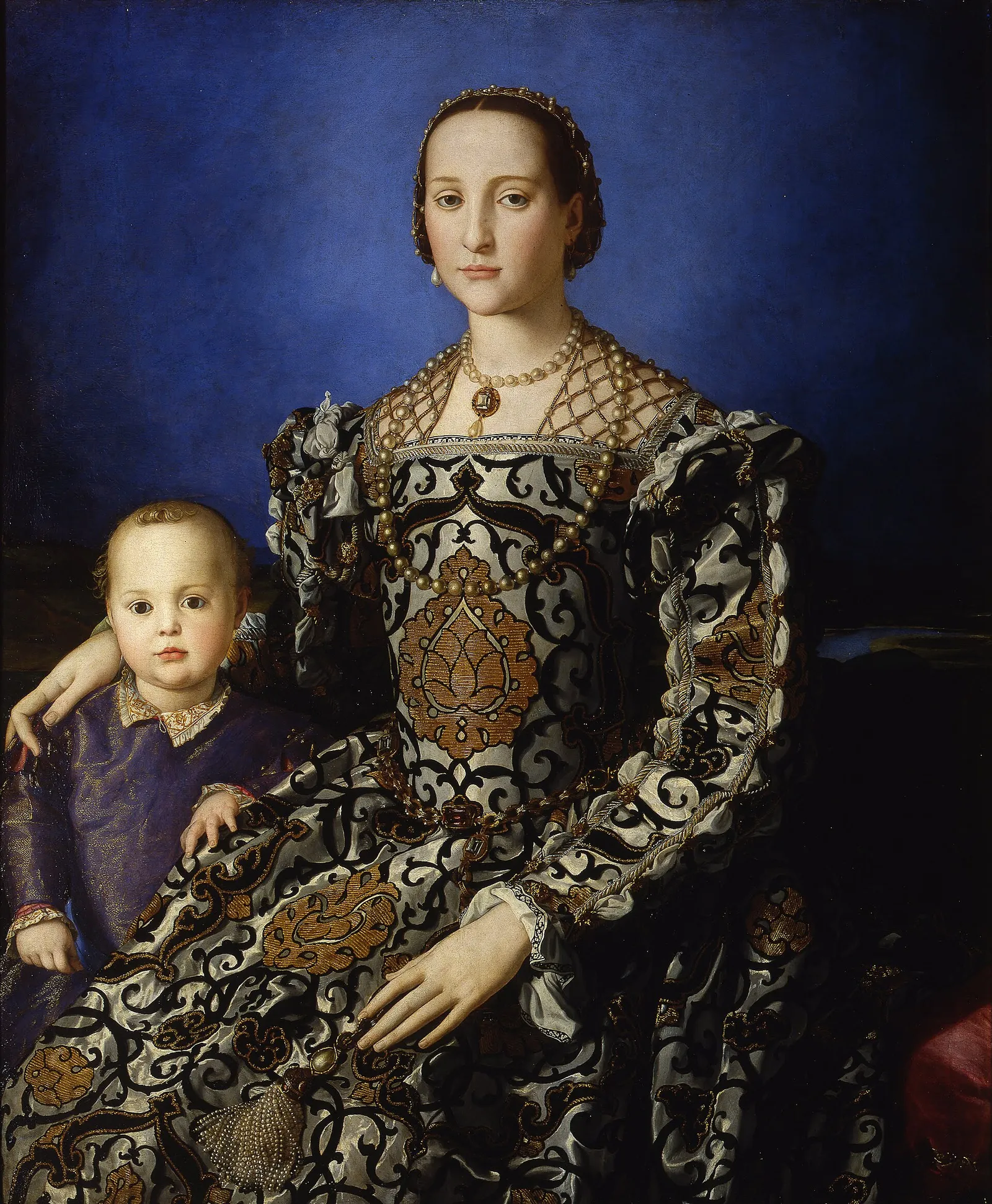
Agnolo Bronzino's Portrait of Eleanor of Toledo and her son Giovanni de' Medici is in the collection of the Uffizi Gallery in Florence. Painted in the 1540s, it shows the wife of Duke Cosimo I de' Medici seated beside one of their young sons, dressed in a richly patterned gown. It is a portrait to look at slowly, from the weave of the fabric to the faint landscape behind the sitters.
Where to see it
The painting belongs to the Uffizi Gallery in Florence. It hung for many years in the Tribuna of the Uffizi, and published records state that since 2012 it has been shown in the red rooms of the Nuovi Uffizi. Displays change, and works can be moved or lent, so check the Uffizi's official website for current display status before you plan your visit around this painting.
What to look for in person
The gown up close
Give most of your time to the dress, which fills much of the panel. It is brocaded velvet woven with raised loops of gold thread, a technique known as riccio sopra riccio, and its design is built around a pomegranate motif. Notice how Bronzino separates the different surfaces: the soft pile of the velvet, the glinting metallic loops and the paler ground between them each read distinctly, even from a short distance. Then step closer and follow the pattern as it bends over her arm and lap.
Pearls, a diamond and a bare hand
Next, follow the jewellery. Eleonora wears two strings of pearls; one carries a gold pendant set with a large diamond and a hanging pearl, and pearl drops hang from her ears. Now look at the hand she rests on the boy's shoulder and you will see that it wears no rings. The contrast between those plain fingers and the jewels at her neck is easy to miss at first glance. Her composed face and the stillness of the pose are typical of Bronzino's cool, polished approach to court portraiture.
The sky, the view and the heir
Step back to take in the setting. Behind mother and son is a deep blue, leaden sky that lightens around Eleonora's head, gently setting her apart from the background. Look low in the distance for a small view of an estate, usually thought to be the Medici villa at Poggio a Caiano. Then turn to the boy standing at her side. His presence carries the picture's message: this is described as the earliest known state-commissioned portrait to include a ruler's heir, presenting the continuity of the Medici line.
About the painting
Agnolo Bronzino was the leading portrait painter at the court of Cosimo I de' Medici, Duke of Florence, and this panel shows the duke's wife, Eleonora of Toledo, with one of their sons. The work is painted in oil on panel and measures 115 × 96 cm. It dates from the 1540s and is generally placed around 1545, a period when the ducal family spent time at the Medici villa of Poggio a Caiano outside Florence.
The composition is simple: Eleonora sits facing the viewer, her hand resting on the shoulder of the boy who stands beside her. Yet the picture works on several levels at once. It records a specific woman and her extraordinary clothing, it advertises the wealth and taste of the new ducal court, and, by placing a child next to the duchess, it presents the family's future. Portraits of rulers' consorts were not new, but bringing the heir into an official image in this way marked a notable step in Medici self-presentation.
The gown has attracted particular interest. When Eleonora's tomb was opened in 1857, it was thought for a time that she had been buried in the dress seen here. Her actual burial gown, however, was of white satin and cut quite differently; it is now shown at the Galleria del Costume in Florence.
The portrait has remained a reference point for later viewers. The French historian Paul Veyne, for example, chose it for his book Mon musee imaginaire, a personal selection of works of art. For visitors, it rewards close attention to surface and detail more than a quick look.
Key facts
| Artist | Agnolo Bronzino |
|---|---|
| Date | 1540s |
| Size | 115 × 96 cm |
| Medium | oil paint, panel |
| Collection | Uffizi Gallery |
How to visit: Uffizi Gallery
Florence, Italy · Museum guide
| Opening hours | Tue–Sun 08:15–18:30 (visitors leave by 18:30) |
|---|---|
| Closed | Mondays, 1 January and 25 December. |
| Last entry | Ticket office closes at 17:30. |
| Admission | Regular, bought on the day EUR 25 Regular, bought in advance EUR 29 Regular, entry from 16:00 (from 1 January 2026) EUR 16 Reduced (EU citizens aged 18–25; citizens of Switzerland, Norway, Liechtenstein, Uruguay etc.; ID required) EUR 2 Under 18 free (under 12s must be accompanied) Uffizi + Vasari Corridor EUR 43 on the day / EUR 47 in advance; named ticket, reservation required, non-refundable PassePartout 5 days (Uffizi, Pitti Palace, Boboli) EUR 40 (EUR 58 with Vasari Corridor) Audio guide EUR 6 |
| Free entry | Free for under-18s; disabled visitors plus one companion; tour guides and interpreters, ICOM members, certain journalists, and university teachers/students on the official list. Admission is free on the first Sunday of each month (national museums), when reservations are not possible. |
| Booking | Reservation is not required, except for the Uffizi + Vasari Corridor ticket, which must be reserved. |
Restoration and rearrangement works mean some rooms are temporarily closed and some artworks are not on display. A staff assembly on 11–12 November 2026 may change opening times.
Official ticket page
Official website
View on map
Hours and prices can change. Please check the official website before you go. (Checked on: 2026-11-12)
More by Agnolo Bronzino

Sources
- Wikidata Q1328065
- Wikipedia (en) (CC BY-SA 4.0)
- Wikipedia (it) (CC BY-SA 4.0)
- Wikipedia (fr) (CC BY-SA 4.0)
- www.uffizi.it