Art! Art! Art! › Works
Paris Street; Rainy Day
 Gustave Caillebotte, 1877
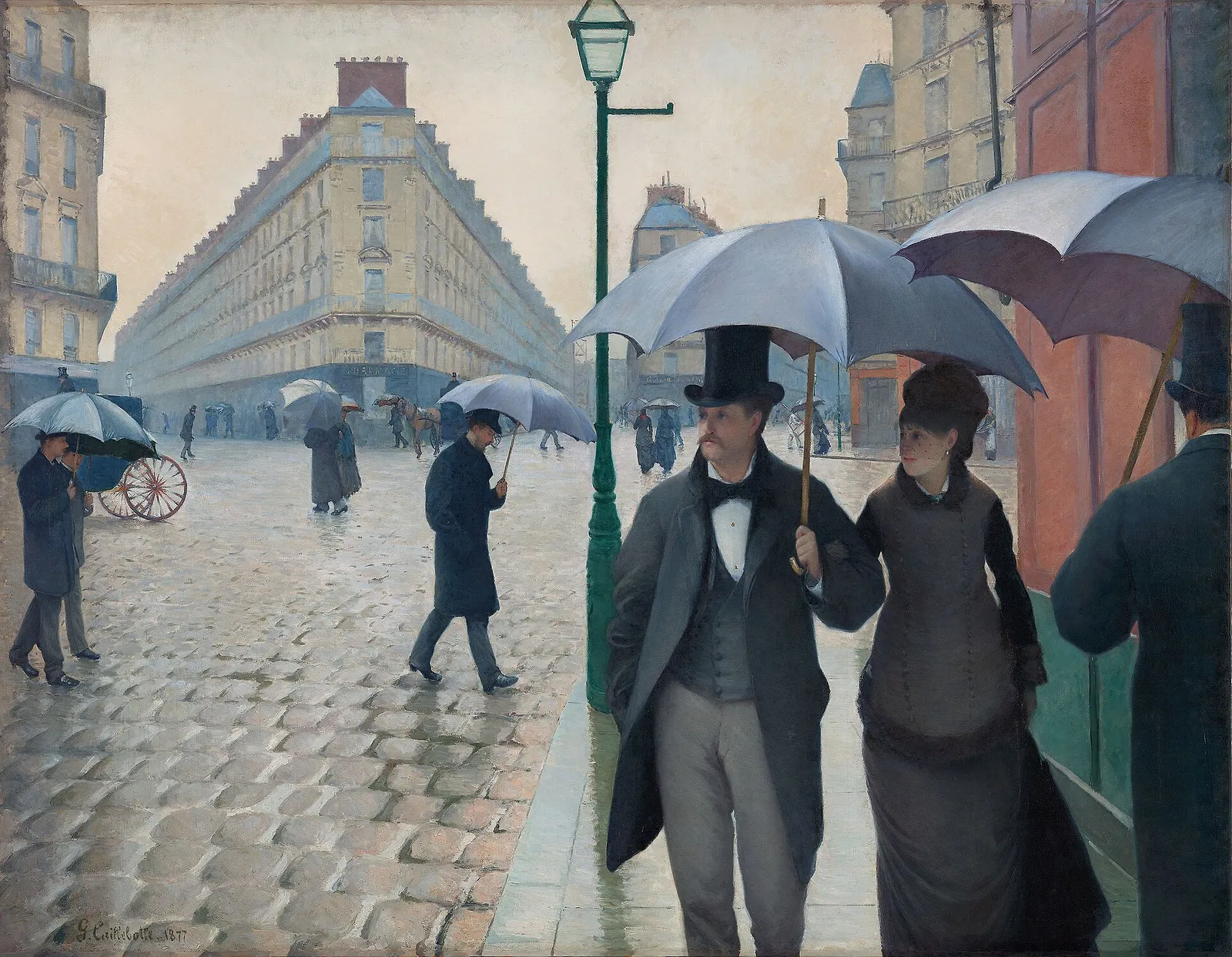
Gustave Caillebotte's Paris Street; Rainy Day, painted in 1877, shows a damp, gray afternoon at a broad intersection in the newly rebuilt Paris. The painting is in the collection of the Art Institute of Chicago, where its scale and sharp perspective reward both a distant look and a close one.
Where to see it
Paris Street; Rainy Day belongs to the Art Institute of Chicago, and the museum is also its listed location. Display arrangements at any museum can change because of rehanging, conservation or loans, so check the Art Institute of Chicago's official website for current display status, opening hours and ticket information before you plan your visit.
What to look for in person
The lamppost that divides the scene
A green lamppost rises from the paving stones near the center of the canvas and splits the composition into two parts. On the right, figures crowd the foreground; on the left, the square opens into deep space and receding facades. Stand back first to see how this single vertical anchors the whole picture, then step closer to notice how its lines align with the edges of buildings. It is a deliberate, almost architectural device, and it helps explain why the painting feels so carefully constructed rather than casually observed.
Rain shown through reflected light
Look down at the street. Caillebotte suggests the rain not with falling drops but with the soft sheen on the wet paving stones. The surface is smooth and controlled, closer to a polished studio finish than to the broken, visible brushwork associated with many of his Impressionist colleagues. Notice how the stones shrink as they recede, reinforcing the steep perspective, and how the gray umbrellas echo the tones of the sky and pavement. The restrained palette of grays, browns and muted blues creates the scene's damp, overcast mood.
Cropped figures and city strangers
The fashionably dressed couple walking toward you on the right shares an umbrella, while at the far right edge another figure is cut off by the frame, as if caught in passing. In the middle distance, pedestrians move alone or in pairs, each sheltered under an umbrella and set apart from the others. Spend time with these spacing choices. People share the same streets yet rarely seem to connect, an effect many viewers read as a quiet portrait of modern urban life and its anonymity.
About the painting
Gustave Caillebotte painted Paris Street; Rainy Day in 1877, the year he showed it at the third Impressionist exhibition in Paris. Caillebotte was both a painter and a supporter of the Impressionist group: from a wealthy family, he helped organize exhibitions and bought works by his fellow artists. His own painting, however, often looked different from theirs, and this canvas shows why. Instead of quick, sketch-like strokes, it offers crisp outlines, careful perspective and smoothly blended surfaces. The setting is a busy intersection near the Saint-Lazare railway station, an area transformed by the large-scale rebuilding of Paris in the mid-nineteenth century. Broad streets, uniform stone apartment buildings and gas lamps were all signs of the modern city, and Caillebotte places them at the center of his subject. The people are equally modern: middle-class Parisians in dark coats and top hats, moving through public space with a kind of reserved politeness. For visitors, the painting works on two levels. From a distance, the large canvas pulls you into the street as though you were standing on the pavement just behind the couple. Up close, you can study details such as the reflections on the stones, the textures of clothing and the delicate rendering of distant figures and windows. Take time to move between those two viewpoints. The shift reveals how Caillebotte combined careful planning with an eye for the ordinary moments of daily city life.
Key facts
| Artist | Gustave Caillebotte |
|---|---|
| Date | 1877 |
| Size | 2122 × 2762 cm |
| Medium | oil paint, canvas |
| Collection | Art Institute of Chicago |
| Gallery | Gallery 201 Checked in the museum's open data on 2026-11-12 (galleries can change) Source |
How to visit: Art Institute of Chicago
Chicago, United States · Museum guide
| Opening hours | Mon, Wed, Fri, Sat, Sun 11:00–17:00 (10:00–11:00 members only) Thu 11:00–20:00 (10:00–11:00 members only) |
|---|---|
| Closed | Closed on Tuesdays, Thanksgiving, Christmas and New Year's Day. |
| Admission | General adult USD 32 (seniors 65+, students, teens 14–17: USD 26) Chicago residents adult USD 20 (seniors/students: USD 14; teens 14–17: free; proof of residence required) Illinois residents adult USD 27 (seniors/students/teens: USD 21; proof of residence required) Fast Pass adult USD 40 (seniors/students/teens: USD 34; skips general admission lines, expedited access to ticketed exhibitions) Children under 14 free Special exhibition add-on (Mary Cassatt: After Impressionism, through 3 Jan) USD 7 (in addition to general admission) |
| Free entry | Free every day for children under 14, Chicago teens under 18, LINK and WIC cardholders, Illinois educators and University Partner students; active-duty military and families from Armed Services Day to Labor Day. Free for Illinois residents on the third Thursday of each month 17:00–20:00, Wed 11 Nov 11:00–17:00, and weekdays 2–18 Dec 11:00–17:00 (Thu until 20:00). |
| Booking | Booking is recommended; there is no timed entry. |
Arts of the Americas galleries 162–179, 265 and 271 are closed during construction of the Grainger Center for Conservation and Science (the Nighthawks and American Gothic galleries remain open). Galleries 136–137 are now Regenstein Hall (Zurbarán: Divine Light from 28 Feb 2027). Currently off view include Monet's Water Lilies (1906) and Water Lily Pond (1900) and Picasso's The Old Guitarist.
Official ticket page
Official website
View on map
Hours and prices can change. Please check the official website before you go. (Checked on: 2026-11-09)
