Art! Art! Art! › Works
Pandora
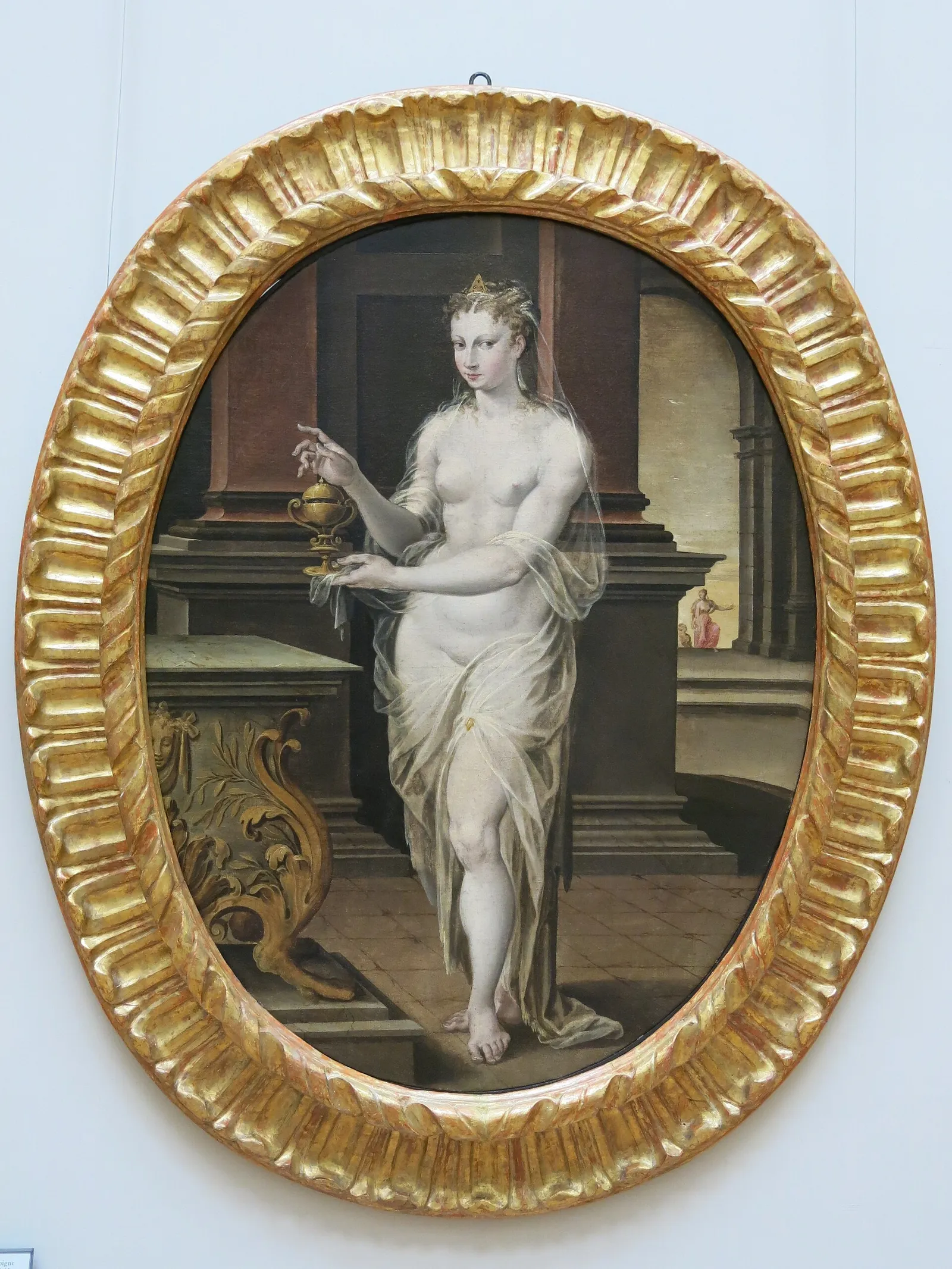
Pandora is a work by the Italian painter Niccolò dell'Abate, dated to the 1550s. It belongs to the Department of Paintings of the Louvre in Paris, where the museum's record places it in Room 823. It is a chance to see a classical myth through the eyes of an artist who helped shape French Renaissance court art.
Where to see it
Pandora is held by the Department of Paintings of the Louvre in Paris, and the museum's record lists its location as Room 823. Gallery hangings change because of rotations, conservation and loans, so check the Louvre's official website for current display status before you visit. If you are making the trip for this work, confirming in advance is worth the few minutes.
What to look for in person
A myth of the first woman
In ancient Greek tradition, best known from the poet Hesiod, Pandora is the first woman, made by the gods and given gifts by each of them. She is famously linked to a vessel whose opening released troubles into the world, leaving only hope inside. Renaissance artists and patrons knew this story well and valued it as a subject combining the ideal female figure with a moral lesson. In front of the painting, ask how the artist presents Pandora: as a divine creation, as a cautionary figure, or both.
A painter of the Fontainebleau years
The 1550s date places this work in the period when Niccolò dell'Abate was active in France. Trained in northern Italy, he moved to France in the early 1550s to work for the French crown at the Château de Fontainebleau, collaborating with Francesco Primaticcio on large decorative schemes. The refined, mythological art made there is now called the School of Fontainebleau. Viewing Pandora, consider it alongside that courtly taste for classical subjects, elegant figures and learned allusion.
What to look for in the style
Art in the Fontainebleau circle typically favours graceful, elongated figures, smooth modelling of skin and carefully posed bodies that owe much to Italian Mannerism. Dell'Abate was also known for his sensitivity to landscape and atmosphere, a strength seen across his career. Look closely at how the figure is proportioned and posed, how light falls across the forms, and whether the setting adds mood to the story. Comparing these features with nearby Italian and French paintings can help you place the work in its moment.
About the painting
Niccolò dell'Abate was an Italian painter from Modena whose career moved from northern Italy to the French royal court. In Italy he built a reputation for fresco decoration in palaces, where he combined figures with lively landscape settings and scenes drawn from literature. In the early 1550s he travelled to France to join the team decorating the Château de Fontainebleau for the French kings. There he worked closely with Francesco Primaticcio, carrying out many designs for grand interiors, and he remained in France for the rest of his life.
The art produced at Fontainebleau mixed Italian Mannerist ideas with French courtly taste. Its painters favoured mythological and allegorical subjects, elegant and often elongated figures, and a polished, sophisticated finish. This style had a lasting influence on French art in the later sixteenth century.
Pandora, dated to the 1550s, belongs to this French phase of the artist's work. Its subject comes from Greek myth: Pandora, fashioned by the gods and given their gifts, became associated with the vessel that let misfortune loose on humanity. For Renaissance viewers the story offered both an occasion to depict ideal beauty and a reflection on curiosity, fate and hope.
Today the work is part of the Department of Paintings of the Louvre, one of the world's major collections of European painting. Seeing it there allows visitors to set dell'Abate's work alongside that of his Italian contemporaries and the French artists who followed the Fontainebleau example. Before visiting, check the Louvre's website to confirm that the painting is on view.
Key facts
| Artist | Niccolò dell'Abate |
|---|---|
| Date | 1550s |
| Medium | oil paint, canvas |
| Collection | Department of Paintings of the Louvre |
How to visit: Louvre Museum
Paris, France · Museum guide
| Opening hours | Mon, Thu, Sat, Sun 09:00–18:00 Wed, Fri 09:00–21:00 (evening opening) Rooms are cleared 30 minutes before closing |
|---|---|
| Closed | Every Tuesday; 1 January, 1 May and 25 December. Other public holidays are open unless they fall on a Tuesday. |
| Last entry | 1 hour before closing |
| Admission | Adult (non-EEA visitors) EUR 32 Adult (EEA citizens and residents) EUR 22 Under 18 free (ID required) EEA citizens/residents under 26 free (photo ID; residents also need a residence permit of over 90 days) Audio guide rental EUR 6 (can be booked in advance online) Rates apply from 14 January 2026 |
| Free entry | Free for under-18s, EEA citizens/residents under 26, all visitors on the first Friday of the month after 18:00 (except July and August) and on 14 July, and disabled visitors plus one carer. Also free with proof for EEA art and art-history teachers, ICOM members, journalists, EEA job seekers and EEA residents on income support. |
| Booking | Entry is by timed slot, and booking in advance is recommended. |
The Cour Carrée entrance is currently closed. On Thursday 12 November 2026 the museum may open later and some exhibition rooms may remain closed.
Official ticket page
Official website
View on map
Hours and prices can change. Please check the official website before you go. (Checked on: 2026-11-11)