Art! Art! Art! › Works
Orchard in Blossom (Les Pommiers en Fleur)
 Charles-François Daubigny, 1874
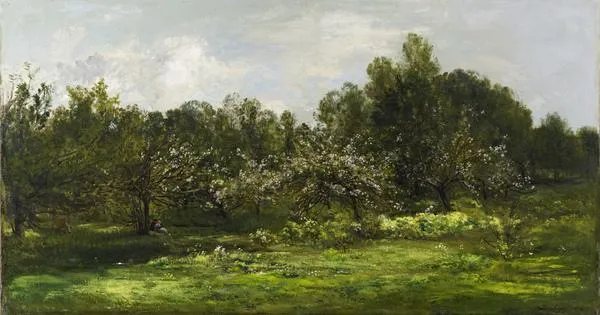
Charles-François Daubigny's Orchard in Blossom (Les Pommiers en Fleur), dated 1874, belongs to National Galleries Scotland and is located at the Scottish National Gallery. It is a wide, spring landscape of apple trees in flower by a painter who linked the Barbizon generation with the Impressionists.
Where to see it
Orchard in Blossom (Les Pommiers en Fleur) is in the collection of National Galleries Scotland, with its location recorded as the Scottish National Gallery. Display arrangements can change because of rehangs, conservation or loans, so check the official National Galleries Scotland website for current display status before you plan your visit.
What to look for in person
A wide, horizontal view
The painting measures 85 cm high by 157 cm wide, almost twice as wide as it is tall. That stretched format suits a landscape: it lets the orchard spread sideways rather than stack upward, so the eye travels across the scene instead of into a single focal point. Start by standing well back to take in the full width, then walk slowly from one end to the other. Notice how the composition holds together without one dominant feature, and how the low, broad shape gives the view a calm, open feeling.
Blossom made from paint
Move closer and look at how the flowering trees are built up. Daubigny's later landscapes are known for broad, visible brushwork, and critics in his own time sometimes complained that his pictures looked unfinished, like sketches. In front of this orchard, watch how the blossom reads as a soft mass of pale colour from a distance but breaks into separate touches of paint up close. Shifting between those two viewing distances is one of the most rewarding ways to spend time with this picture.
A bridge to Impressionism
Daubigny was a key figure of the Barbizon school, a group of French painters who turned to direct observation of the countryside. He is widely regarded as an important forerunner of Impressionism: he worked outdoors, often painted from a studio boat on the rivers of northern France, and supported younger artists such as Claude Monet. As you look, consider how the interest in seasonal light and fleeting effects here anticipates what the Impressionists would soon make central to their work.
About the painting
Charles-François Daubigny was one of the leading French landscape painters of the nineteenth century and is usually grouped with the Barbizon school, the painters who rejected idealised, studio-composed scenery in favour of the real French countryside. Unlike some of his Barbizon colleagues, who focused on the forest of Fontainebleau, Daubigny became especially associated with rivers. He famously fitted out a boat, which he called Le Botin, as a floating studio, allowing him to paint the banks of the Seine and the Oise directly from the water. This commitment to working in front of the motif, and his attention to the changing light of particular seasons and times of day, made him an important example for the younger generation. Daubigny also used his position on the official Salon jury to support emerging artists, and he encouraged Claude Monet; Vincent van Gogh later expressed great admiration for his work. Orchard in Blossom (Les Pommiers en Fleur) is dated 1874, a period in Daubigny's late career when his handling had become freer and more broadly brushed. Flowering orchards were a favoured subject in French landscape painting of this era, offering painters a chance to capture a brief moment of spring. When you visit, it helps to think of the picture less as a detailed record of trees and more as an attempt to convey the look and feel of a season. The painting is part of the collection of National Galleries Scotland and is located at the Scottish National Gallery. Its generous size, 85 by 157 cm, rewards viewing from several distances, so allow time to step back and then come close.
Key facts
| Artist | Charles-François Daubigny |
|---|---|
| Date | 1874 |
| Size | 85 × 157 cm |
| Medium | oil paint, canvas |
| Collection | National Galleries Scotland |
How to visit: National Gallery
London, United Kingdom · Museum guide
| Opening hours | Mon–Thu, Sat, Sun 10:00–18:00 Fri 10:00–21:00 (Friday late) |
|---|---|
| Closed | 24–26 December and 1 January. |
| Admission | General admission (collection) free; donations invited Some exhibitions are charged (e.g. Renoir and Love, until 31 Jan 2027) |
| Free entry | General admission is always free. |
| Booking | No reservation or timed entry is required. Free timed booking gives fast-track entry. |
Building work and improvements are under way: some rooms are closed and some paintings have moved, so check the floorplans or collection search before visiting. A new Research Centre is due to open in 2028. On 17 November only, some east wing rooms and the Espresso Bar close from 16:00.
Official ticket page
Official website
View on map
Hours and prices can change. Please check the official website before you go. (Checked on: 2026-11-11)