Art! Art! Art! › Works
Oedipus and the Sphinx
 Gustave Moreau, 1864
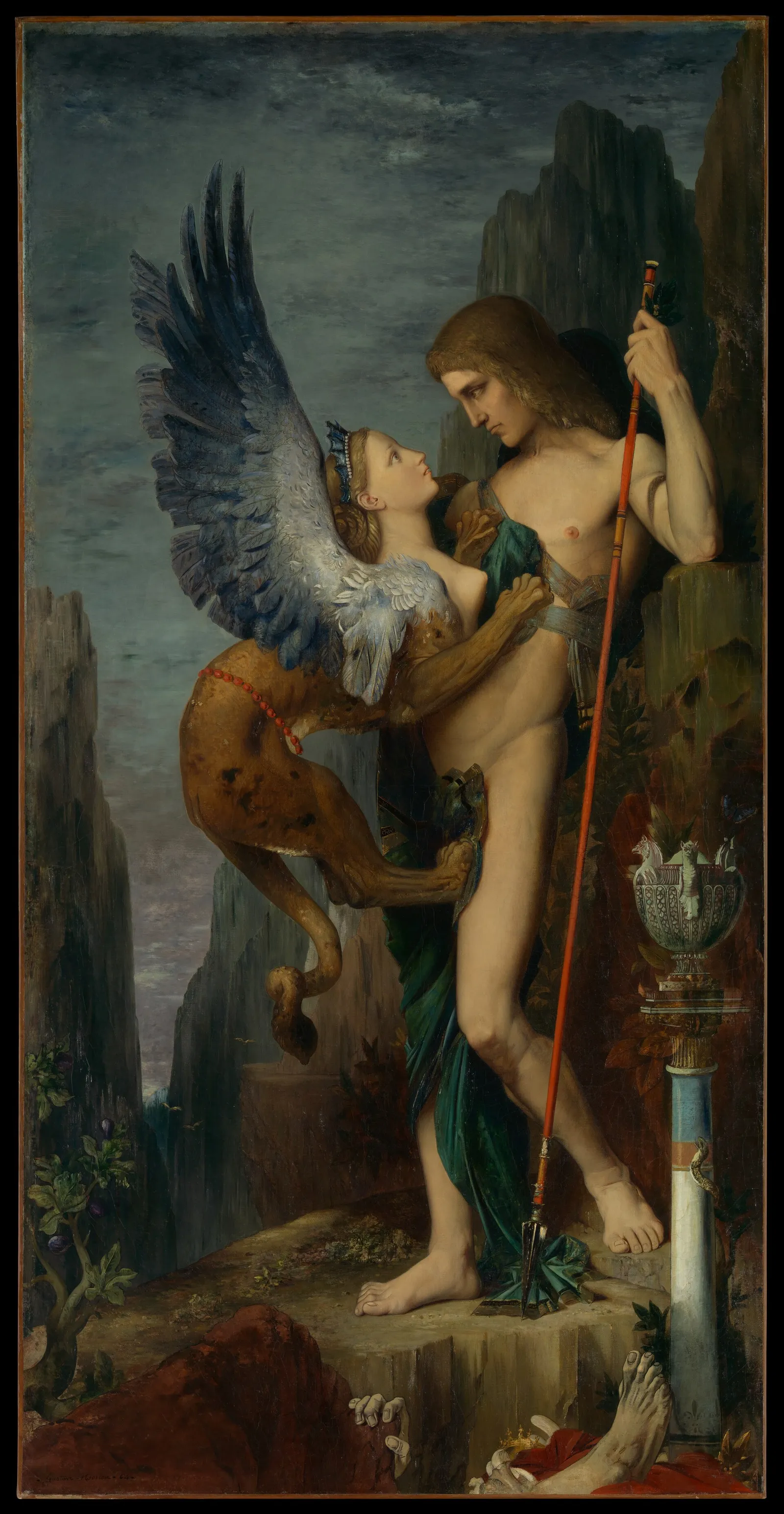
Gustave Moreau's Oedipus and the Sphinx, dated 1864, shows the Greek hero face to face with the winged monster whose riddle has destroyed every traveler before him. The painting belongs to the Metropolitan Museum of Art, where visitors can study its tense, close-up encounter and its carefully worked detail.
Where to see it
Oedipus and the Sphinx is in the collection of the Metropolitan Museum of Art, and that is the museum to visit to see it. Works are sometimes moved, rotated or lent to other institutions, so check the Metropolitan Museum of Art's official website for current display status before you plan your visit.
What to look for in person
The locked gaze
The Sphinx, with a woman's head and breasts, a lion's body and wings, has sprung onto Oedipus and grips his chest with her claws. Neither figure moves; they stare into each other's eyes at very close range. Stand back first to see how the two bodies form a single, tight vertical group, then step closer to study the faces. Oedipus appears calm and controlled while the creature presses against him, and the tension of the scene comes from this stillness rather than from violent action.
Remains at the lower edge
Look down to the bottom of the canvas. Moreau placed fragments of the Sphinx's earlier victims among the rocks, including a hand and a foot belonging to bodies lying below the ledge. These details are easy to miss if you only look at the two central figures, yet they make the stakes of the encounter clear: those who failed to answer the riddle did not survive. The contrast between the smooth, carefully modeled main figures and these grim fragments is a key part of the picture's effect.
Tall format and fine detail
At 206 by 105 centimeters, the canvas is roughly twice as tall as it is wide, and this format squeezes the figures into a narrow rocky pass. Take time over the precise finish of the bodies and the ornamental, almost jewel-like treatment of the Sphinx's wings and headdress, as well as the small symbolic objects placed around the figures. Close looking rewards visitors here: meticulous detail and dense symbolism are characteristic of Moreau's approach to mythological subjects throughout his career.
About the painting
Gustave Moreau was a French painter best known for mythological and biblical subjects treated with rich ornament and a mood of quiet, charged stillness. Oedipus and the Sphinx, dated 1864, is among his most widely recognized works and is often discussed as the painting that first brought him broad public attention in Paris. The subject comes from Greek myth. The Sphinx guarded the road to Thebes and posed a riddle to travelers, killing those who could not answer. Oedipus solved it, and the creature's power was broken. Moreau does not show the answer or the defeat; he chooses the moment of confrontation, with the monster pressed against the hero and both held in a silent exchange of looks. Art historians commonly connect the picture with Jean-Auguste-Dominique Ingres's earlier treatment of the same theme, and comparing the two helps explain Moreau's choices: where earlier versions tend to separate the figures, Moreau brings them into intimate, uneasy contact. The large vertical canvas, 206 by 105 centimeters, gives the figures near life-size presence. In the gallery, it is worth alternating between distance and proximity. From afar the composition reads as a single upright mass of rock and bodies; up close, the finely handled surfaces, decorative details and the remains of victims at the lower edge reveal how much thought went into every part of the scene. The painting is frequently seen as an early sign of the interests that later made Moreau important to Symbolist artists and writers.
Key facts
| Artist | Gustave Moreau |
|---|---|
| Date | 1864 |
| Size | 206 × 105 cm |
| Medium | oil paint, canvas |
| Collection | Metropolitan Museum of Art |
| Gallery | Gallery 800 Checked in the museum's open data on 2026-11-12 (galleries can change) Source |
How to visit: Metropolitan Museum of Art
New York City, United States · Museum guide
| Opening hours | Sun, Mon, Tue, Thu 10:00–17:00 Fri, Sat 10:00–21:00 |
|---|---|
| Closed | Wednesdays; Thanksgiving Day, 25 December, 1 January and the first Monday in May |
| Admission | Adults USD 30 Seniors (65 and over) USD 22 Visitors with a disability (in person only) USD 22 Students USD 17 Children (12 and under) free Care partners of visitors with a disability (in person only) free New York State residents; NY, NJ and CT students: pay what you wish (minimum USD 0.01). Online requires a NY State billing address; NJ/CT students in person with student ID |
| Free entry | Free for children 12 and under, Members and Patrons, and care partners of visitors with a disability. Pay what you wish for New York State residents and NY/NJ/CT students. |
| Booking | No reservation is required and there is no timed entry. |
The Cantor Roof Garden, the Modern and Contemporary Galleries, and the Ancient West Asia and Ancient Cyprus Galleries are closed for renovation.
Official ticket page
Official website
View on map
Hours and prices can change. Please check the official website before you go. (Checked on: 2026-11-09)