Art! Art! Art! › Works
Landscape through a Window
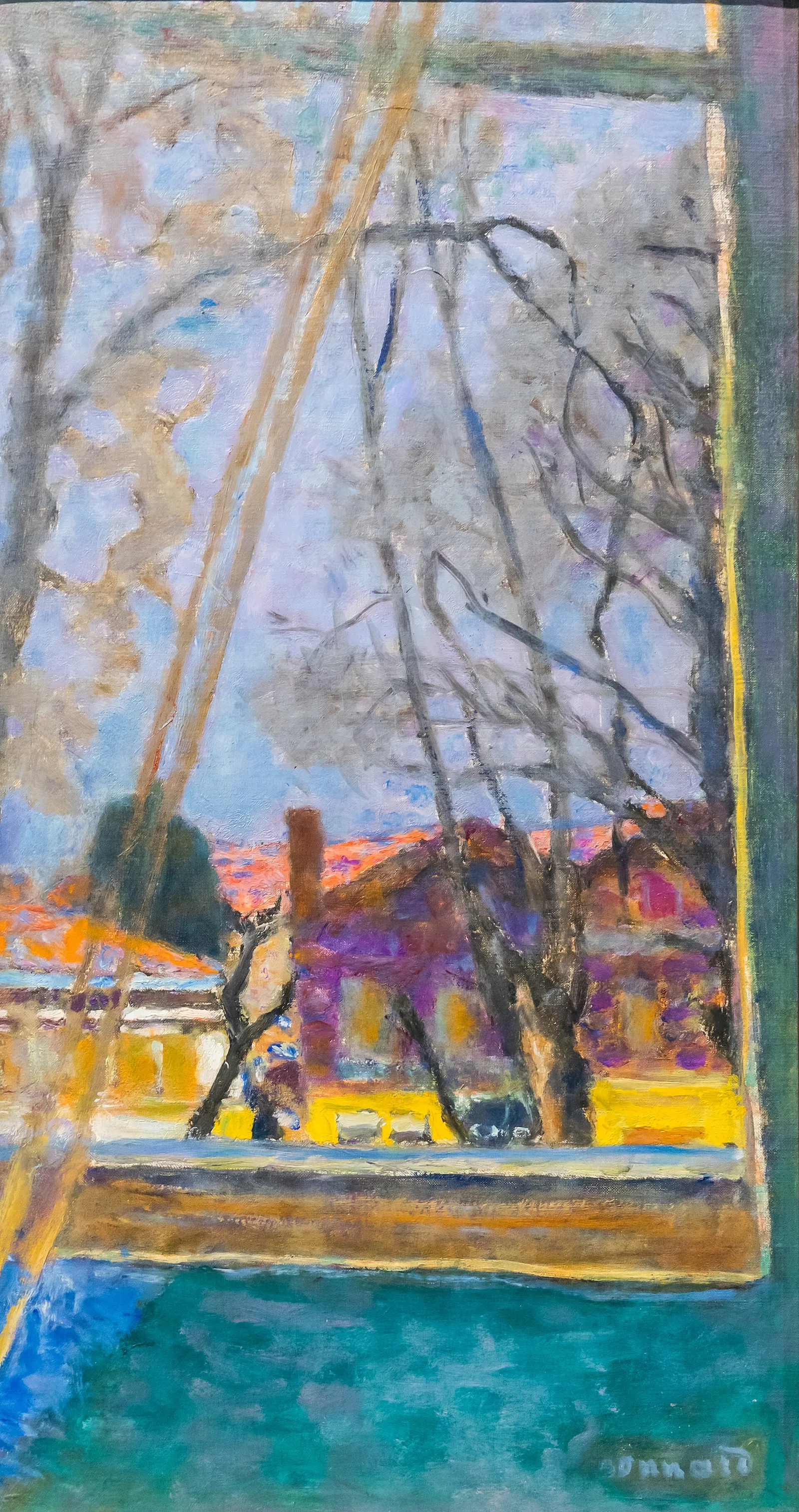
Pierre Bonnard's Landscape through a Window, dated 1918, is held at the Wallraf–Richartz Museum as part of the Fondation Corboud collection. It is a tall, narrow canvas, and its title points to a theme Bonnard returned to often: an outdoor view framed by the edges of a window.
Where to see it
Landscape through a Window belongs to the Fondation Corboud and the Wallraf–Richartz Museum, and it is located at the Wallraf–Richartz Museum. Works in a collection are not always on view, because pictures are rotated, lent or taken off display for conservation. Before you plan a trip around this painting, check the Wallraf–Richartz Museum's official website or contact the museum to confirm that it is currently on display.
What to look for in person
A tall, narrow format
The canvas measures 61 cm high by 33.3 cm wide, so it is almost twice as tall as it is wide. That upright shape suits a subject seen through a window, which already acts as a vertical frame. Stand back first and notice how the narrow format guides your eye up and down rather than across. Then move closer. At this modest size the picture rewards a near view, where individual brushstrokes and colour shifts become visible.
Inside and outside at once
Bonnard often painted views from windows and doorways, where the room around the viewer and the landscape beyond share the same picture. As you look, try to sort out what belongs indoors and what lies outside, and where the boundary between them falls. In many of his window pictures that line is deliberately soft, with interior and exterior blending into one surface of colour. Use this canvas to test how clearly, or how loosely, the two spaces are separated here.
Colour built up in layers
Bonnard is known as a colourist who worked his paint in layers, letting tones sit next to and over one another so that light seems to come from the colour itself rather than from sharp outlines. In front of the canvas, look for places where one hue shows through another and where edges dissolve. Compare the brightness of the view outside with the tones near the frame. Small, close-up observations like these reveal how he constructed the sense of light.
About the painting
Pierre Bonnard, a French painter, made Landscape through a Window in 1918, near the end of the First World War. By then he was an established artist. In the 1890s he had been associated with the Nabis, a group of young painters who valued flat, decorative arrangements of colour over strict imitation of nature. In the following decades his work moved towards richer, more luminous colour, and he became especially known for domestic interiors, gardens and landscapes, often combined in a single view. The window was one of his most useful devices. It allowed him to place the intimate space of a room next to open countryside, and to treat the frame of the window as part of the composition rather than a neutral border. Bonnard is widely understood to have worked largely from memory and sketches rather than painting directly before his subject, which helps explain why his pictures can feel more like recollected impressions than exact records. This painting is a fairly small, upright canvas of 61 by 33.3 centimetres. It is part of the Fondation Corboud holdings at the Wallraf–Richartz Museum, a collection known for its strength in Impressionist and Post-Impressionist painting. Seeing it there gives visitors a chance to consider Bonnard alongside the broader French tradition he drew on and departed from. When you visit, allow time to view it from a few steps away and then up close, since both distances show different aspects of how the picture works.
Key facts
| Artist | Pierre Bonnard |
|---|---|
| Date | 1918 |
| Size | 61 × 33.3 cm |
| Medium | oil paint, canvas |
| Collection | Fondation Corboud / Wallraf–Richartz Museum |
How to visit: Wallraf–Richartz Museum
Cologne, Germany
Hours and prices can change. Please check the official website before you go.