Art! Art! Art! › Works
Jupiter, Mercury and Virtue
 Dosso Dossi, 1523
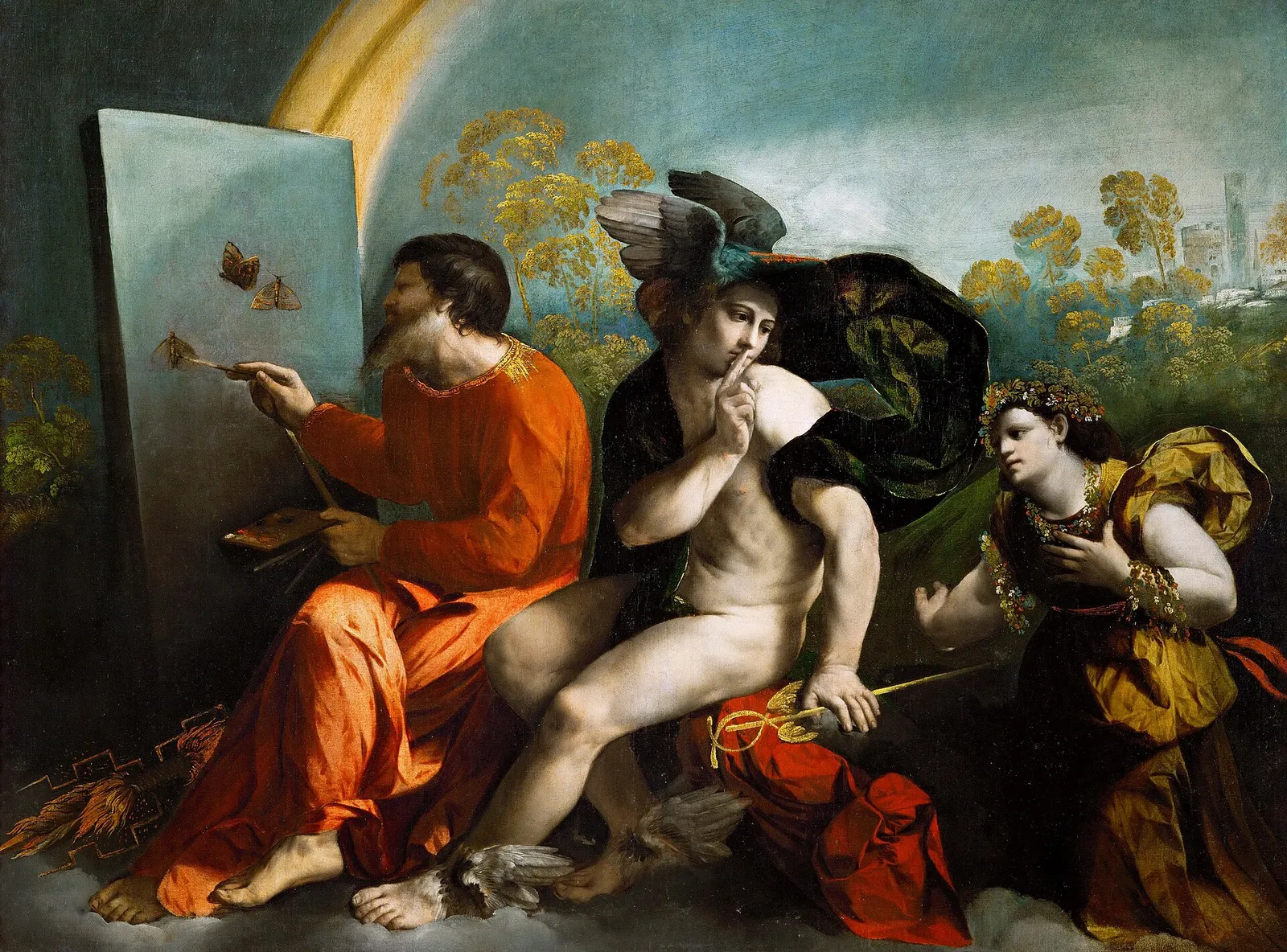
Dosso Dossi's Jupiter, Mercury and Virtue is an oil on canvas dated 1523 that shows the king of the gods busy at an easel, painting butterflies. It is held at Wawel Castle in Kraków, Poland, and it rewards slow looking at its gestures, attributes and quiet humour.
Where to see it
Jupiter, Mercury and Virtue is in the collection of Wawel Castle in Kraków, Poland. The canvas measures 111.3 × 150 cm, so it is a mid-sized, horizontal picture that is best viewed from a few steps back before moving in for detail. Display arrangements can change, so check Wawel Castle's official website for current display status, opening hours and ticketing before you visit.
What to look for in person
Jupiter at the easel
Start on the left, where Jupiter sits painting butterflies onto a canvas. Look closely at his face: his eyes are closed as he works, a detail that turns the scene into something playful and puzzling at once. His thunderbolt, the usual sign of his power, lies discarded at his feet rather than in his hand. Behind the easel a rainbow arcs through the sky. Take a moment to compare the small, delicate butterflies on his canvas with the broad landscape and figures around him.
Mercury calls for silence
In the centre, Mercury sits on a red drapery that anchors the middle of the composition. His attributes are easy to spot once you know them: the petasos, or traveller's hat, on his head, winged sandals on his feet and a golden caduceus in his hand. Notice the direction of his gesture. He signals for silence toward the woman approaching from the right, effectively standing between her and the absorbed Jupiter. Following his hand is the simplest way to read the story from left to right.
The woman arriving from the right
The figure entering on the right has traditionally been identified as Virtue, as the painting's title suggests. Look at the details of her appearance: a crown of flowers, garlands, bare arms and a dress in three parts that seems to be caught by the wind. Her movement contrasts with the stillness of the two seated gods. Because of these attributes, some writers have proposed reading her differently, so it is worth looking at her carefully and asking yourself what kind of visitor Dosso has painted.
About the painting
Dosso Dossi was one of the leading painters at the court of the Este dukes in Ferrara, and this canvas belongs to that courtly world. It was commissioned by Duke Alfonso I d'Este and was intended for his bedchamber in the Castello del Belvedere, a private setting where an erudite, witty subject would have suited a learned owner and his guests. The fact sheet gives the date as 1523; the Italian Wikipedia places it around 1523–1524.
The subject comes from a literary source: Leon Battista Alberti's intercenale titled Virtus, one of his short Latin pieces. Rather than illustrating a famous myth, Dosso builds a scene around the gods' indifference: Jupiter is absorbed in painting butterflies, his thunderbolt set aside, while Mercury hushes the woman who has come to approach them. The joke depends on the viewer recognising the conventional attributes of each god and noticing how they are being used, or ignored.
The picture also has a personal dimension. Jupiter's features have been compared to those of Alfonso I himself, which would make the god-as-painter a flattering, or teasing, image of the patron. The rainbow, the drifting butterflies and the wind-blown drapery show Dosso's interest in colour, light and atmosphere, qualities often associated with Ferrarese painting of this period.
When you stand in front of the work, read it as a sequence: the busy, eyes-closed painter on the left, the messenger god in the middle, and the arriving figure on the right. The meaning lies in how these three relate to one another.
Key facts
| Artist | Dosso Dossi |
|---|---|
| Date | 1523 |
| Size | 111.3 × 150 cm |
| Medium | oil paint, canvas |
| Collection | Wawel Castle |
How to visit: Wawel Castle
Kraków, Poland
Hours and prices can change. Please check the official website before you go.
Sources
- Wikidata Q1282794
- Wikipedia (it) (CC BY-SA 4.0)
- Wikipedia (es) (CC BY-SA 4.0)