Art! Art! Art! › Works
Judith Beheading Holofernes
 Artemisia Gentileschi, 1620
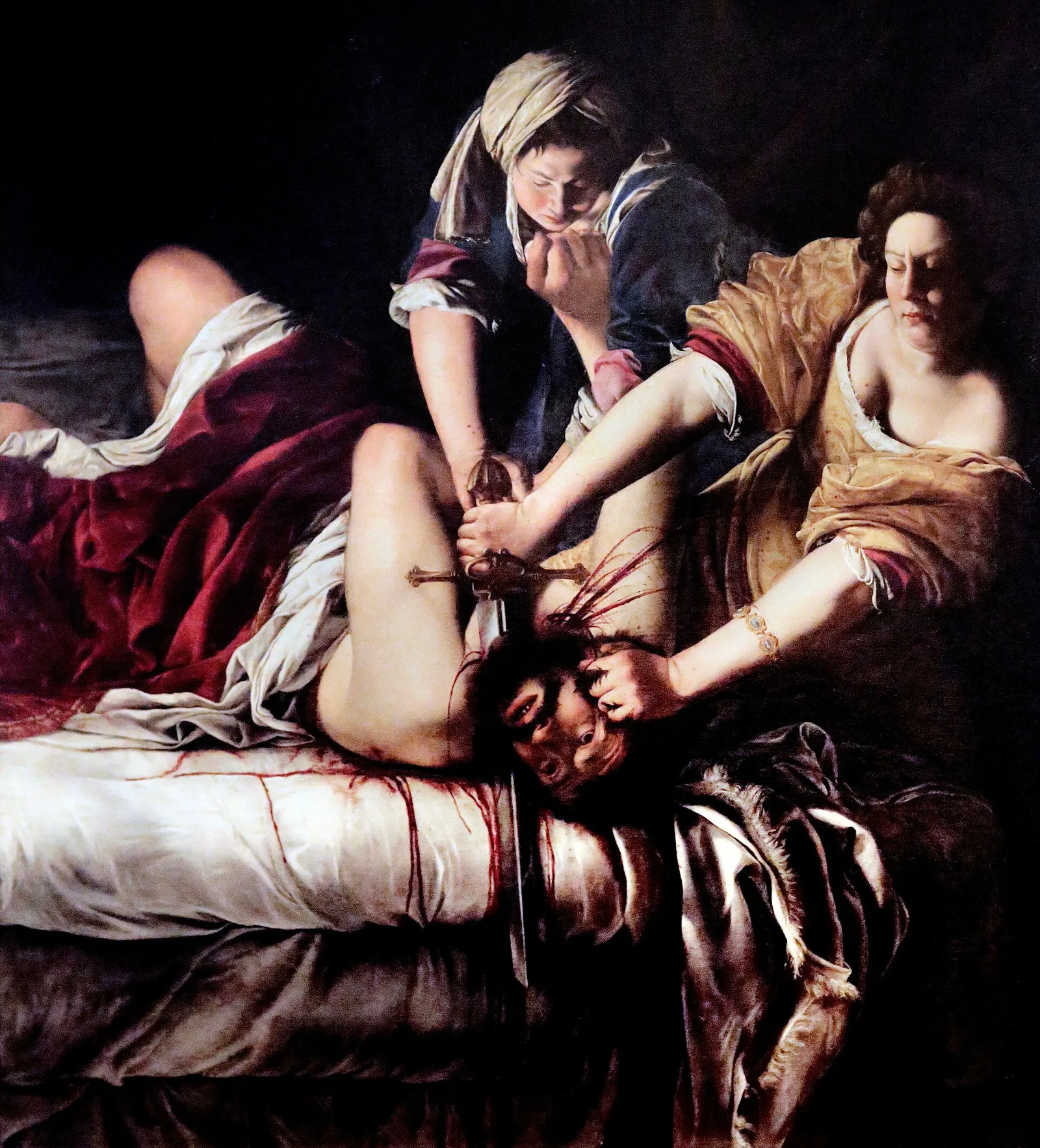
Judith Beheading Holofernes is a large Baroque canvas dated 1620 and held by the Uffizi Gallery in Florence. It shows the climactic moment of the Old Testament story of Judith, painted with stark contrasts of light and shadow and an unflinching physical directness that draws visitors in close.
Where to see it
The painting is in the collection of the Uffizi Gallery, and its location is listed as the Uffizi Gallery. Display arrangements at major museums can change because of rehanging, conservation or loans, so check the Uffizi Gallery's official website for current display status, opening hours and ticketing before you visit. The canvas measures 199 x 162.5 cm, so expect a large, near life-size scene that is best seen first from a few steps back and then up close.
What to look for in person
Two women acting together
Look first at how the action is shared. Judith does not act alone: her maidservant leans over the bed and pins Holofernes down with her full weight while Judith grips his hair and draws the sword through his neck. The arms of all three figures converge on the centre of the picture, forming a tight knot of limbs around the blade. Follow the lines of those arms and you will see how the composition pushes your eye straight to the point of violence, leaving little room for distraction.
Light carved out of darkness
The figures are lit by a strong, raking light against an almost black background, a technique associated with Caravaggio and his followers. Notice how the light falls on faces, forearms and the white bed linen while everything else sinks into shadow. This contrast makes the scene feel close and theatrical, as if lit by a single source in a dark tent. Step back to see the overall pattern of light shapes, then move in to see how flesh, fabric and steel each catch the light differently.
Blood, fabric and close detail
Up close, the painting rewards slow looking. Watch for the fine arcs of blood spraying from the wound and the dark stains soaking into the white sheets, details that give the scene its well-known physical intensity. Compare the textures: the heavy folds of Judith's gown, the crumpled bedclothes, the red cover over Holofernes' body and the hard edge of the sword. Look also at the jewellery on Judith's arm, a small decorative detail placed right beside the most brutal part of the picture.
About the painting
The subject comes from the Book of Judith. Judith, a widow from the besieged town of Bethulia, enters the camp of the Assyrian general Holofernes, and when he lies drunk in his tent she and her maidservant kill him, saving her people. The episode was a popular theme in European art, often presented as an image of courage or virtue overcoming tyranny. Many earlier treatments show Judith calmly holding the severed head after the deed. This painting instead shows the act itself, in progress, with both women physically straining against the resisting general.
The work is by Artemisia Gentileschi, one of the most prominent painters of the Italian Baroque, and is dated 1620 in the source data. She had painted the same subject in an earlier version, now in Naples, and the Uffizi canvas is generally regarded as a later, larger reworking of that composition. The influence of Caravaggio, whose own painting of Judith and Holofernes is in Rome, is widely recognised in the dramatic lighting, the dark background and the realism of the figures.
For visitors, the painting is a strong example of how Baroque artists used light, gesture and tight composition to make a story feel immediate. At 199 x 162.5 cm, the figures are close to life-size, which adds to the sense of being a witness to the scene. Give yourself time to look both at the overall structure, the converging arms and pool of light, and at the small details of fabric, blood and jewellery that reveal the artist's control of paint.
Key facts
| Artist | Artemisia Gentileschi |
|---|---|
| Date | 1620 |
| Size | 199 × 162.5 cm |
| Medium | oil paint, canvas |
| Collection | Uffizi Gallery |
How to visit: Uffizi Gallery
Florence, Italy · Museum guide
| Opening hours | Tue–Sun 08:15–18:30 (visitors leave by 18:30) |
|---|---|
| Closed | Mondays, 1 January and 25 December. |
| Last entry | Ticket office closes at 17:30. |
| Admission | Regular, bought on the day EUR 25 Regular, bought in advance EUR 29 Regular, entry from 16:00 (from 1 January 2026) EUR 16 Reduced (EU citizens aged 18–25; citizens of Switzerland, Norway, Liechtenstein, Uruguay etc.; ID required) EUR 2 Under 18 free (under 12s must be accompanied) Uffizi + Vasari Corridor EUR 43 on the day / EUR 47 in advance; named ticket, reservation required, non-refundable PassePartout 5 days (Uffizi, Pitti Palace, Boboli) EUR 40 (EUR 58 with Vasari Corridor) Audio guide EUR 6 |
| Free entry | Free for under-18s; disabled visitors plus one companion; tour guides and interpreters, ICOM members, certain journalists, and university teachers/students on the official list. Admission is free on the first Sunday of each month (national museums), when reservations are not possible. |
| Booking | Reservation is not required, except for the Uffizi + Vasari Corridor ticket, which must be reserved. |
Restoration and rearrangement works mean some rooms are temporarily closed and some artworks are not on display. A staff assembly on 11–12 November 2026 may change opening times.
Official ticket page
Official website
View on map
Hours and prices can change. Please check the official website before you go. (Checked on: 2026-11-12)