Art! Art! Art! › Works
Jester with lute
 Frans Hals, 1623
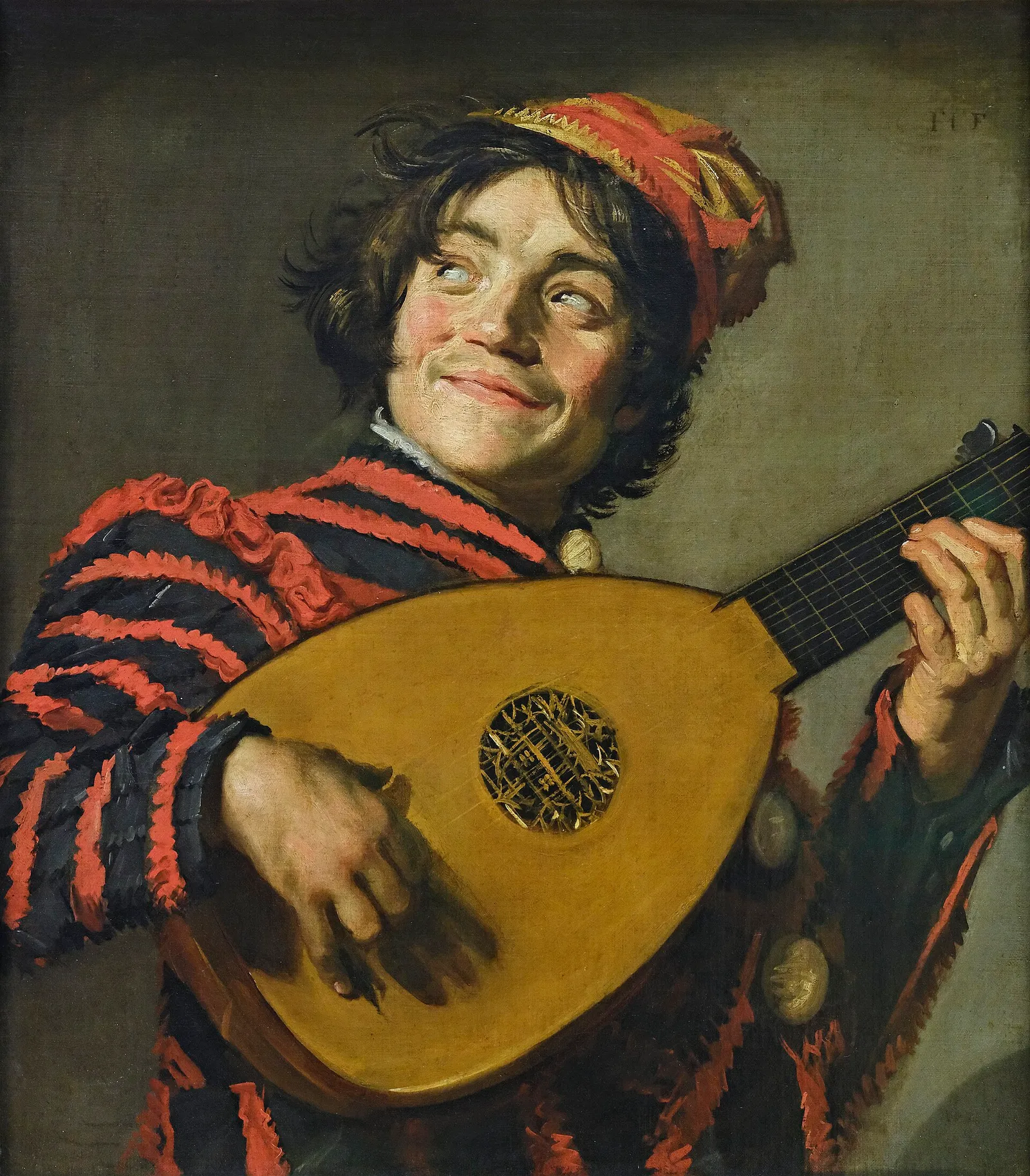
Frans Hals's Jester with lute, dated 1623, belongs to the Department of Paintings of the Louvre, where the fact sheet places it in Room 846. Measuring 70 by 62 cm, it shows a half-length musician caught mid-performance, painted with the quick, open brushwork that defines Hals's style.
Where to see it
Jester with lute is held by the Department of Paintings of the Louvre, and our fact sheet lists its location as Room 846. Displays change because of rehanging, conservation and loans, so check the Louvre's official website for the painting's current display status before you visit. At 70 x 62 cm it is a modest-sized canvas, so give yourself time to stand close. Most of what makes it rewarding is in the handling of the paint, which only shows up at short range.
What to look for in person
A face caught in motion
Start with the jester's face. Hals does not give us a posed, still sitter but someone in the middle of an expression, with a lively smile and a glance that seems to move past the viewer. Step close and notice how the features are built from separate, confident strokes rather than smoothly blended tones. Then step back a few paces and watch those marks resolve into a convincing, animated face. That shift between near and far viewing is one of the main pleasures of looking at Hals in person.
Hands and instrument
Follow the jester's hands to the lute. Hals sets the instrument close to the front of the picture, so the figure feels as if he is performing just for the person standing before him. Look at how the fingers are suggested with only a few touches of paint, yet still read as active and placed on the strings. The lute is a key part of the image's subject: music, entertainment and good humour, themes Hals returned to repeatedly in his single-figure genre paintings of the 1620s.
Brushwork in the costume
Turn your attention to the clothing and headwear. Here Hals's brush moves most freely, with broad, visible strokes laid down rapidly and left unblended. Rather than describing every fold or stitch, he uses the direction and thickness of the paint to suggest fabric and movement. Compare these loose passages with the slightly more worked areas of the face to see how he directs your eye. The 70 x 62 cm format keeps the half-length figure near life-sized in feel, which makes this handling easy to study up close.
About the painting
Frans Hals worked in Haarlem and is best known today as a portraitist, but in the 1620s he also painted a group of lively single figures: musicians, drinkers and laughing youths. These pictures were not formal portraits of named patrons in the usual sense. They were character studies meant to entertain, built around a mood, a gesture or an expression rather than a sitter's status. Jester with lute, dated 1623 on our fact sheet, belongs to this phase of his career. Art historians widely link these half-length musicians to a wider fashion in the Dutch Republic at the time, when painters in Utrecht, influenced by Caravaggio, produced close-up figures of musicians and merrymakers set against plain backgrounds. Hals took up the type but made it his own through speed and freshness of execution. Where many contemporaries aimed for smooth finish, he left his brushstrokes openly visible, so that the painting seems to record a fleeting moment. The figure of the jester or fool carried associations of performance, wit and licence to laugh, which suits Hals's interest in spontaneous expression. Hals's loose technique was later admired by nineteenth-century painters, who saw in it an early example of painterly freedom, and that reputation is part of why works like this one draw attention today. When you visit, it helps to treat the picture as a performance frozen in paint: read the expression, follow the hands to the instrument, and then look at how few strokes Hals needed to make it all convincing. The painting is now part of the Department of Paintings of the Louvre.
Key facts
| Artist | Frans Hals |
|---|---|
| Date | 1623 |
| Size | 70 × 62 cm |
| Medium | oil paint, canvas |
| Collection | Department of Paintings of the Louvre |
| Gallery | Room 846, Richelieu wing, level 2 Checked in the museum's open data on 2026-11-12 (galleries can change) Source |
How to visit: Louvre Museum
Paris, France · Museum guide
| Opening hours | Mon, Thu, Sat, Sun 09:00–18:00 Wed, Fri 09:00–21:00 (evening opening) Rooms are cleared 30 minutes before closing |
|---|---|
| Closed | Every Tuesday; 1 January, 1 May and 25 December. Other public holidays are open unless they fall on a Tuesday. |
| Last entry | 1 hour before closing |
| Admission | Adult (non-EEA visitors) EUR 32 Adult (EEA citizens and residents) EUR 22 Under 18 free (ID required) EEA citizens/residents under 26 free (photo ID; residents also need a residence permit of over 90 days) Audio guide rental EUR 6 (can be booked in advance online) Rates apply from 14 January 2026 |
| Free entry | Free for under-18s, EEA citizens/residents under 26, all visitors on the first Friday of the month after 18:00 (except July and August) and on 14 July, and disabled visitors plus one carer. Also free with proof for EEA art and art-history teachers, ICOM members, journalists, EEA job seekers and EEA residents on income support. |
| Booking | Entry is by timed slot, and booking in advance is recommended. |
The Cour Carrée entrance is currently closed. On Thursday 12 November 2026 the museum may open later and some exhibition rooms may remain closed.
Official ticket page
Official website
View on map
Hours and prices can change. Please check the official website before you go. (Checked on: 2026-11-11)
