Art! Art! Art! › Works
Jan Gerritsz. van Egmond, bailli de Nieuwburg
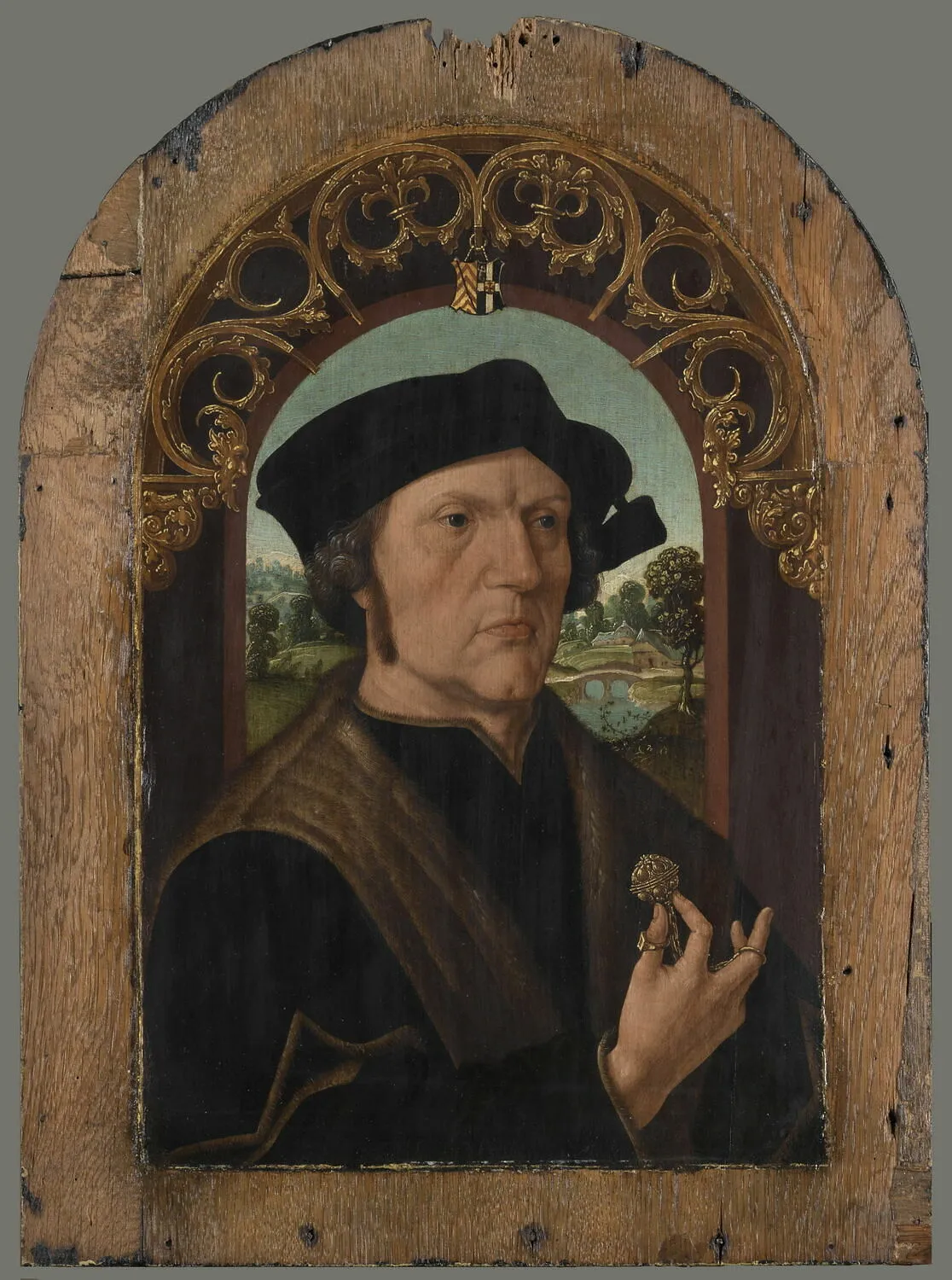
Jacob Cornelisz. van Oostsanen's portrait of Jan Gerritsz. van Egmond, bailli de Nieuwburg, dates from 1516 and belongs to the Department of Paintings of the Louvre. It is a small, close-range likeness of a regional official, made by one of the leading painters working in Amsterdam in the early sixteenth century.
Where to see it
The portrait is held by the Department of Paintings of the Louvre, and its recorded location is Louvre Museum storage. This means it may not be on public display. Check the Louvre's official website, or contact the museum, for current display status before you plan a visit around this work.
What to look for in person
An intimate format
The panel measures 46.5 by 35 cm, a little smaller than a sheet of newspaper. This modest size was common for private portraits in the Low Countries at the time. Such works were made to be seen up close in a home rather than across a large hall. If you are able to see it, stand near enough to view it as its first owners would have. At this distance you can follow the fine handling of skin, hair and fabric that painters of this tradition were known for.
A named official, not an anonymous face
The title identifies the sitter by name and by office: Jan Gerritsz. van Egmond, bailiff of Nieuwburg. A bailiff was a local official who acted for a lord or ruler, especially in matters of justice and administration. That role gives a clue to how a portrait like this worked. It recorded a specific person and his public standing. As you look, notice how the painter presents the sitter's dress, bearing and expression. These were the main ways such portraits signalled rank and character.
A dated work from a key moment
The portrait is dated 1516, during the middle of Jacob Cornelisz.'s career. In these years, Netherlandish painting still kept its native traditions of exact observation, while some artists were also starting to respond to new influences. Use the date as a reference point. Compare this work with other early sixteenth-century Netherlandish portraits in the Louvre's collection. Look for how the likeness is set against its background, and how the painter balances careful detail with an overall sense of the sitter's presence.
About the painting
Jacob Cornelisz. van Oostsanen was a painter and designer of woodcuts who ran a busy workshop in Amsterdam in the early sixteenth century. His name refers to Oostzaan, a village north of Amsterdam that is generally given as his place of origin. He is best known for religious paintings and for many woodcut designs. He also painted portraits of people from the region, and this work is one of them. He is often noted as the early teacher of Jan van Scorel, who went on to bring Italian ideas into Netherlandish painting.
The portrait shows Jan Gerritsz. van Egmond, whom the title calls bailiff of Nieuwburg. The title as recorded is partly in French, the language of the Louvre's catalogue. It names the man and the office that defined his public role. The painting is dated 1516 and measures 46.5 by 35 cm. That is a size suited to private viewing and typical of portraits from this region and period.
For visitors, the main interest is the chance to look closely at a Northern Renaissance portrait of a known individual. Painters in this tradition were valued for capturing a person's features and clothing with patience and precision. The small scale invites slow, close looking. Today the work belongs to the Department of Paintings of the Louvre, and its recorded location is the museum's storage. Anyone hoping to see it should check the Louvre's official website for current display information before visiting.
Key facts
| Artist | Jacob Cornelisz. van Oostsanen |
|---|---|
| Date | 1516 |
| Size | 46.5 × 35 cm |
| Medium | oil paint, panel |
| Collection | Department of Paintings of the Louvre |
How to visit: Louvre Museum
Paris, France · Museum guide
| Opening hours | Mon, Thu, Sat, Sun 09:00–18:00 Wed, Fri 09:00–21:00 (evening opening) Rooms are cleared 30 minutes before closing |
|---|---|
| Closed | Every Tuesday; 1 January, 1 May and 25 December. Other public holidays are open unless they fall on a Tuesday. |
| Last entry | 1 hour before closing |
| Admission | Adult (non-EEA visitors) EUR 32 Adult (EEA citizens and residents) EUR 22 Under 18 free (ID required) EEA citizens/residents under 26 free (photo ID; residents also need a residence permit of over 90 days) Audio guide rental EUR 6 (can be booked in advance online) Rates apply from 14 January 2026 |
| Free entry | Free for under-18s, EEA citizens/residents under 26, all visitors on the first Friday of the month after 18:00 (except July and August) and on 14 July, and disabled visitors plus one carer. Also free with proof for EEA art and art-history teachers, ICOM members, journalists, EEA job seekers and EEA residents on income support. |
| Booking | Entry is by timed slot, and booking in advance is recommended. |
The Cour Carrée entrance is currently closed. On Thursday 12 November 2026 the museum may open later and some exhibition rooms may remain closed.
Official ticket page
Official website
View on map
Hours and prices can change. Please check the official website before you go. (Checked on: 2026-11-11)