Art! Art! Art! › Works
Hope
 George Frederic Watts, 1886
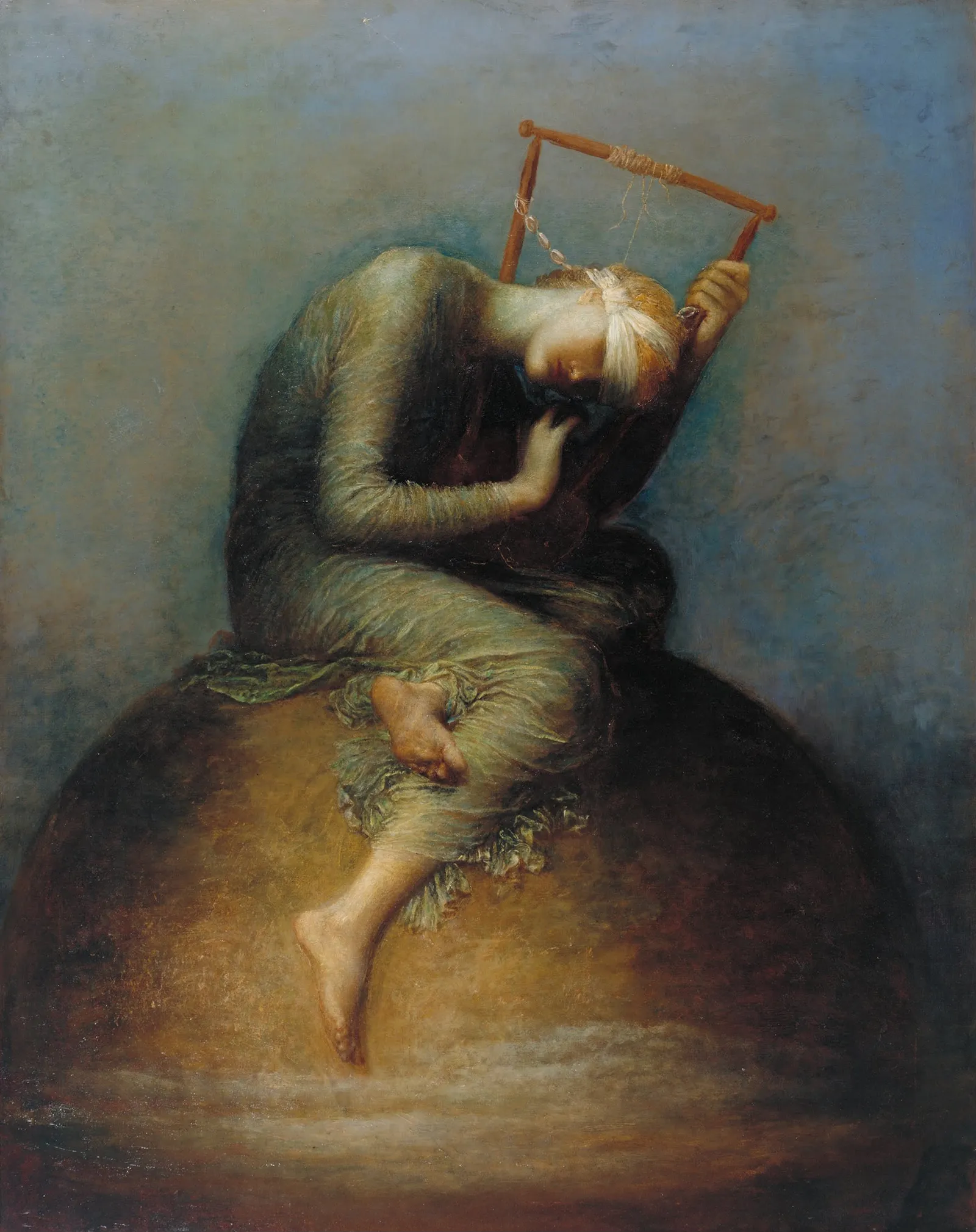
George Frederic Watts's Hope, dated 1886, shows a blindfolded woman seated on a globe, leaning close to a lyre to hear its last remaining string. The painting is in the Tate collection and is located at Tate Britain. In person, it rewards slow looking: its quiet colour and small details carry the meaning.
Where to see it
Hope is located at Tate Britain and belongs to the Tate collection; the fact sheet also lists the National Gallery in connection with the collection. Works are sometimes moved, rested or lent, so check Tate's official website for the painting's current display status before you visit.
What to look for in person
The single string
Look closely at the lyre in the figure's hands. Almost all of its strings are broken, and only one remains. She bends her head toward it, as if straining to catch a faint note. This is the centre of the picture's idea: hope is not shown as triumph, but as the effort to keep listening when very little is left. Stand near enough to see how lightly the string is painted, and how the composition guides your eye to that one point.
Blindfold and globe
The woman's eyes are covered with a bandage, so she cannot see her surroundings. She sits, hunched and barefoot, on a globe that seems to float in a hazy space. Together these details suggest isolation and uncertainty rather than comfort. Notice her posture: the curve of her back and her inclined head make the figure feel fragile. Watts uses the body itself, rather than any setting or story, to carry the mood of the painting.
Muted colour and the faint star
The palette is restrained, built mainly from soft blues, greens and greys that blend the figure into the misty background. Edges are softened, and the surface can look almost veiled. Let your eyes adjust and search the upper part of the canvas, where a small, pale star appears in the darkness. It is easy to miss at first. That faint point of light adds a quiet note of possibility to an otherwise subdued scene.
About the painting
George Frederic Watts was a Victorian painter and sculptor who wanted art to deal with large moral and spiritual ideas. Rather than illustrating a particular story from myth or scripture, many of his later paintings present personified ideas, such as love, death or time, as single, simplified figures. Hope, dated 1886, is one of the best-known examples of this approach.
The picture is usually discussed alongside Symbolism, the broad European movement that favoured suggestion, mood and allegory over direct description. Watts's handling suits that aim. Forms are softened, the space is undefined, and the colour is kept within a narrow, cool range, so that the viewer reads the scene as an idea rather than a real place.
What makes Hope distinctive is its refusal to show hope as easy. Traditional images of Hope often used an anchor or an upward gaze. Watts instead shows a blind figure with a nearly ruined instrument, still listening. Some early viewers found the image closer to despair than hope; others saw in it a more honest picture of persistence. That tension is a large part of why the painting has continued to attract attention.
Watts is known to have painted more than one version of this composition. The work described here is the one listed in the fact sheet: dated 1886, in the Tate collection, and located at Tate Britain, with recorded dimensions of 111.8 cm and 142.2 cm. When you visit, give yourself time in front of it; the details that carry its meaning, from the single string to the faint star, only emerge with patient looking.
Key facts
| Artist | George Frederic Watts |
|---|---|
| Date | 1886 |
| Size | 111.8 × 142.2 cm |
| Medium | oil paint, canvas |
| Collection | Tate / National Gallery |
How to visit: Tate Britain
London, United Kingdom · Museum guide
| Opening hours | Mon–Sun 10:00–18:00 (galleries start closing at 17:50) |
|---|---|
| Closed | 24–26 December (all Tate galleries, festive period). |
| Last entry | 17:30 |
| Admission | Collection (everyone): free, no booking needed Tate Collective (16–25) exhibition ticket: GBP 5 (free Tate Collective sign-up required) Family child ticket, ages 12–18 (exhibitions): GBP 5 Children 11 and under (exhibitions): free (up to four per parent/guardian) |
| Free entry | The collection is free for everyone. Exhibitions are free for Members, and some exhibitions are free for all (listed as FREE). Disabled visitors pay a concessionary rate; companions go free. |
| Booking | No reservation is required and there is no timed entry. |
The Millbank entrance is closed until 2027 for construction of the Clore Garden; use the Manton Entrance on Atterbury Street.
Official ticket page
Official website
View on map
Hours and prices can change. Please check the official website before you go. (Checked on: 2026-11-09)