Art! Art! Art! › Works
Gismonda
 Alfons Maria Mucha, 1894
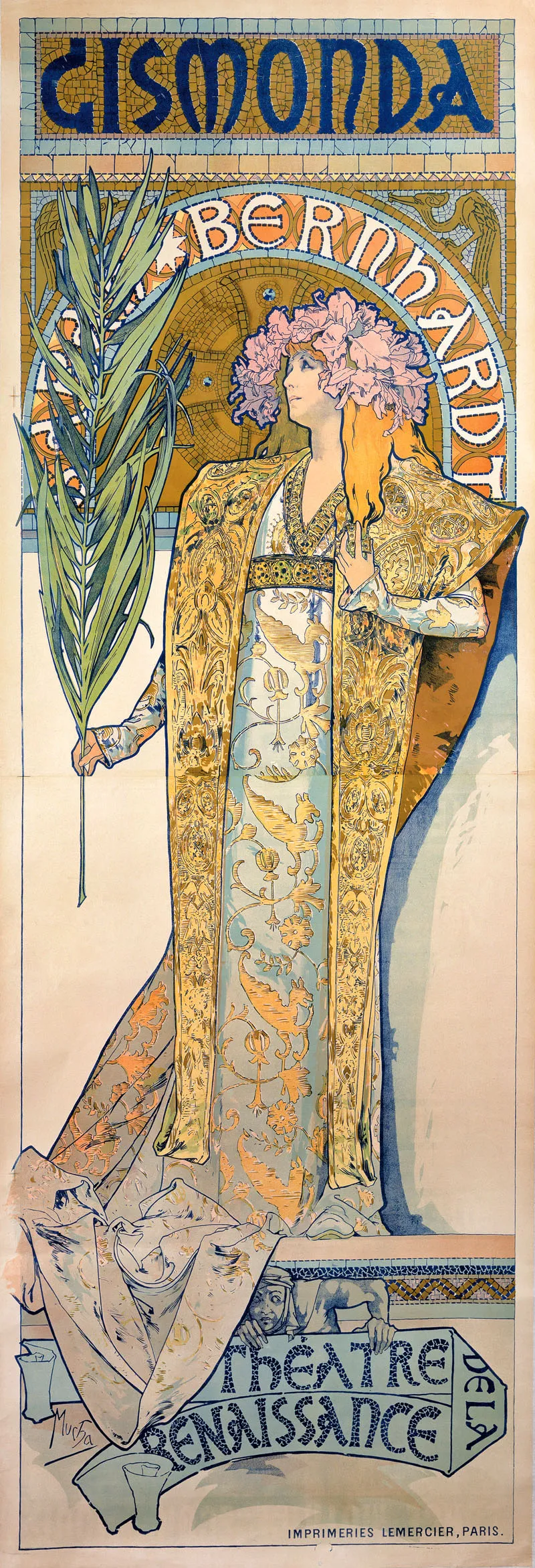
Gismonda, dated 1894, is the theatre poster that made Alfons Maria Mucha a household name in Paris. It shows the actress Sarah Bernhardt in a tall, narrow format, and it is held by the National Gallery Prague, with its location recorded as the Trade Fair Palace.
Where to see it
Gismonda belongs to the collection of the National Gallery Prague, and its recorded location is the Trade Fair Palace. Works on paper are often rotated or kept in storage to protect them from light, so check the National Gallery Prague's official website for current display status, opening hours and tickets before you plan your visit.
What to look for in person
A towering figure in a narrow frame
The format is unusually tall and slender, recorded at 198 by 67 centimetres, and Bernhardt's figure fills almost the full height. Stand back first to take in the vertical sweep, then move closer. Notice how the long robe falls in heavy folds toward the lower edge, drawing your eye downward, while her head sits high near the top. The proportions recall a church panel or a column more than a conventional theatre bill, which helps explain why the design stood out so sharply on the streets of Paris.
The palm branch and the costume
Bernhardt appears in the title role of Victorien Sardou's play Gismonda, a drama set in medieval Athens. She holds a palm branch, a reference to a Palm Sunday procession in the play. Look closely at the richly patterned costume and the flowers in her hair. Mucha chose soft, muted tones of gold, olive, rose and lilac rather than loud primary colours. This restrained palette and the careful decorative detail give the figure a calm, almost devotional presence that sets it apart from the more boisterous posters of the period.
Arch, mosaic and lettering working together
Behind the actress's head, an arched band carries the play's title, set against a pattern that evokes Byzantine mosaics. Her name runs across the top of the sheet, and the theatre's details sit in a panel near the bottom. Pay attention to how the lettering is built into the design rather than laid over it: text, ornament and figure form one composition. This close integration of word, decoration and the human figure became a defining feature of the style later associated with Mucha's name.
About the painting
Alfons Maria Mucha was a Czech artist working in Paris when he produced Gismonda, dated 1894. The poster advertised Sarah Bernhardt, the most celebrated actress of her day, in Victorien Sardou's play of the same name at the Theatre de la Renaissance, a theatre Bernhardt herself managed. Before this commission, Mucha was known mainly as an illustrator. The poster's appearance changed that: its elongated format, quiet colour and stately, almost icon-like treatment of the actress caught the attention of the Parisian public, and Bernhardt went on to work with Mucha on further posters and designs. The design is widely seen as a turning point in his career and as an early example of the decorative manner that became central to Art Nouveau poster design. For visitors, the value of seeing Gismonda in person lies in scale and surface. Reproductions shrink the work to a postcard, but in front of it you can register how the figure approaches human height and how the flat areas of colour, fine outlines and ornamental borders interact. Spend time on the transitions: from the patterned arch around the head, down through the folds of the robe, to the lettering at the base. It is also worth considering the poster's original purpose. It was made to be seen quickly on a city wall, yet it rewards slow looking, which is one reason it has passed from the street into a museum collection. Seeing it in the National Gallery Prague also connects the work to Mucha's Czech origins.
Key facts
| Artist | Alfons Maria Mucha |
|---|---|
| Date | 1894 |
| Size | 198 × 67 cm |
| Medium | tempera, canvas |
| Collection | National Gallery Prague |
How to visit: National Gallery
London, United Kingdom · Museum guide
| Opening hours | Mon–Thu, Sat, Sun 10:00–18:00 Fri 10:00–21:00 (Friday late) |
|---|---|
| Closed | 24–26 December and 1 January. |
| Admission | General admission (collection) free; donations invited Some exhibitions are charged (e.g. Renoir and Love, until 31 Jan 2027) |
| Free entry | General admission is always free. |
| Booking | No reservation or timed entry is required. Free timed booking gives fast-track entry. |
Building work and improvements are under way: some rooms are closed and some paintings have moved, so check the floorplans or collection search before visiting. A new Research Centre is due to open in 2028. On 17 November only, some east wing rooms and the Espresso Bar close from 16:00.
Official ticket page
Official website
View on map
Hours and prices can change. Please check the official website before you go. (Checked on: 2026-11-11)