Art! Art! Art! › Works
Danae
 Jan Gossaert, 1527
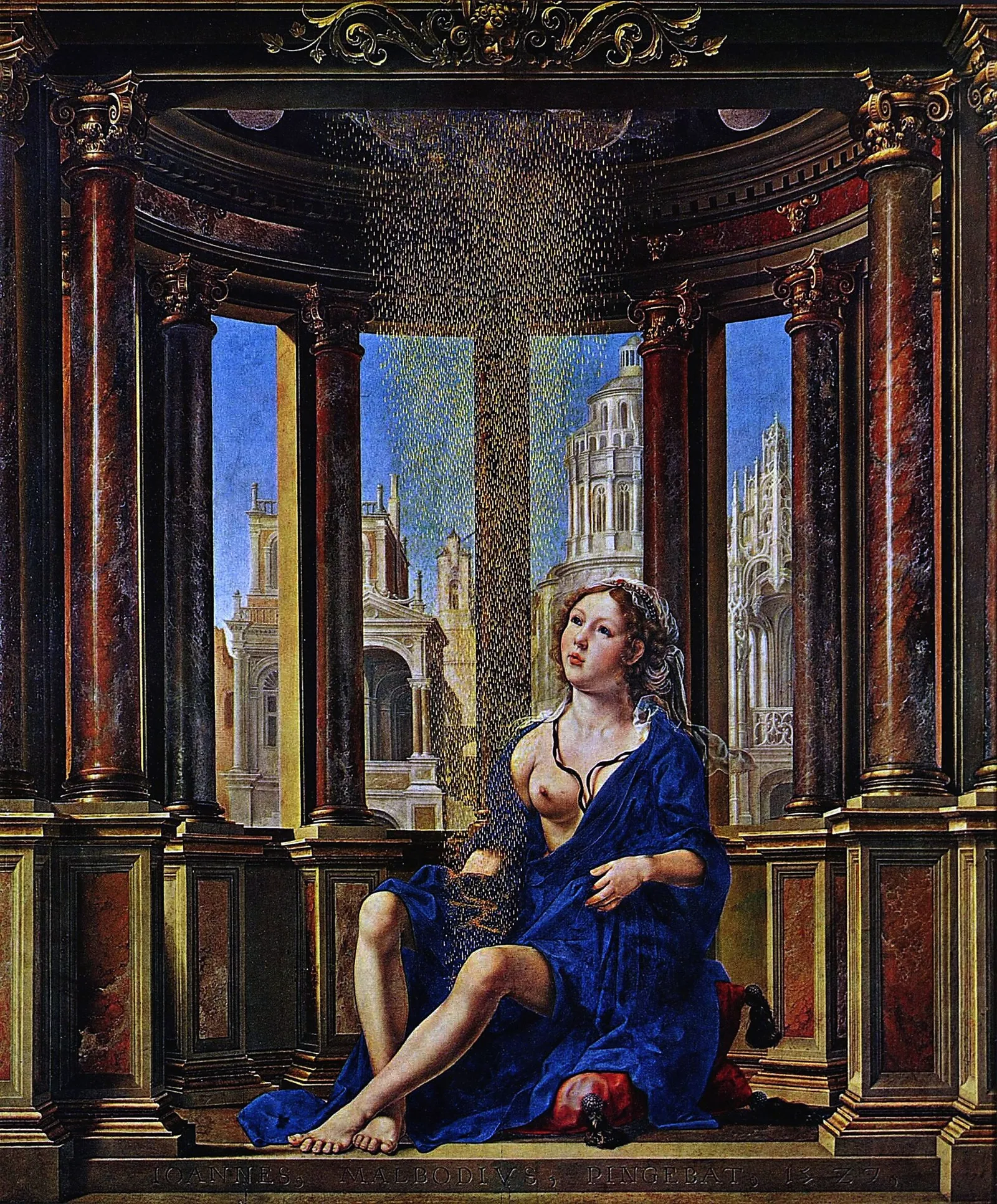
Jan Gossaert's Danae, dated 1527, belongs to the Bavarian State Painting Collections and is associated with the Alte Pinakothek. It shows the princess of Greek myth at the moment Jupiter reaches her as a shower of gold, set inside an imagined classical building. The picture is a compact, carefully staged example of how a Netherlandish painter took up the subjects and architecture of the Italian Renaissance.
Where to see it
Danae is held by the Bavarian State Painting Collections, and its listed location is the Alte Pinakothek. Works can move between rooms, go on loan or be taken off view for conservation, so check the official website of the Alte Pinakothek or the Bavarian State Painting Collections for current display status before you visit. The painting measures 114.3 x 95.4 cm. It is large enough to read from across a room, but it is worth stepping close for the fine detail.
What to look for in person
The falling gold
Start at the top of the picture. Drops of gold fall from an opening above Danae and come down toward her. This is how the myth tells it: Jupiter visits the imprisoned princess as a golden shower. Gossaert paints the drops as small, separate points of light rather than as a vague glow. Follow their path downward and notice how Danae's upturned gaze and the open fall of her robe direct you back to the miracle. The composition is built around this single event.
A figure in blue
Danae wears a deep blue mantle, and she is seated with a calm, inward expression. For viewers in the early sixteenth century, a young woman in blue, alone in an enclosed space and visited from above, would also call to mind images of the Virgin Mary. Medieval writers had sometimes linked Danae with ideas of chastity and divine conception. Look at how Gossaert balances the bare skin of a mythological subject with the quiet, devotional pose familiar from religious painting.
Imagined classical architecture
Danae sits within a columned, rounded interior that stands in for the tower where her father confined her. Through the openings you can glimpse more buildings in an antique-inspired style. Gossaert was among the Netherlandish painters who took up Italian and classical forms after travelling to Italy, and the architecture here is as deliberate as the figure. Notice the polished surfaces, the carved details and the patterned floor. They show a northern painter's precise finish applied to a southern, classical setting.
About the painting
The story behind the painting comes from Greek myth. King Acrisius was warned that a son born to his daughter Danae would one day kill him, so he shut her away. Jupiter reached her anyway, in the form of a shower of gold, and she later gave birth to the hero Perseus. Artists chose the scene because it combined a female figure, a miraculous event and a setting that could be designed freely. Jan Gossaert, a painter from the Low Countries, was known for bringing such classical and mythological subjects into Netherlandish art. His visit to Rome early in his career, in the service of a Burgundian patron, is generally seen as a turning point. After it he painted nudes and mythological scenes and paid close attention to classical architecture, while keeping the sharp detail and smooth, enamel-like surfaces of the Flemish tradition. Danae, dated 1527, comes from the later part of his career. It measures 114.3 x 95.4 cm, a format suited to close, private looking rather than a large public space. The work shows two approaches meeting on one panel. The subject and the architecture point to Italy and antiquity. The colour, the finish and the echoes of Marian imagery come from northern religious painting. Viewers then and now can read the picture on more than one level: as a myth, as a learned display of classical taste, and as an image that borrows the language of sacred art. Today the painting is part of the Bavarian State Painting Collections, with its location given as the Alte Pinakothek.
Key facts
| Artist | Jan Gossaert |
|---|---|
| Date | 1527 |
| Size | 114.3 × 95.4 cm |
| Medium | oil paint, panel |
| Collection | Bavarian State Painting Collections |
How to visit: Alte Pinakothek
Munich, Germany · Museum guide
| Opening hours | Thu–Sun 10:00–18:00 Tue–Wed 10:00–20:00 |
|---|---|
| Closed | Closed on Mondays. Also closed on Shrove Tuesday (17.02.2026), Labour Day (01.05.), Christmas Eve (24.12.), Christmas Day (25.12.) and New Year's Eve (31.12.). Open until 18:00 on Epiphany, Easter (Good Friday to Easter Monday), Whitsun, Boxing Day, New Year's Day and, in 2026, on Ascension Day, Assumption Day, German Unity Day and All Saints' Day. |
| Admission | Adult (permanent collection) EUR 9 Reduced (students, visitors 65+, severely disabled visitors, groups of 15+) EUR 6 (ID required) Under 18 free Sundays (all visitors) EUR 1 Combined ticket (Alte Pinakothek, Pinakothek der Moderne, Museum Brandhorst, Sammlung Schack, one day) EUR 12 (museum ticket office only; excludes paid special exhibitions) Annual ticket EUR 90 (reduced EUR 60) |
| Free entry | Free for under-18s. Sundays cost EUR 1. Special exhibitions may be priced separately. |
| Booking | No reservation is needed and there is no timed entry. |
The Neue Pinakothek is closed for renovation, with reopening planned for 2029; a selection of its 19th-century main works is shown on the ground floor of the Alte Pinakothek (East Wing) and in Sammlung Schack. No closure of the Alte Pinakothek itself has been announced.
Official ticket page
Official website
View on map
Hours and prices can change. Please check the official website before you go. (Checked on: 2026-11-09)