Art! Art! Art! › Works
Coronation of the Virgin
 Fra Angelico, 1430s
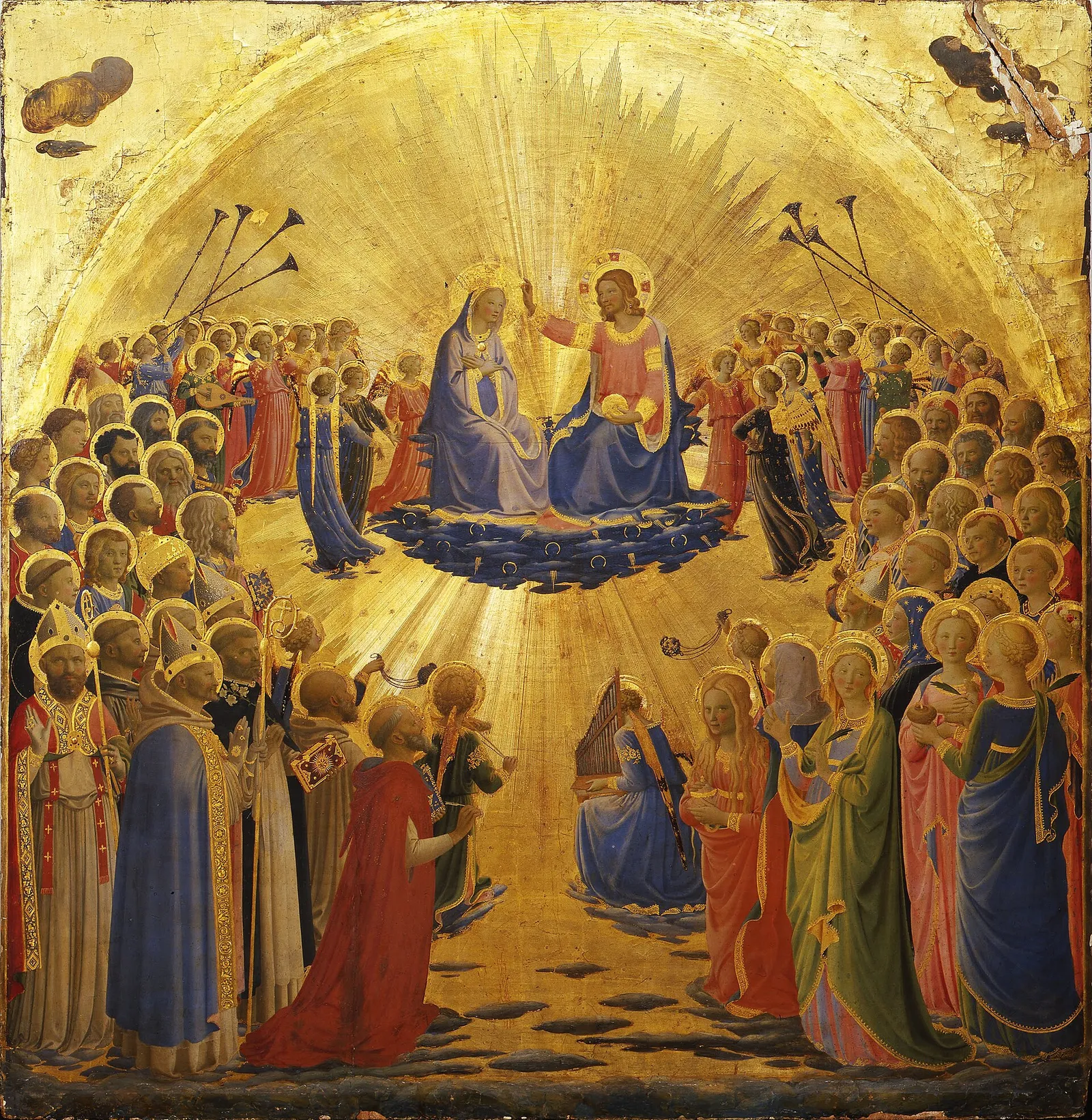
Fra Angelico's Coronation of the Virgin, dated to the 1430s, is in the collection of the Uffizi Gallery. The panel shows a heavenly court filled with angels and saints gathered around Christ as he crowns his mother. At 112 by 114 centimetres, it is nearly square and rewards close, unhurried looking.
Where to see it
The Coronation of the Virgin is held by the Uffizi Gallery, which is also its listed location. Works in large museums can be moved between rooms, taken off view for conservation or lent to exhibitions, so check the Uffizi Gallery's official website for current display status, opening hours and ticketing before you visit. Booking ahead is generally sensible for major museums, and allowing extra time will let you study the painting's many small figures closely.
What to look for in person
A heaven made of gold
Instead of a landscape or architectural setting, the scene sits against a gleaming gold ground. Look for the fine lines of rays that fan outward from the central figures, turning the whole surface into an image of divine light. Change your viewing angle slightly and notice how the gold responds to the gallery lighting, brightening and dimming as you move. This shimmering effect was intended to suggest a space beyond the everyday world, and it is something photographs rarely capture as well as standing in front of the panel.
The crowning at the centre
Find the main event near the top centre: Christ, seated, lifting a crown toward the head of the Virgin, who bows slightly toward him. The two figures are set apart by the radiating light, which draws the eye straight to the gesture of crowning. Around them, angels play musical instruments, including long trumpets, so the moment reads almost as a celebration with sound. Take a moment to compare the calm, gentle expressions of the central pair with the livelier movement of the music-making angels nearby.
Rows of saints and angels
Below and to either side, crowds of saints and angels are arranged in tiers, filling the nearly square panel. Step closer to see how individual faces differ, and look for objects or clothing that identify particular saints, such as books, palms or religious habits. Fra Angelico's colour is a pleasure here: clear blues, soft pinks, reds and greens repeat across the crowd, creating rhythm without confusion. The orderly arrangement lets a very full composition remain easy to read, guiding your eye back up toward the coronation.
About the painting
Fra Angelico was a Dominican friar and one of the leading painters of early fifteenth-century Italy, known for altarpieces and for the frescoes he painted in the convent of San Marco. His work combines the luminous gold and decorative richness of earlier religious painting with a growing interest in solid, clearly modelled figures and calm, readable compositions. He was later given the name by which he is known, meaning 'angelic friar', reflecting the devotional character long associated with his art. The Coronation of the Virgin is a traditional Christian subject: after her death and Assumption, Mary is received into heaven and crowned as Queen of Heaven by Christ. Italian painters often treated it as a vision of the entire heavenly court, and this panel follows that approach, surrounding the central pair with musician angels and ranks of saints. The fact sheet dates the work to the 1430s and gives its size as 112 by 114 centimetres, making it almost square, an unusual and compact format that concentrates a large gathering of figures into a single field of gold. For visitors, the painting works on two levels. From a distance, the radiating gold and balanced arrangement give a strong overall impression of order and light. Up close, the small details reward attention: the varied faces, the instruments, the patterns of colour in robes and halos. Plan to view it both ways, first stepping back to take in the whole design, then moving closer to explore the crowd one figure at a time.
Key facts
| Artist | Fra Angelico |
|---|---|
| Date | 1430s |
| Size | 112 × 114 cm |
| Medium | tempera, poplar panel |
| Collection | Uffizi Gallery |
How to visit: Uffizi Gallery
Florence, Italy · Museum guide
| Opening hours | Tue–Sun 08:15–18:30 (visitors leave by 18:30) |
|---|---|
| Closed | Mondays, 1 January and 25 December. |
| Last entry | Ticket office closes at 17:30. |
| Admission | Regular, bought on the day EUR 25 Regular, bought in advance EUR 29 Regular, entry from 16:00 (from 1 January 2026) EUR 16 Reduced (EU citizens aged 18–25; citizens of Switzerland, Norway, Liechtenstein, Uruguay etc.; ID required) EUR 2 Under 18 free (under 12s must be accompanied) Uffizi + Vasari Corridor EUR 43 on the day / EUR 47 in advance; named ticket, reservation required, non-refundable PassePartout 5 days (Uffizi, Pitti Palace, Boboli) EUR 40 (EUR 58 with Vasari Corridor) Audio guide EUR 6 |
| Free entry | Free for under-18s; disabled visitors plus one companion; tour guides and interpreters, ICOM members, certain journalists, and university teachers/students on the official list. Admission is free on the first Sunday of each month (national museums), when reservations are not possible. |
| Booking | Reservation is not required, except for the Uffizi + Vasari Corridor ticket, which must be reserved. |
Restoration and rearrangement works mean some rooms are temporarily closed and some artworks are not on display. A staff assembly on 11–12 November 2026 may change opening times.
Official ticket page
Official website
View on map
Hours and prices can change. Please check the official website before you go. (Checked on: 2026-11-12)