Art! Art! Art! › Works
Capo di Noli, near Genoa
 Paul Signac, 1898
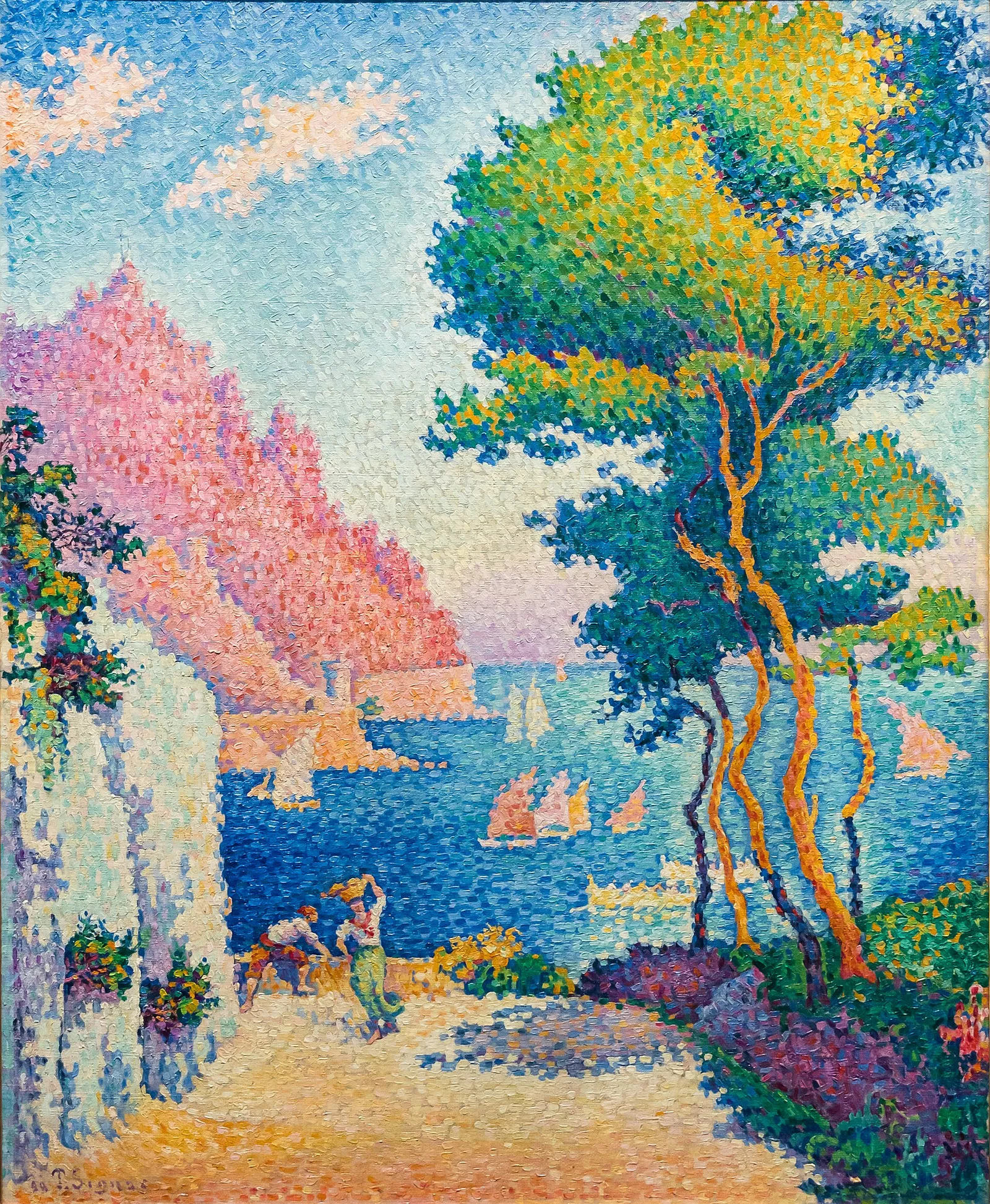
Paul Signac's Capo di Noli, near Genoa (1898) is an oil-on-canvas view of a rocky cape on the Italian Riviera, built from deliberate touches of intense colour. The painting is in the collection of the Wallraf–Richartz Museum in Cologne, Germany.
Where to see it
Capo di Noli, near Genoa is held by the Wallraf–Richartz Museum in Cologne, Germany. Works can be moved, lent or taken off view, so check the museum's official website for current display status before you visit. The canvas measures 91.5 × 73 cm, a taller-than-wide format, so give yourself room to view it from both a distance and close up.
What to look for in person
Colour pushed as far as it will go
Start by taking in the whole picture from a few steps back. Signac stated that he wanted every part of this canvas to reach the furthest possible intensity of colour, and the result is a coastline that glows rather than simply describes. Look for the red and white rocks, the blue shadows cast across them, the pale violet band of the horizon and the golden patches where sunlight falls. Notice how these hues sit side by side instead of being blended, so the colours seem to vibrate against one another.
Brushstrokes that follow the landscape
Move closer and watch the direction of the marks. The rocks at the far left and the plants on the right are laid down in upright, vertical strokes, which give them a sense of height and solidity. By contrast, the calm sea and the path are made with horizontal strokes, so these areas read as flat and still. Tracing these changes of direction is a useful way to see how Signac organised the composition: the handling of the paint itself separates land, vegetation and water.
A sky made of dots and crossing strokes
Finally, look up at the sky, where the technique shifts again. Close to the horizon the surface is made of small dots, a hallmark of the pointillist approach. As your eye moves upward and toward the foreground, the dots give way to diagonal strokes that cross one another. Step back and forth to see how these separate touches merge at a distance into a luminous, shimmering sky, then break apart again into individual marks when you stand close to the canvas.
About the painting
Paul Signac painted Capo di Noli, near Genoa in 1898, in oil on canvas. The subject is a cape at Noli on the Ligurian Riviera in northwest Italy, not far from Genoa. At the time, Signac was based in Saint-Tropez on the French Mediterranean coast, where he lived from 1892 to 1900, and from there he often travelled to the Noli area. He reached this particular spot on foot from Saint-Tropez, and finished the painting about two years after that journey.
The work is painted in a pointillist manner, with colour applied as distinct dots and short strokes rather than smooth, blended areas. Signac is widely recognised as one of the central figures of Neo-Impressionism, the movement that developed this method of placing separate touches of colour next to one another so that they combine in the viewer's eye. In Capo di Noli he did not apply a single uniform touch. He varied the size and direction of his marks to suit each part of the scene: upright strokes for rocks and plants, horizontal ones for water and path, and dots and crossing diagonals for the sky.
Signac described his ambition for this canvas as taking every area to the furthest extreme of colour. That aim explains the vivid palette of red and white rock, blue shadow, violet horizon and gold sunlight. For visitors, the painting rewards two ways of looking: from a distance, as a bright Mediterranean coastal view, and up close, as a carefully constructed surface of individual marks.
Key facts
| Artist | Paul Signac |
|---|---|
| Date | 1898 |
| Size | 91.5 × 73 cm |
| Medium | oil paint, canvas |
| Collection | Wallraf–Richartz Museum |
How to visit: Wallraf–Richartz Museum
Cologne, Germany
Hours and prices can change. Please check the official website before you go.
Sources
- Wikidata Q5748612
- Wikipedia (en) (CC BY-SA 4.0)
- Wikipedia (fr) (CC BY-SA 4.0)
- Wikipedia (es) (CC BY-SA 4.0)