Art! Art! Art! › Works
Archduke Leopold Wilhelm in his Gallery
 David Teniers the Younger, 17th century
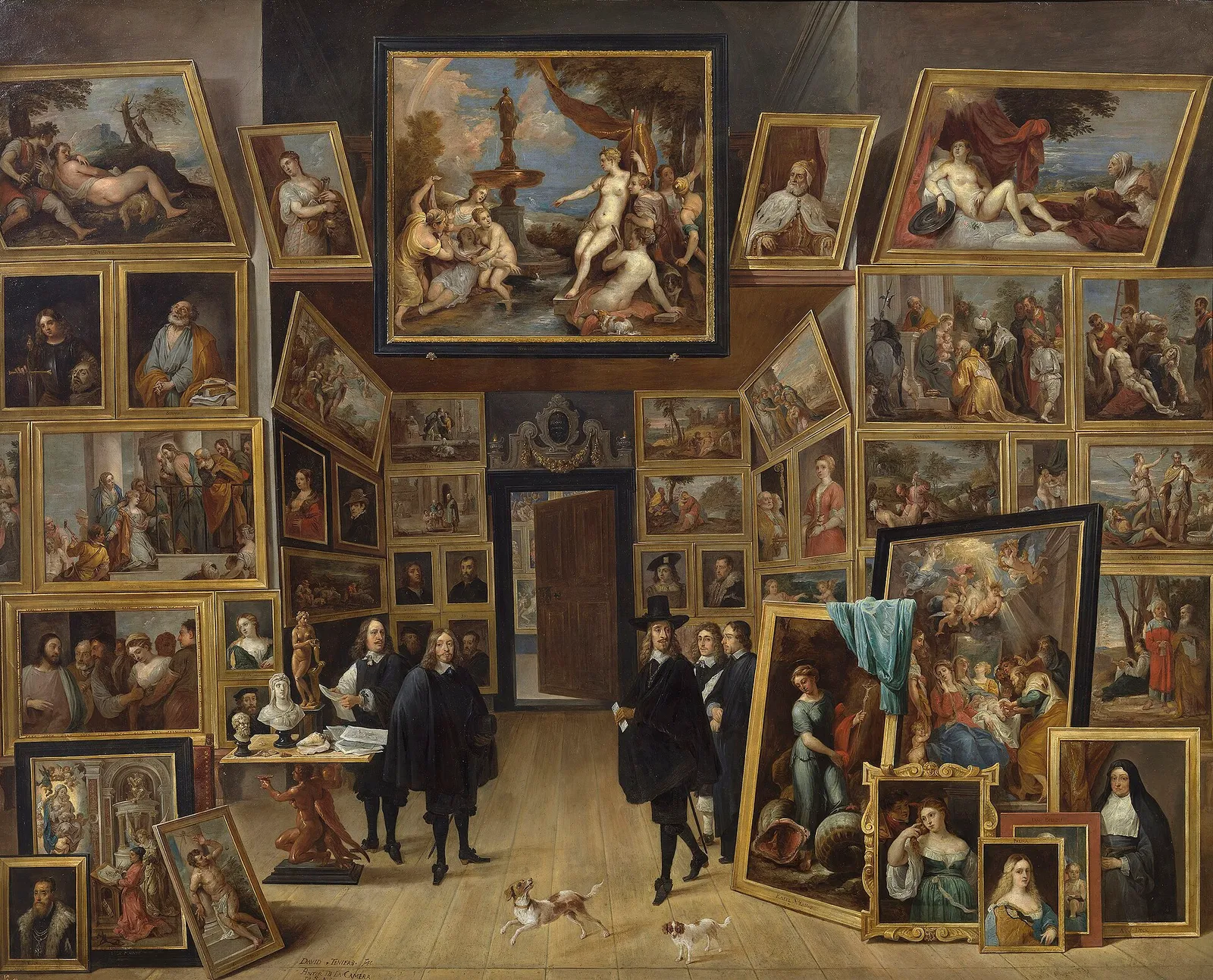
David Teniers the Younger's Archduke Leopold Wilhelm in his Gallery is a 17th-century painting of a collector surrounded by his collection, in the Museo del Prado. It is a picture made of pictures: dozens of small, carefully copied paintings line the walls while the archduke and his companions stand among them.
Where to see it
The painting belongs to the Museo del Prado, and the fact sheet lists its location as Prado Hall 077. Displays change and works are sometimes moved or temporarily withdrawn, so check the Museo del Prado's official website for the painting's current display status before you visit.
What to look for in person
A wall built from paintings
Start with the walls. Pictures are hung edge to edge, frame against frame, rising in tiers well above head height, the dense hanging style of 17th-century princely collections. Each one is a miniature version of a real work, and Teniers adjusts his handling to suggest different artists' styles, from broad, warm figure compositions to smaller, more finely detailed scenes. Move in close to compare a few of these tiny copies, then step back and see how the gilded frames form a rhythmic grid across the room.
The patron among his treasures
Look next at the figures in the room. Archduke Leopold Wilhelm is shown not on a throne but standing with a small group of companions, presented as a collector who looks at, discusses and handles his pictures. That choice tells you how the painting presents its subject: rank expressed through taste and ownership rather than through ceremony. Teniers's gallery views also often include paintings propped against furniture or resting on the floor, so scan the lower part of the canvas for works not yet hung on the walls.
A record at a manageable scale
At 104.8 by 130.4 centimetres, the canvas is large enough to read as a room you could walk into, yet the paintings it reproduces are reduced to a few centimetres each. That compression is the point. Gallery pictures like this worked as a visual inventory and a display of a collection that could be shown to others. For today's visitor it is also a document: many works from the archduke's collection survive in other museums, and this canvas records how they were once seen together.
About the painting
David Teniers the Younger was a Flemish painter from Antwerp, best known for scenes of peasant life, taverns and village gatherings. His career changed when he entered the service of Archduke Leopold Wilhelm of Austria, governor of the Spanish Netherlands, who was based in Brussels. Teniers became the archduke's court painter and keeper of his picture collection, a post that put him in daily contact with one of the major art collections of the period.
The archduke collected on a large scale, and Italian painting, especially Venetian work, was at the heart of his holdings. Teniers documented the collection in several ways. He painted a number of gallery views showing the archduke among his pictures, and he also produced the Theatrum Pictorium, a published volume of engravings reproducing Italian paintings from the collection. The gallery views belong to a type of picture developed in Antwerp in the 17th century, in which a room filled with art becomes the subject itself.
This canvas, dated to the 17th century and measuring 104.8 by 130.4 centimetres, is one of those gallery views. In front of it, it helps to think of it as both a portrait and a catalogue. The archduke appears as a knowledgeable owner, while the walls reproduce individual works closely enough that art historians have been able to match many of them with surviving originals. Much of Leopold Wilhelm's collection later passed to Vienna, which makes paintings like this one valuable evidence of how the pictures were arranged and seen before they were dispersed or rehung elsewhere.
Key facts
| Artist | David Teniers the Younger |
|---|---|
| Date | 17th century |
| Size | 104.8 × 130.4 cm |
| Medium | copper, oil paint |
| Collection | Museo del Prado |
How to visit: Museo del Prado
Madrid, Spain · Museum guide
| Opening hours | Mon–Sat 10:00–20:00 Sun and public holidays 10:00–19:00 6 Jan, 24 Dec, 31 Dec 10:00–14:00 (limited opening) |
|---|---|
| Closed | Closed on 1 January, 1 May and 25 December. |
| Last entry | Last entry 30 minutes before closing; visitors are asked to leave the galleries 10 minutes before closing. |
| Admission | General EUR 15 (includes the Collection and temporary exhibitions) Reduced (over 65, youth card holders, members of large families) EUR 7.5 Under 18, students aged 18–25, people with a disability of 33% or more, and other listed groups: free (official proof required at the ticket office on the day) Audio guide EUR 5 (added to the ticket; over 250 works in 15 languages) |
| Free entry | The Collection is free during the last two hours before closing (tickets at the ticket office, subject to capacity; 50% off temporary exhibitions). Always free for under-18s, students aged 18–25 and other listed groups with official proof at the ticket office. |
| Booking | Entry is by timed ticket. |
Official ticket page
Official website
View on map
Hours and prices can change. Please check the official website before you go. (Checked on: 2026-11-11)
