Art! Art! Art! › Works
Adoration of the Magi
 Gentile da Fabriano, 1423
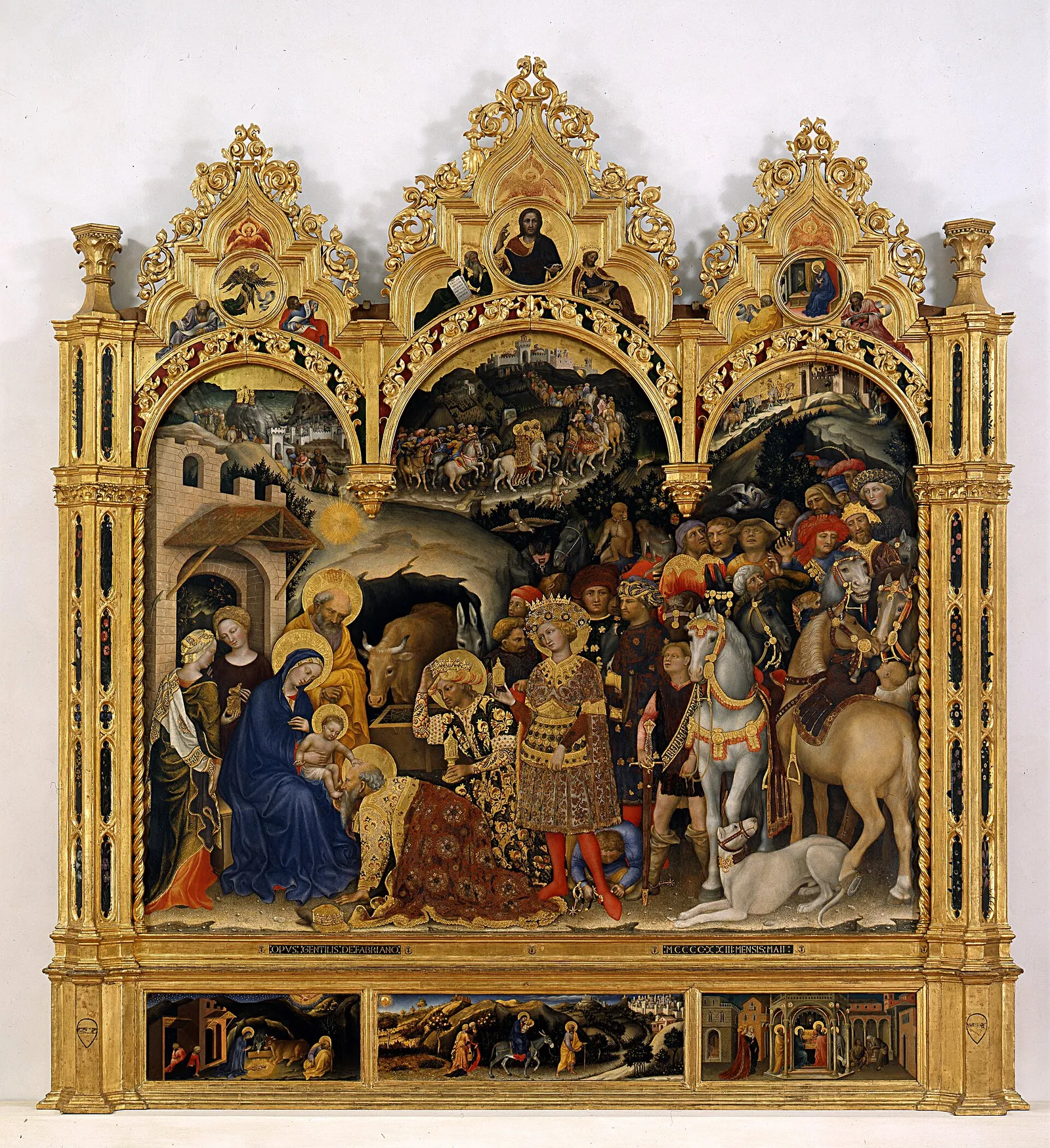
Gentile da Fabriano's Adoration of the Magi is a large gilded altarpiece dated 1423 and held by the Uffizi Gallery. It was painted for a private family chapel in Florence, and it rewards a slow look, from the crowded procession at the top to the small scenes along the base.
Where to see it
The altarpiece belongs to the Uffizi Gallery (inventory 1890 n. 8364). The fact sheet places it in Room A7, Lorenzo Monaco - Gentile da Fabriano, where it is shown alongside work by Lorenzo Monaco. Displays can change because of rehangs, conservation or loans, so check the Uffizi's official website for current display status before you visit. Note that one of the original predella scenes, the Presentation in the Temple, is in the Louvre. The panel you see in that position at the Uffizi is a later copy.
What to look for in person
The procession of the Magi
Start at the top and let your eye travel down. In the arched sections above the main scene, Gentile shows the kings on their journey, and the travellers then wind down through a hilly landscape into the foreground. There they arrive before the Virgin and Child. Look at how the kings are arranged by age. The eldest kneels closest to the Child, a middle-aged king bows, and the youngest stands waiting. Behind them a dense crowd of attendants, horses and other animals fills the panel, giving the sacred event the feel of a grand courtly arrival.
Gold, texture and fine detail
Step close and look at the surface rather than the composition. The work is painted in tempera on panel, and gold is used generously. In the crowns, harnesses, spurs and embroidered garments it is often raised and worked so that it catches the light from different angles. Rich fabrics and patterned costumes show the taste for luxury and decorative detail associated with the International Gothic style. Gentile's precise rendering of animals, plants and faces is worth examining slowly. Look for the many small creatures tucked into the crowd.
The predella and the signature
Do not skip the strip of small paintings along the bottom, called the predella. These scenes continue the story of Christ's infancy in a more intimate, storytelling register, and the night setting of the Nativity scene is often singled out for its handling of light. The Presentation in the Temple panel at the right end is a copy painted in 1903 by Gaspare Diomede della Bruna. The original went to the Louvre in 1812. On the frame molding between the main panel and the predella, look for the inscription 'OPVS GENTILIS DE FABRIANO' together with the date.
About the painting
Gentile da Fabriano was one of the most sought-after painters of early fifteenth-century Italy. The banker Palla Strozzi commissioned this altarpiece in 1420, soon after the artist arrived in Florence. It was made for the Strozzi family chapel in the sacristy of the church of Santa Trinita, and the finished work is dated 1423. Gentile did not work alone. The painters Arcangelo di Cola da Camerino, Giovanni da Imola and Michele d'Ungheria assisted him. The commission reflects the wealth and ambitions of its patron. The costly materials, the abundance of gold and the parade of richly dressed figures suited a family chapel intended to display both devotion and status. The work is regarded as a key example of the International Gothic style in Florence, painted just as other artists in the city were beginning to explore new approaches to space and form. The altarpiece later left its original setting. In 1806, during the Napoleonic suppressions, it was moved into storage, and in 1810 it went to the Galleria dell'Accademia. In 1812 the predella panel of the Presentation in the Temple was removed and taken to the Louvre, where it remains. A replacement copy was painted for the predella in 1903. The altarpiece entered the Uffizi in 1919. In 2004 it was restored by Sandra Freschi and Nicola Ann MacGregor under the supervision of Alessandro Cecchi. The Louvre panel was not part of this restoration. The Uffizi gives the overall dimensions as 300 x 282 cm, which makes it a commanding object to stand before.
Key facts
| Artist | Gentile da Fabriano |
|---|---|
| Date | 1423 |
| Size | 301.5 × 283 cm |
| Medium | tempera, panel |
| Collection | Uffizi Gallery |
How to visit: Uffizi Gallery
Florence, Italy · Museum guide
| Opening hours | Tue–Sun 08:15–18:30 (visitors leave by 18:30) |
|---|---|
| Closed | Mondays, 1 January and 25 December. |
| Last entry | Ticket office closes at 17:30. |
| Admission | Regular, bought on the day EUR 25 Regular, bought in advance EUR 29 Regular, entry from 16:00 (from 1 January 2026) EUR 16 Reduced (EU citizens aged 18–25; citizens of Switzerland, Norway, Liechtenstein, Uruguay etc.; ID required) EUR 2 Under 18 free (under 12s must be accompanied) Uffizi + Vasari Corridor EUR 43 on the day / EUR 47 in advance; named ticket, reservation required, non-refundable PassePartout 5 days (Uffizi, Pitti Palace, Boboli) EUR 40 (EUR 58 with Vasari Corridor) Audio guide EUR 6 |
| Free entry | Free for under-18s; disabled visitors plus one companion; tour guides and interpreters, ICOM members, certain journalists, and university teachers/students on the official list. Admission is free on the first Sunday of each month (national museums), when reservations are not possible. |
| Booking | Reservation is not required, except for the Uffizi + Vasari Corridor ticket, which must be reserved. |
Restoration and rearrangement works mean some rooms are temporarily closed and some artworks are not on display. A staff assembly on 11–12 November 2026 may change opening times.
Official ticket page
Official website
View on map
Hours and prices can change. Please check the official website before you go. (Checked on: 2026-11-12)
Sources
- Wikidata Q1055117
- Wikipedia (en) (CC BY-SA 4.0)
- Wikipedia (ja) (CC BY-SA 4.0)
- Wikipedia (it) (CC BY-SA 4.0)
- Wikipedia (fr) (CC BY-SA 4.0)
- Museum website (uffizi.it)
- www.uffizi.it