Rembrandt
1606–1669 · Dutch Golden Age painting
Rembrandt (1606-1669) was the leading painter of Dutch Golden Age painting, admired for his handling of light and shadow and for portraits that seem to record inner life as well as appearance. This gallery moves from his early history scenes to the large group portraits and late works in which his brushwork grew broad and free.
 The Mill1645–1648 · National Gallery of Art
 Artist in his studio1628 · Museum of Fine Arts Boston
 Rembrandt and Saskia in the parable of the Prodigal Son1635 · Staatliche Kunstsammlungen Dresden
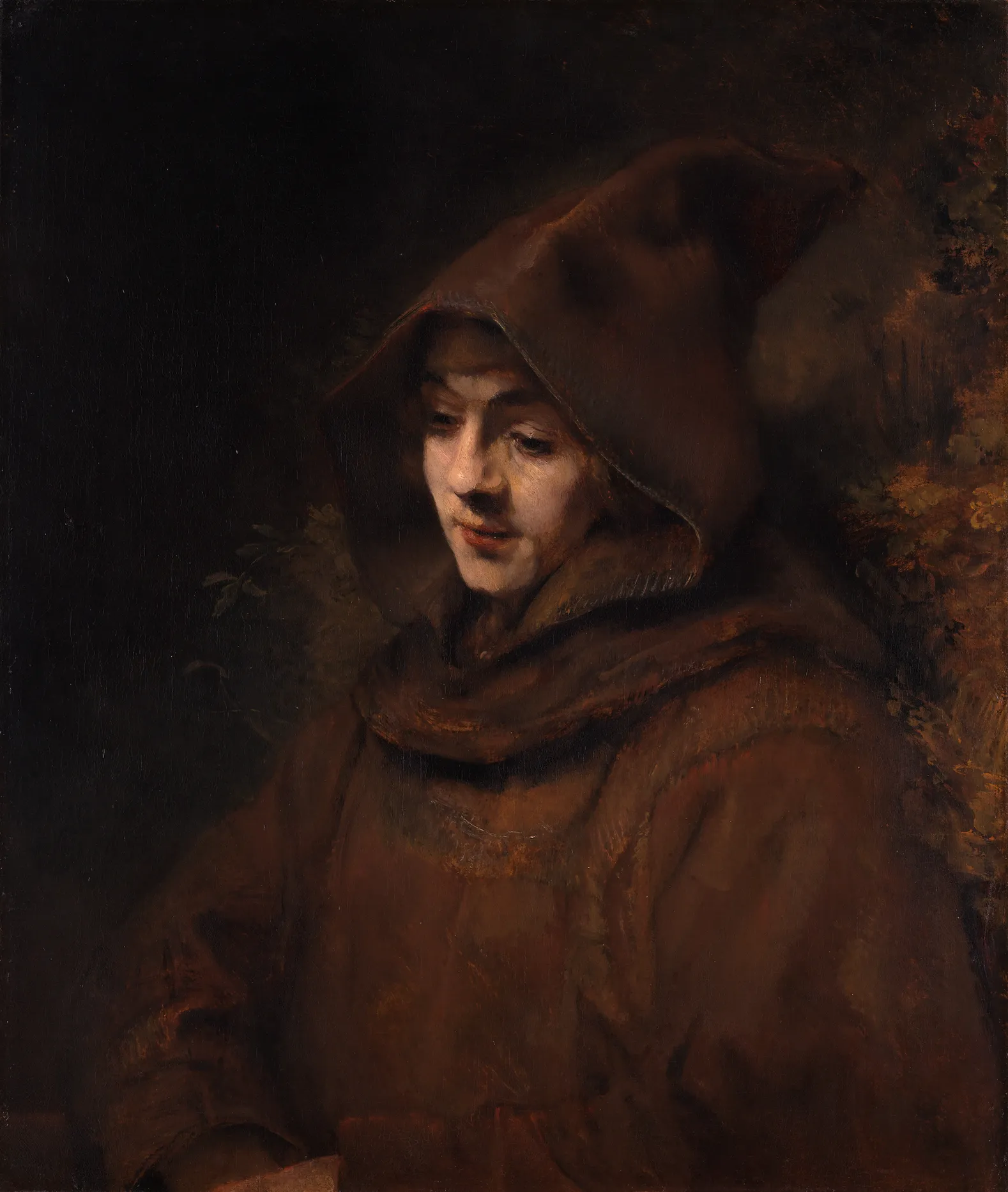 Titus as a Monk1660 · Rijksmuseum
 The Abduction of Europa1632 · J. Paul Getty Museum
 A Woman Bathing in a Stream (Hendrickje Stoffels?)1654–1655 · National Gallery
 El retorno del hijo gey1666–1668
 The Anatomy Lesson of Dr. Nicolaes Tulp1632 · Mauritshuis
 The Night Watch1642 · Rijksmuseum
 Syndics of the Drapers' Guild1662 · Rijksmuseum
 Danaë1636–1637
 The Storm on the Sea of Galilee1633
 The Polish Rider1655 · The Frick Collection
 The Descent from the Crossc. 1634 · Alte Pinakothek
 The Conspiracy of Claudius Civilis1661–1662 · Rijksmuseum
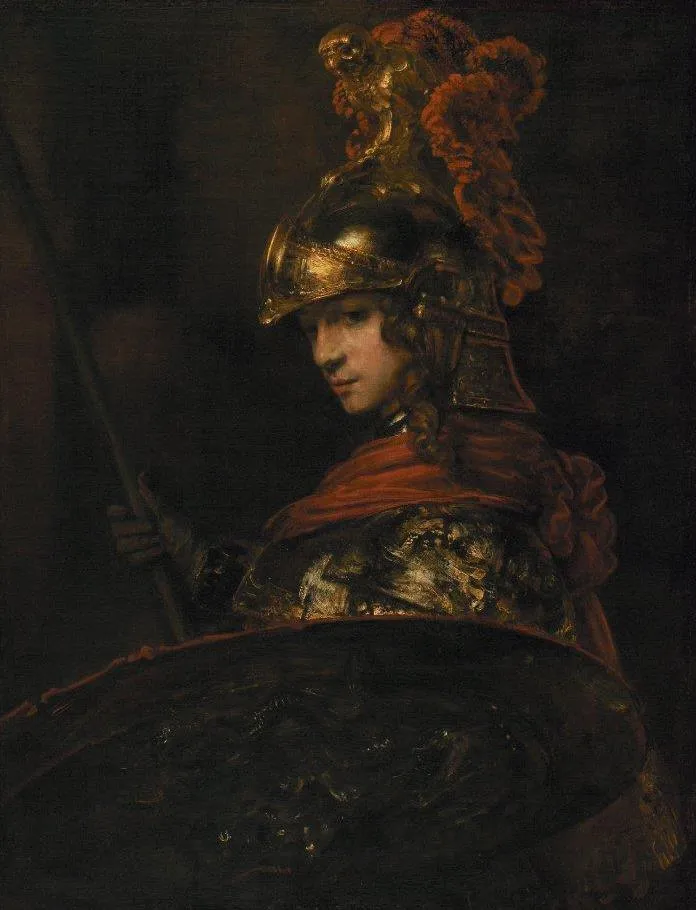 Pallas Athena1663
 The Jewish BrideRijksmuseum
 Belshazzar's FeastNational Gallery
 Aristotle with a Bust of HomerMetropolitan Museum of Art
 Moses Smashing the Tablets of the LawGemäldegalerie Berlin
 Bathsheba at Her BathLouvre Museum
 The Stoning of Saint Stephen
 Juno
 Saskia van Uylenburgh, the Wife of the Artist1635
 A Woman in Bed1645
 Hendrickje Stoffels1655
 Portrait of Haesje Jacobsdr. van Cleyburg1634
 The Raising of the Crossc. 1634
 Flora1634
 Artemisia1634
 Christ and the Adulteress1644
 Self-Portrait at the Age of 34
 Balaam and the Ass
Life and work
Rembrandt was born in Leiden in 1606, and his early works show a young painter testing ambitious subjects on a modest scale. The lapidation of Saint Stephen (1625) is a crowded, dramatic history scene. Artist in his studio (1628) shows a small figure dwarfed by a huge easel, a quiet reflection on the act of painting. He later settled in Amsterdam, where he became a sought-after portraitist. The Anatomy Lesson of Dr. Nicolaes Tulp (1632) made his name, and portraits such as that of Haesje Jacobsdr. van Cleyburg (1634) followed. The same years produced theatrical history and mythological pictures, including The Abduction of Europa (1632), The Storm on the Sea of Galilee (1633) and Danaë (1636-1637). His wife, Saskia van Uylenburgh, appears in several works from this period. The Night Watch (1642) was his most ambitious commission. Later paintings, such as A Woman Bathing in a Stream (1654-1655) and Hendrickje Stoffels (1655), show looser, more textured paint. Titus as a Monk (1660) depicts his son. Late works such as Syndics of the Drapers' Guild (1662) and The Conspiracy of Claudius Civilis (1661-1662) show him still taking on major public pictures. He died in Amsterdam in 1669.
The Night Watch (1642), Rijksmuseum
This is a group portrait of an Amsterdam civic militia company, but Rembrandt avoided the usual neat rows of sitters. The figures move, load weapons and turn toward each other, as if the company is setting off. Watch how light picks out the captain in black and the lieutenant in pale yellow, and a small girl glowing in gold among the men. The familiar title is a later nickname, prompted by darkened varnish. Stand back first to take in the whole scene, then look closely at the costume details.
The Anatomy Lesson of Dr. Nicolaes Tulp (1632), Mauritshuis
Dr. Tulp lifts the muscles of a dissected forearm with forceps while his other hand demonstrates how they move the fingers. The surgeons around him lean in at different angles. Some study the arm, some look at the open book, and some look out toward the viewer. That variety turns a commissioned group portrait into a moment of shared attention. Notice how the pale body is the brightest area of the canvas and draws your eye diagonally to Tulp. The work established the young Rembrandt's reputation in Amsterdam.
Where to see the paintings
| National Gallery of Art | |
|---|---|
| Museum of Fine Arts Boston | |
| Staatliche Kunstsammlungen Dresden | |
| Rijksmuseum | |
| J. Paul Getty Museum | |
| National Gallery | |
| Mauritshuis | |
| The Frick Collection | |
| Alte Pinakothek | |
| Metropolitan Museum of Art | |
| Gemäldegalerie Berlin | |
| Louvre Museum |


Works may be off view or on loan. See each painting’s page for museum details.
Sources
- Wikidata Q5598
- Images: Wikimedia Commons (public domain / CC0); sources on each painting’s page