Pierre Puvis de Chavannes
1824–1898 · Symbolism
Pierre Puvis de Chavannes (1824-1898) was a French painter best known for large, calm decorative paintings that look like faded frescoes. His muted colours, simplified figures and dreamlike stillness made him an important figure for Symbolism. This gallery follows him from early allegories such as Le Travail (1863) to the late Shepherd's Song (1897).
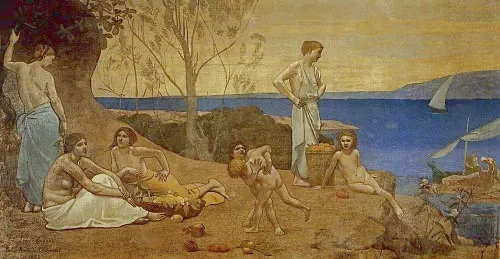 The Sweet Landscape1882
 Le Travail1863
 Mary Magdalene in the desert1869
 The white rock1869–1872
 L'Espérance1872
 Geneviève veillant sur Paris1874–1879
 The dream1883
 The Shepherd's Song1897
Life and work
Pierre Puvis de Chavannes was born in Lyon in 1824 and died in Paris in 1898. He worked against the busy, dramatic history painting of his time and developed a quieter way of picturing ideas. He became known above all for mural decoration. Many of his large paintings were made on canvas and then fixed to walls, and their pale, matte surfaces suggest old fresco painting. Le Travail (1863) shows this public, decorative side, presenting labour as a timeless scene rather than a modern event. Alongside the murals he painted smaller easel pictures. These include Mary Magdalene in the desert (1869), L'Espérance (1872), The dream (1883) and The Shepherd's Song (1897), in which single figures or small groups stand for a mood or an idea. Geneviève veillant sur Paris (1874-1879) belongs to his work on the story of Saint Geneviève, patron saint of Paris. The Happy Land (1882) imagines an idyllic, unhurried world. His simplified forms, flat colour and preference for meaning over storytelling place him within Symbolism. Later generations of artists also admired him for these qualities. A visitor will find little drama in his pictures, but a steady, deliberate calm that rewards slow looking.
Fresco-like colour and flattened space
Stand back first. Puvis keeps his palette pale and chalky, with soft blues, greys, ochres and off-whites, and he avoids glossy highlights. Space is shallow, horizons are low and wide, and figures are lined up almost like a frieze across the surface. Compare The Happy Land with The Shepherd's Song. In both, landscape is reduced to broad, simple bands, so the eye moves sideways across the picture instead of deep into it. This flatness was deliberate. It helps the paintings sit quietly on a wall and gives them their timeless, weathered look.
Allegory instead of story
Ask what the figures stand for rather than what they are doing. In L'Espérance, a lone young woman holding a sprig of green represents hope amid a bleak setting. In The dream, a sleeping traveller is visited by luminous apparitions. Puvis strips away detail of time and place, and gestures are slow and still. Even Le Travail treats work as an idea rather than a specific scene. Notice how little seems to happen. The meaning lies in pose, silence and the relationship between figure and empty space, which is a key reason he is linked with Symbolism.
Sources
- Wikidata Q216873
- Images: Wikimedia Commons (public domain / CC0); sources on each painting’s page