Claude Monet
1840–1926 · Impressionism
Claude Monet (1840–1926) was the French painter most closely identified with Impressionism. This gallery follows him from his early scenes of Paris and his family to the series of haystacks, cathedrals and river views, and finally to the Water Lilies he painted at Giverny.
 Impression, Sunrise1872 · Musée Marmottan Monet
 Woman with a Parasol – Madame Monet and Her Son1875 · National Gallery of Art
 Boulevard des Capucines1873
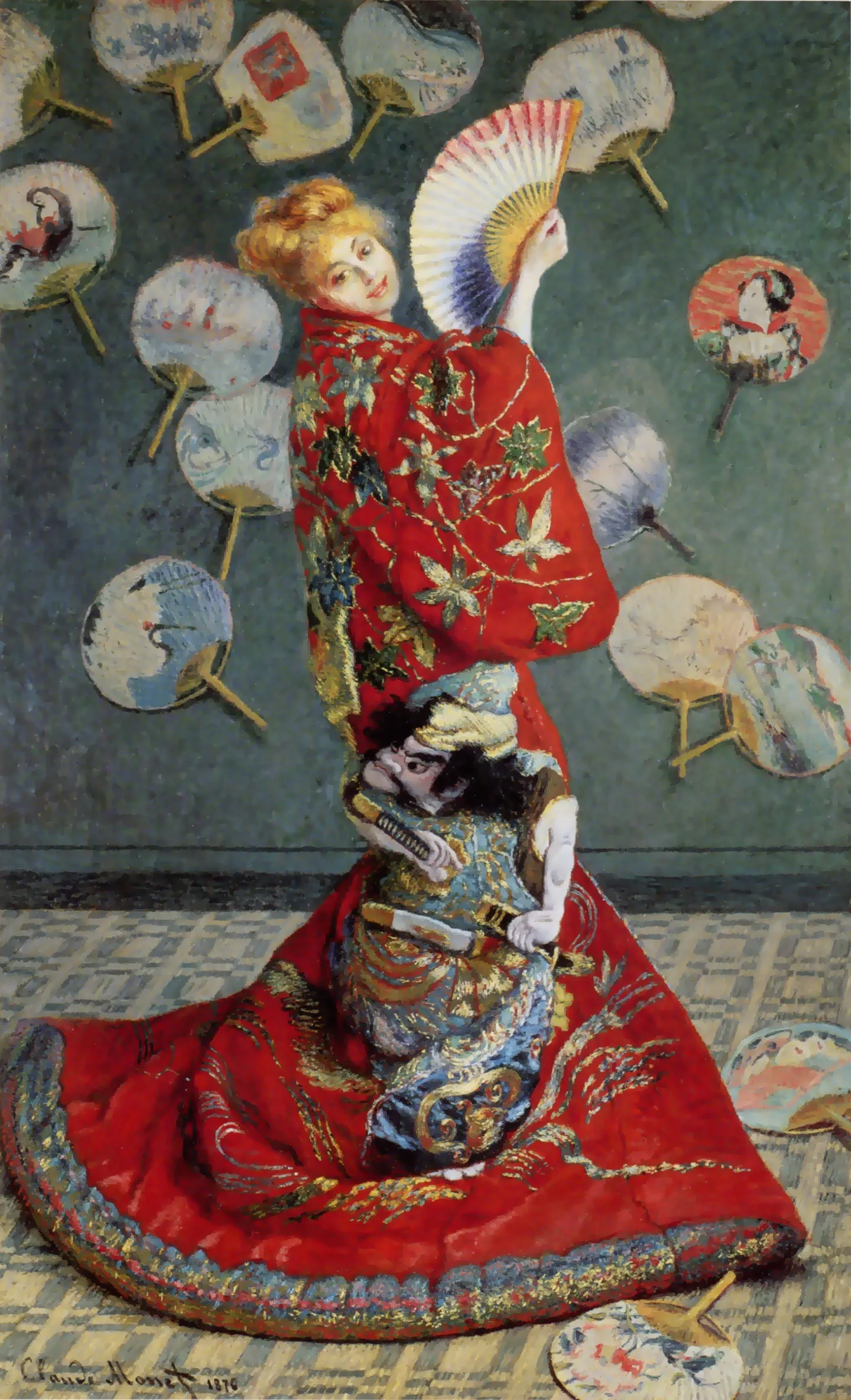 Madame Monet wearing a kimono1875–1876 · Museum of Fine Arts Boston
 Garden at Sainte-AdresseMetropolitan Museum of Art
 Women in the GardenMusée d'Orsay
 The MagpieMusée d'Orsay
 Woman in the Garden
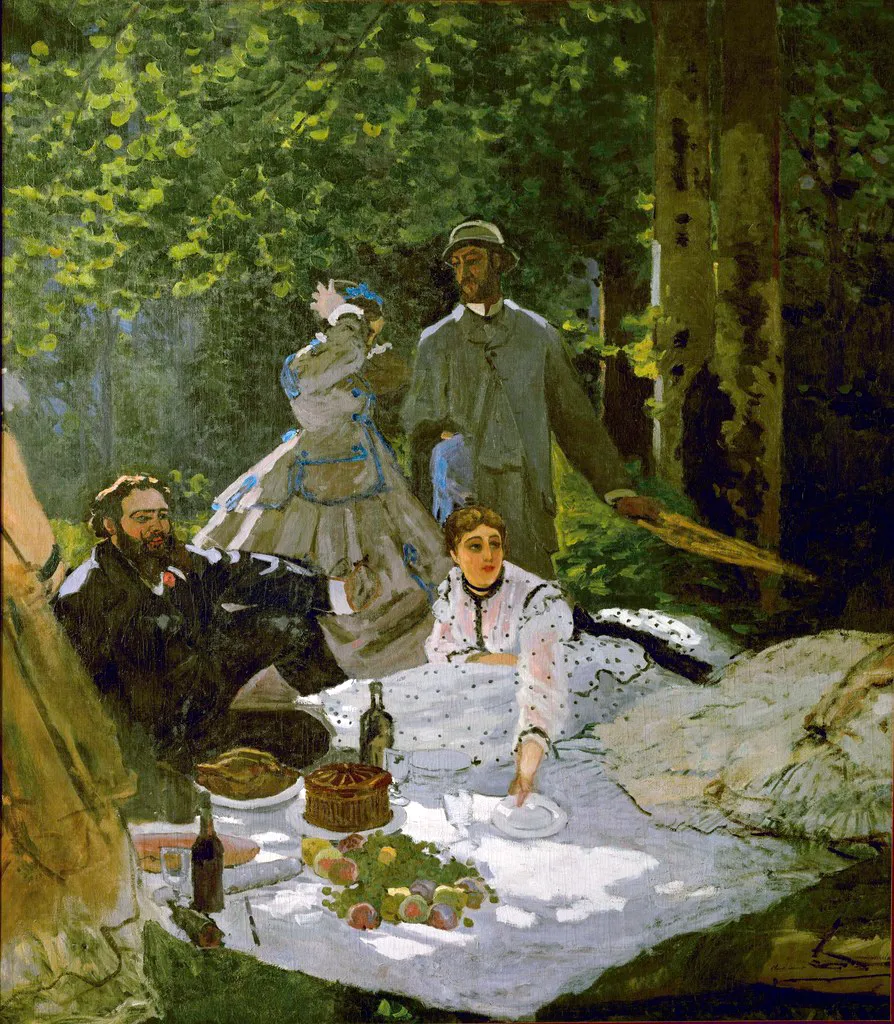 Luncheon on the GrassMusée d'Orsay
 Rocks at Belle-Île, Port-DomoisCincinnati Art Museum
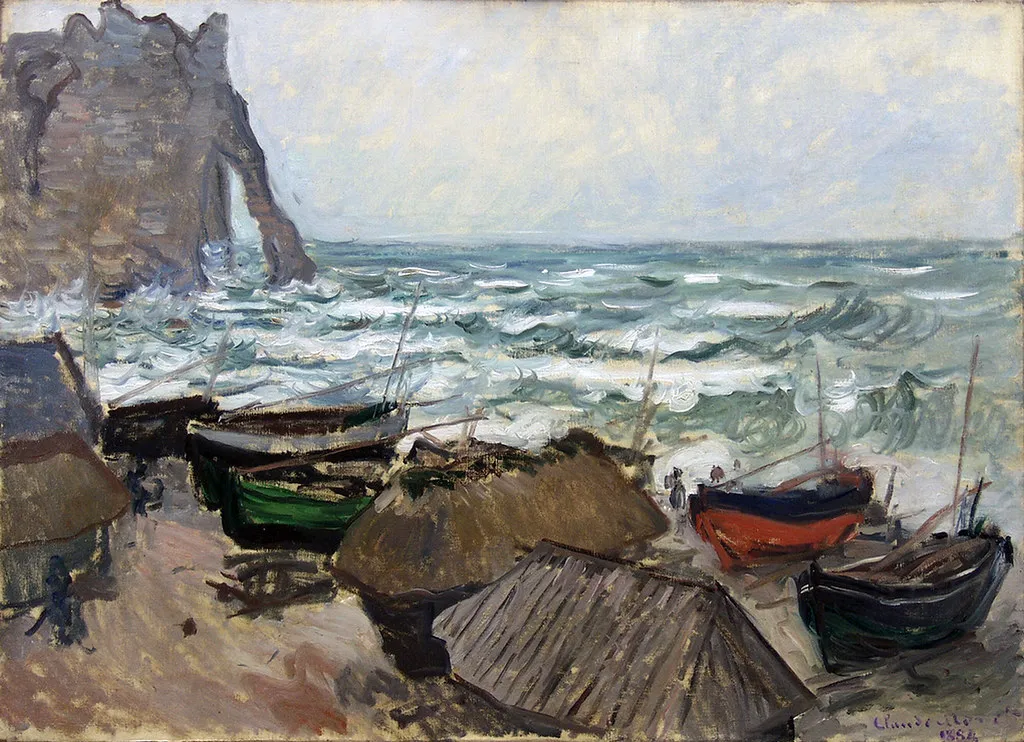 Hollowed Cliff near Étretat
 Bahnhof Saint Lazare in Paris1877
 Stacks of Wheat1888–1889
 Haystacks, end of Summer1890–1891
 Stacks of Wheat (Sunset, Snow Effect)1890–1891
 Rouen Cathedral1892–1893
 Rouen Cathedral1892–1893
 Rouen Cathedral1892–1893
 Houses of Parliament, London1900–1901
 Houses of Parliament, London1902
 Houses of Parliament, London1904
 The Japanese Footbridge and the Water Lily Pool, Giverny1899
 Water Liliesc. 1920
 Water Lilies1908
 Water Lilies1906
 Water Lilies1907
 Water Lilies1907
 Water Lilies1915
 Water Lilies1920–1926
 Water Lilies1920s
 La Grenouillère
 Regatta at Sainte-Adresse
Life and work
Claude Monet was born in Paris in 1840 and died at Giverny in 1926. He is the artist most closely linked with Impressionism, and the movement's name is generally traced to one of his canvases, Impression, Sunrise (1872), whose title a critic turned into a mocking label. In the 1870s his subjects were often modern city life and his own family: the crowds and traffic seen from above in Le Boulevard des Capucines (1873), the smoke and steam of the Saint-Lazare railway station (1877), and his wife and son on a breezy rise in Woman with a Parasol (1875). Madame Monet wearing a kimono (1875–1876) reflects the period's fascination with Japanese objects and prints. From the late 1880s he worked increasingly in series, returning to a single motif under different light, seasons and weather: stacks of wheat (1888–1891), the facade of Rouen Cathedral (1892–1893) and the Houses of Parliament in London (1900–1904). In these pictures the subject matters less than the shifting atmosphere around it. His later decades centred on his garden at Giverny, with its water-lily pond and Japanese-style footbridge, which he painted in 1899 and then again and again in the Water Lilies canvases that occupied him until his death. Across these late works the brushwork loosens and the horizon often disappears, leaving only water, reflected sky and floating leaves.
One motif, many moments
Monet's series reward side-by-side viewing. Compare the stacks of wheat at the end of summer with the same forms at sunset in snow: the shapes barely change, but the colour of the shadows does, shifting toward blues and violets. In the Rouen Cathedral and Houses of Parliament pictures, stone and towers dissolve into light or fog, built up from thick, layered strokes. The Water Lilies carry the idea further: with no shoreline or horizon, the pond's surface becomes the whole picture, and the reflected sky reads as clearly as the flowers themselves.
Three works with known homes
At the Musée Marmottan Monet, Impression, Sunrise is smaller and sketchier than many expect; notice how the orange sun and its broken reflection stand out against the grey-blue harbour haze. At the National Gallery of Art, Woman with a Parasol is seen from below, so the figure rises against a bright, windy sky, her veil and skirt caught in quick strokes. At the Museum of Fine Arts Boston, Madame Monet wearing a kimono is a large, decorative figure painting, dominated by a vivid red robe and fans scattered across the wall.
Where to see the paintings
| Musée Marmottan Monet | |
|---|---|
| National Gallery of Art | |
| Museum of Fine Arts Boston | |
| Metropolitan Museum of Art | |
| Musée d'Orsay | |
| Cincinnati Art Museum |


Works may be off view or on loan. See each painting’s page for museum details.
Sources
- Wikidata Q296
- Images: Wikimedia Commons (public domain / CC0); sources on each painting’s page