Ilya Repin
1844–1930 · realism
Ilya Repin (1844–1930) was one of the leading realist painters of the Russian Empire, equally at home with crowded scenes of everyday life, history subjects and searching portraits. This gallery gathers his best-known canvases alongside quieter works, with notes on what to look for when you stand in front of them.
 Religious Procession in Kursk Province1880–1883
 Barge Haulers on the Volga1870–1873
 Reply of the Zaporozhian Cossacks1880–1891
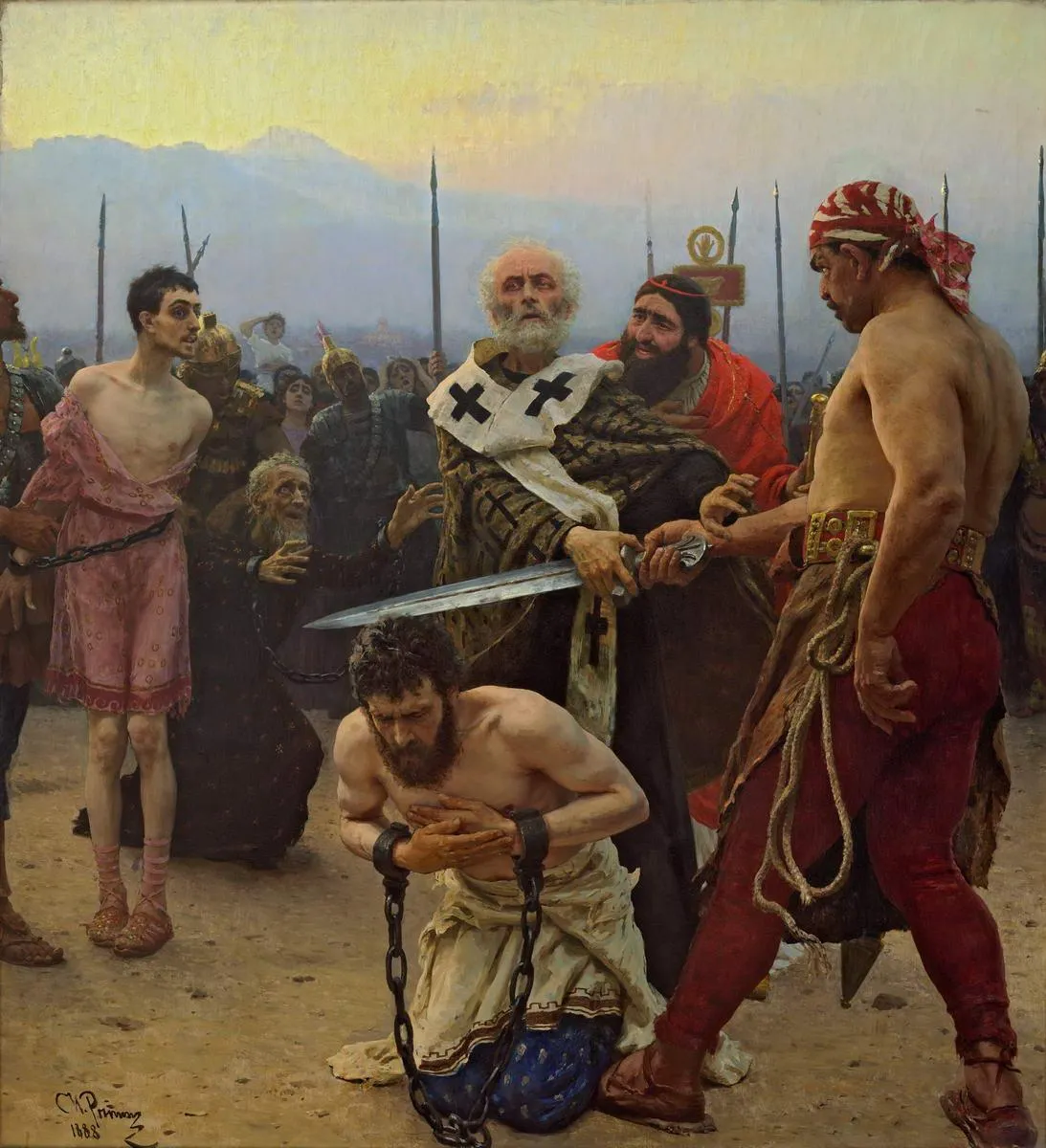 Saint Nicholas of Myra saves three innocents from death1888
 Russian State Council commemorating its 100th anniversary1903
 Apples and leaves1879
 Party1881
 Portrait of Dmitry Ivanovich Mendeleev wearing the Edinburgh University professor robe1885
 Mikhail Ivanovich Glinka during the composition of the opera “Ruslan and Lyudmila”1887
 Lev Nikolayevich Tolstoy resting in the forest1891
 Autumn Bunch. Portrait of Vera Ilyinichna Repina, the Artist's Daughter1892
 Portrait of Composer Nikolai Andreyevich Rimsky-Korsakov1893
 Arrest of a Propagandist1880–1889,1892
 Grand Duchess Sofia at the Novodevichy Convent1879
Life and work
Ilya Repin was born in Chuhuiv in 1844 and died in Repino in 1930. He worked within realism, and his output covers a remarkable range: monumental scenes of collective life, history paintings and probing portraits of the prominent figures of his time. The works gathered here run from Barge Haulers on the Volga (1870–1873), the painting that made his name, to the vast group portrait Russian State Council commemorating its 100th anniversary (1903).
The years around 1880 were especially productive. Repin worked for long stretches on several major canvases at once: Religious Procession in Kursk Province (1880–1883), Reply of the Zaporozhian Cossacks (1880–1891) and Arrest of a Propagandist, begun in 1880 and taken up again in 1892. Alongside them came the historical subject Grand Duchess Sofia at the Novodevichy Convent (1879), the still life Apples and leaves (1879), and more intimate pictures such as Taking a rest (1882).
From the mid-1880s portraiture comes to the fore. Repin painted the chemist Dmitry Mendeleev (1885), the writer Lev Tolstoy (1891) and the composer Nikolai Rimsky-Korsakov (1893), as well as a scene of Mikhail Glinka at work on his opera (1887) and a portrait of his daughter Vera (1892). Born a subject of the Russian Empire, he is recorded as stateless at the end of his life, a reminder of how the upheavals of his final decades reshaped his world.
Barge Haulers on the Volga (1870–1873)
Read the picture from left to right as a slow-moving frieze of men harnessed to a single towline. Repin gives each hauler a distinct face, age and posture, from the bowed, exhausted figures to those staring blankly ahead. Look for the young man near the centre who lifts his head and tugs at his strap, the one figure who seems to resist the weight. Note the leather harnesses across their chests, the heavy sand underfoot and the wide, pale river behind them, which makes the line of bodies feel even more burdened.
Reply of the Zaporozhian Cossacks (1880–1891)
This crowded scene is built around a single moment: a group of Cossacks composing a mocking letter. Start with the seated scribe at the centre, then let your eye travel outward through the ring of listeners. Almost every face shows a different kind of laughter, from a broad roar to a sly grin, and the gestures, hats, weapons and bare shoulders add to the sense of rowdy energy. Repin worked on the canvas for years, and the care shows in the way each character remains an individual within the tightly packed group.
Sources
- Wikidata Q172911
- Images: Wikimedia Commons (public domain / CC0); sources on each painting’s page